
Threat Intelligence Sources: Where CTI Data Comes From and Why It Matters

Share
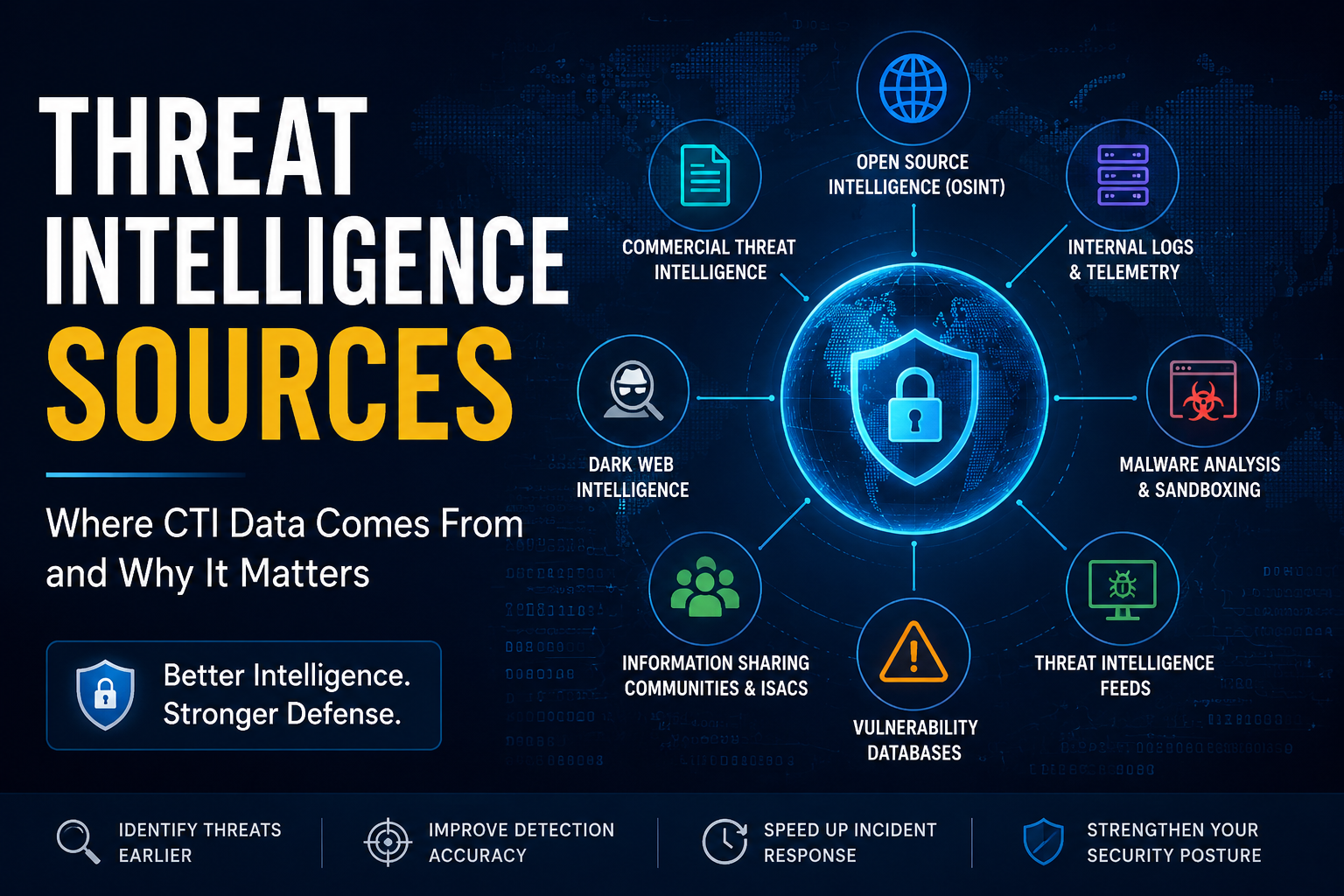
Cyber threat intelligence is only as valuable as the information behind it. Organizations rely on threat intelligence sources to identify emerging threats, understand attacker behavior, and strengthen their defenses before an incident occurs.
As cyberattacks become more sophisticated, businesses can no longer depend on a single source of information. Threat actors operate across multiple channels, including the dark web, social media, malware campaigns, and compromised infrastructure. To stay ahead, security teams collect and analyze data from a variety of threat intelligence sources.
According to the 2025 Verizon Data Breach Investigations Report, researchers analyzed more than 22,000 security incidents and over 12,000 confirmed data breaches worldwide, highlighting the scale of today’s threat landscape.
Key Takeaways
- Threat intelligence sources provide the raw data used to create actionable cyber threat intelligence.
- Organizations use a combination of internal and external sources for better visibility.
- Open-source intelligence, commercial feeds, dark web monitoring, and vulnerability databases are among the most common sources.
- No single source provides a complete picture of cyber threats.
- Businesses that combine multiple intelligence sources can improve detection and response capabilities.
What Are Threat Intelligence Sources?
Threat intelligence sources are the origins of the information used to identify, analyze, and understand cyber threats. They provide the raw data that security teams collect and transform into actionable intelligence. Without reliable sources, cyber threat intelligence (CTI) would be little more than guesswork.
Think of threat intelligence sources as the foundation of a CTI program. Just as journalists rely on interviews, documents, and eyewitness accounts to report a story, cybersecurity professionals rely on multiple sources to build an accurate picture of the threat landscape.
These sources can come from within an organization or from external environments. Internal sources include security logs, endpoint alerts, network traffic data, and incident reports. External sources include security researchers, vulnerability databases, commercial intelligence providers, dark web forums, and industry information-sharing communities.
The primary purpose of threat intelligence sources is to help organizations answer critical security questions such as:
- Who is targeting our industry?
- What vulnerabilities are actively being exploited?
- Which attack techniques are becoming more common?
- Are our systems showing signs of compromise?
- What emerging threats should we prepare for?
By gathering information from multiple sources, organizations can move beyond reactive security and take a more proactive approach to threat management.
How Threat Intelligence Sources Become Actionable Intelligence
Raw data alone does not provide much value. A single malicious IP address, a vulnerability disclosure, or a suspicious login attempt may not tell the whole story.
Threat intelligence analysts collect data from various sources and analyze it to identify patterns, connections, and risks. This process transforms scattered information into intelligence that can support security operations and business decisions.
For example:
- A vulnerability database reports a newly discovered software flaw.
- Security researchers publish evidence of active exploitation.
- Commercial intelligence providers identify threat actors using the vulnerability.
- Internal security logs reveal attempted exploitation within the organization’s environment.
When these pieces are combined, they provide a clearer understanding of the threat and allow security teams to take action before significant damage occurs.
Why the Quality of Threat Intelligence Sources Matters
Not all threat intelligence sources provide the same level of accuracy or value. Some sources may contain outdated information, unverified claims, or large amounts of irrelevant data.
High-quality threat intelligence sources typically offer:
- Accurate and verified information
- Timely updates on emerging threats
- Relevant context about attacker behavior
- Actionable indicators and recommendations
- Consistent and trustworthy reporting
A 2025 report from the World Economic Forum found that cyber threats continue to grow in complexity, making access to reliable intelligence more important than ever for organizations of all sizes. As attackers become more sophisticated, businesses need trusted sources that provide timely and relevant information rather than overwhelming volumes of raw data.
Threat Intelligence Sources vs. Threat Intelligence Feeds
Many people use these terms interchangeably, but they are not the same.
| Threat Intelligence Sources | Threat Intelligence Feeds |
| Original locations where threat data originates | Curated streams of intelligence delivered to users |
| Can be internal or external | Usually provided by vendors or intelligence platforms |
| May contain raw or unprocessed data | Often filtered, analyzed, and enriched |
| Examples include security researchers, logs, and vulnerability databases | Examples include commercial threat feeds and IOC subscriptions |
A useful way to think about it is this: threat intelligence sources are where the information is discovered, while threat intelligence feeds are one of the ways that information is distributed to security teams.
Understanding threat intelligence sources is essential because the effectiveness of any CTI program depends on the quality, diversity, and reliability of the data being collected. The broader the range of trusted sources, the more complete an organization’s view of the cyber threat landscape becomes.
Importance of Threat Intelligence Sources
Threat intelligence sources are critical as they provide the data that security teams use to detect threats, investigate incidents, and make informed decisions. Without reliable sources of information, organizations would have limited visibility into the tactics, techniques, and procedures (TTPs) used by cybercriminals. As cyberattacks continue to increase in frequency and sophistication, businesses need access to accurate and timely intelligence to stay ahead of emerging threats.
- They Help Organizations Detect Threats Earlier
One of the biggest advantages of using multiple threat intelligence sources is the ability to identify threats before they become major security incidents. For example, a vulnerability disclosure may reveal a newly discovered software flaw. Security researchers might then report active exploitation attempts, while threat intelligence providers publish indicators associated with the attack campaign. Organizations that monitor these sources can take preventive action before attackers gain access to their systems. Early threat detection can significantly reduce the likelihood of data breaches, ransomware infections, and operational disruptions.
- They Improve Security Decision-Making
Security teams are constantly faced with decisions about where to focus their time and resources. Not every vulnerability requires immediate attention, and not every security alert represents a genuine threat. Threat intelligence sources provide the context needed to prioritize risks effectively.
For example, if a vulnerability is being actively exploited by threat actors targeting a specific industry, organizations within that sector may choose to accelerate patching efforts. On the other hand, vulnerabilities with no known exploitation activity may be scheduled as part of routine maintenance. This intelligence-driven approach helps organizations make smarter security decisions rather than reacting to every alert equally.
They Provide Visibility Beyond the Organization
Internal security tools can only detect activity occurring within an organization’s environment. They cannot always reveal emerging threats that are developing elsewhere. External threat intelligence sources provide visibility into:
- New malware campaigns
- Threat actor activities
- Industry-specific attack trends
- Exploited vulnerabilities
- Dark web discussions
- Global cybercrime operations
This broader perspective allows organizations to prepare for threats before they reach their networks.
For example, a financial institution may learn through industry intelligence sharing groups that a banking trojan is targeting similar organizations. This information enables security teams to strengthen defenses before becoming a target themselves.
- They Strengthen Incident Response
When a security incident occurs, time is critical. The faster security teams understand an attack, the faster they can contain and remediate it. Threat intelligence sources help incident responders answer key questions such as:
- Who is behind the attack?
- What techniques are being used?
- Are there known indicators of compromise?
- Have similar attacks been reported elsewhere?
- What mitigation strategies have proven effective?
By providing context around an incident, threat intelligence can significantly reduce investigation time and improve response effectiveness.
- They Reduce False Positives
Security teams often deal with thousands of alerts every day. Many of these alerts turn out to be benign activity rather than genuine threats. Threat intelligence sources help validate security alerts by providing additional context about suspicious IP addresses, domains, file hashes, and attacker infrastructure.
For example, if a firewall alert references an IP address already associated with a known ransomware group, the alert becomes a higher priority. Conversely, if the activity is linked to a legitimate service, security teams can avoid wasting valuable resources on unnecessary investigations.
Reducing false positives helps security teams focus on the threats that matter most.
They Support Proactive Cybersecurity
Traditional cybersecurity approaches are often reactive. Organizations respond after an attack has already occurred. Threat intelligence sources enable a more proactive security strategy by helping businesses anticipate potential threats and prepare defenses in advance.
Organizations can use intelligence to:
- Identify vulnerable systems
- Monitor emerging attack techniques
- Strengthen security controls
- Update detection rules
- Improve employee awareness programs
This proactive approach reduces risk and improves overall security resilience.
- They Help Business Leaders Understand Cyber Risk
Threat intelligence is not just for technical teams. Business leaders and executives also benefit from understanding the information provided by threat intelligence sources. Strategic intelligence gathered from trusted sources can help decision-makers:
- Assess organizational risk
- Prioritize cybersecurity investments
- Support compliance initiatives
- Evaluate third-party risks
- Prepare for emerging threats
For example, if intelligence sources indicate a rise in ransomware attacks targeting manufacturing companies, leadership may choose to invest in backup systems, employee training, and incident response planning. This ensures that cybersecurity decisions align with broader business objectives.
- They Create a More Complete Threat Picture
No single threat intelligence source can provide complete visibility into the cyber threat landscape. Internal logs may reveal suspicious activity within an organization, while vulnerability databases identify new weaknesses. OSINT sources may uncover attacker discussions, and dark web monitoring may expose stolen credentials.
When these sources are combined, organizations gain a more comprehensive understanding of threats and their potential impact. This layered approach helps security teams connect isolated pieces of information and transform them into actionable intelligence.
Internal Threat Intelligence Sources
One of the most valuable intelligence sources is often overlooked: an organization’s own environment. Internal sources provide direct insight into attacks targeting the business.
Common internal sources include:
- Security Logs
Logs generated by firewalls, servers, cloud environments, and applications can reveal suspicious activity and unauthorized access attempts.
- Endpoint Detection and Response (EDR)
EDR platforms collect endpoint telemetry that helps identify malware infections, lateral movement, and unusual user behavior.
- Security Information and Event Management (SIEM)
SIEM platforms aggregate data from multiple systems, making it easier to detect patterns and correlate security events.
- Network Monitoring Systems
Network traffic analysis can uncover command-and-control communications, data exfiltration attempts, and malicious connections.
- Business Use Case
A manufacturing company notices repeated failed login attempts across multiple systems. Internal logs reveal credential-stuffing activity. Security teams block the offending IP addresses and require password resets before attackers gain access.
This demonstrates how internal intelligence sources can provide immediate and highly relevant threat visibility.
Open-Source Intelligence (OSINT)
Open-source intelligence, commonly known as OSINT, refers to publicly available information that can be used for threat analysis. OSINT remains one of the most widely used threat intelligence sources because it is accessible and often provides early warning of emerging threats.
Common OSINT sources include:
- Security blogs
- Research publications
- Security forums
- Public code repositories
- Social media platforms
- Vulnerability disclosures
- Government advisories
For example, a retail company discovers discussions on a security forum about a newly disclosed vulnerability affecting its e-commerce platform. The security team patches the system before active exploitation begins.
OSINT often serves as an early warning system, helping organizations identify risks before they impact operations.
Commercial Threat Intelligence Sources
Many organizations supplement internal intelligence with commercial providers.
Commercial threat intelligence vendors collect and analyze large volumes of threat data from multiple sources and provide actionable insights.
These services often include:
- Threat actor tracking
- Malware analysis
- Industry-specific intelligence
- Attack infrastructure monitoring
- Brand monitoring
- Executive threat reporting
For example, a financial services company subscribes to a commercial intelligence platform that identifies phishing infrastructure targeting its customers. The company works with hosting providers to remove malicious domains before large-scale fraud occurs.
Commercial sources provide depth and context that many organizations cannot generate internally.
Dark Web Intelligence Sources
The dark web has become a major source of threat intelligence. Cybercriminals frequently use underground forums and marketplaces to sell stolen credentials, discuss vulnerabilities, and advertise access to compromised systems. Organizations monitor dark web activity to identify:
- Stolen employee credentials
- Leaked customer data
- Ransomware discussions
- Initial access broker activity
- Fraud campaigns
IBM’s threat intelligence research found that identity theft and credential abuse continue to be among the most common attack methods used by threat actors. In the 2025 X-Force Threat Intelligence Index, abuse of user identities appeared in 30% of observed incidents.
For example, a healthcare provider discovers employee credentials being sold on a dark web marketplace. Security teams immediately force password resets and investigate potential compromise, preventing a larger breach.
Malware Analysis as a Threat Intelligence Source
Malware analysis provides intelligence that cannot always be obtained through other methods.
Security researchers examine malware samples to understand how they operate and what indicators can be used for detection.
Malware analysis often reveals:
- File hashes
- Command-and-control servers
- Malicious domains
- Registry modifications
- Persistence mechanisms
- Attacker tactics and techniques
This intelligence helps organizations create detection rules and strengthen defenses against similar attacks.
For example, after analyzing a ransomware sample, a security team identifies communication patterns used by the malware. These indicators are deployed across monitoring systems to detect future attacks.
Vulnerability Intelligence Sources
Vulnerability intelligence focuses on identifying weaknesses that attackers may exploit.
Important sources include:
- CVE disclosures
- Vendor security advisories
- National Vulnerability Database (NVD)
- Security research reports
- Exploit repositories
Vulnerability intelligence has become increasingly important as attackers accelerate exploitation timelines.
Recent research indicates that attackers are using AI to identify and exploit weaknesses faster than ever, reducing the time organizations have to patch vulnerable systems.
For example, a software company tracks vulnerability disclosures affecting its cloud infrastructure. Security teams prioritize critical patches based on active exploitation intelligence rather than patching everything equally.
Why Multiple Threat Intelligence Sources Work Better Together
No single source provides complete visibility into cyber threats. A ransomware campaign may first appear in a vulnerability disclosure, then surface in OSINT discussions, become visible on dark web forums, and eventually generate indicators through malware analysis. Organizations that correlate multiple intelligence sources gain:
- Better context
- Improved accuracy
- Faster detection
- Reduced false positives
- Stronger decision-making
This layered approach is particularly important as supply chain attacks and third-party breaches continue to grow. Recent Verizon findings show that third-party involvement was present in approximately 30% of breaches.
To Sum Up
Threat intelligence sources form the foundation of every successful cyber threat intelligence program. Whether the information comes from internal logs, OSINT research, commercial intelligence providers, dark web monitoring, malware analysis, or vulnerability databases, each source contributes a unique perspective on the threat landscape. For business managers and entrepreneurs, understanding where threat intelligence comes from is no longer optional. Cyber threats continue to evolve, and organizations that rely on diverse, high-quality intelligence sources are better positioned to detect risks, respond quickly, and protect critical assets. The most effective security programs do not depend on a single source. They combine multiple threat intelligence sources to create a complete and actionable view of emerging threats.
Frequently Asked Questions About Threat Intelligence Sources
What are threat intelligence sources?
Threat intelligence sources are the origins of data used to identify, analyze, and respond to cyber threats. They include internal logs, OSINT, commercial intelligence platforms, malware analysis, dark web monitoring, and vulnerability databases.
Why are threat intelligence sources important?
Threat intelligence sources provide the information security teams need to detect threats, assess risks, and make informed cybersecurity decisions before attacks cause damage.
What is the most common threat intelligence source?
Open-source intelligence (OSINT) is one of the most commonly used threat intelligence sources because it provides publicly available information about emerging threats and vulnerabilities.
How do organizations use multiple threat intelligence sources?
Organizations combine internal and external sources to gain broader visibility, improve accuracy, and reduce the chances of missing critical threat indicators.
Are threat intelligence sources the same as threat intelligence feeds?
No. Threat intelligence sources are where information originates, while threat intelligence feeds distribute and deliver intelligence gathered from multiple sources.
Which threat intelligence sources are best for small businesses?
Small businesses often start with OSINT, security logs, vendor advisories, and basic threat intelligence feeds because they are cost-effective and provide valuable security insights.
How does dark web monitoring support threat intelligence sources?
Dark web monitoring helps organizations discover stolen credentials, leaked data, ransomware discussions, and other criminal activity that may indicate future attacks.