
SentinelOne CEO on AI, Claude, and the Future of Security

Share
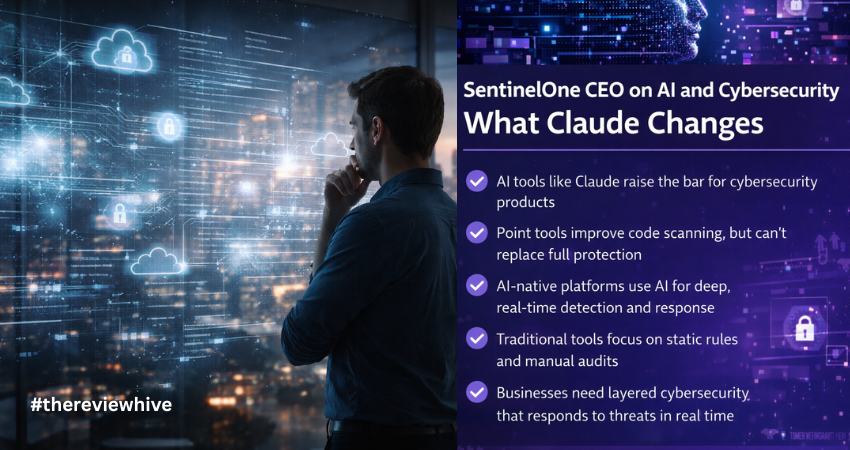
Artificial intelligence isn’t just a buzzword in cybersecurity anymore. It’s reshaping how security products work, how defenders tackle attacks, and where the market is headed. Tomer Weingarten, co-founder and CEO of SentinelOne, offered a clear view of this shift in a recent interview and posts on social platforms. His comments show both the promise and the challenge AI brings to the industry.
TL;DR
AI tools like Claude are pushing cybersecurity products to do more than basic scanning and alerts. SentinelOne CEO Tomer Weingarten says AI raises the bar for what security platforms should deliver, but point tools alone can’t replace full, real-time protection. The future is AI-native, autonomous security that can detect and respond to threats at speed.
AI Is Redefining What Cybersecurity Tools Should Do
In a discussion on CNBC’s The Exchange, Weingarten made a pointed observation about how new AI tools are changing expectations in cybersecurity:
“AI is software’s biggest disruptor, and the biggest opportunity of our time...
So it raises the bar to what cybersecurity products, you know, should do and can do. It’s significantly better than the state-of-the-art currently.”
This comment came in reaction to the release of Claude Code Security by Anthropic, an AI-based vulnerability finder and fixer. Weingarten called it an “impressive” example of what AI can now achieve in scanning code and suggesting corrections — tasks that were traditionally slow and manual.
He noted that code security makes up roughly 5% of the overall cybersecurity market, a relatively small slice compared to things like endpoint protection, cloud security, and runtime defense. Yet, that 5% shows how quickly AI can leapfrog older, rule-based tools.
Why Claude Matters, But Only So Much
Weingarten was clear that products like Claude don’t replace the core functions of a cybersecurity platform. They improve certain features, but don’t address the most complex challenges. He said:
“AI models like Claude are simply better, faster, and cheaper at reading
and reasoning through static code.”
That’s important. Many legacy tools relied on pattern matching and manual audits, which are slow and often generate false positives. AI tools can find issues more intelligently. But as Weingarten pointed out, there’s a big difference between finding a bug in a static environment and stopping an active breach in real time.
That distinction matters because most serious attacks don’t come from simple code errors. They come from attackers exploiting systems at runtime, hiding in network traffic, or engaging in complex, multi-step intrusions.
How SentinelOne Sees the Future of AI in Security
Weingarten used the interview to talk about how SentinelOne itself approaches AI. The company positions itself as AI-native, meaning it builds AI into the core of its products rather than bolting it on. He said:
“We’re actually an investor in Anthropic, and we’re incorporating their models
in our software as well as OpenAI and Google Gemini.”
This shows that even companies with their own AI strategy see value in broader models like Claude or GPT-4-style systems. The goal isn’t just to use AI; it’s to make defense faster, more autonomous, and more resilient.
Legacy Tools vs. Autonomous Security
A key theme in Weingarten’s remarks was that legacy cybersecurity tools have limits. Many earlier solutions work by stitching together standalone features acquired from other companies. Weingarten said:
“AI will subsume certain cybersecurity features of disjointed platforms — specifically
those based on manual review, audits, and pattern matching.”
That’s a strong statement. He’s essentially predicting that traditional scanning tools will become commodities, replaced by fast, AI-driven capabilities.
SentinelOne’s strategy goes further. The company has been building what it calls autonomous, AI-native defense, where systems don’t just spot issues but act on them with limited human direction. That future is very different from yesterday’s “alert and wait” model.
Cybersecurity is already under pressure to evolve. Businesses face more threats, and attackers are using AI too. Some research shows that over 80% of Fortune 500 companies now run AI agents, with many lacking proper security controls.
At the same time, many companies are only beginning to think about securing AI use, not just traditional IT assets. If defenders don’t catch up, attackers could exploit models themselves or use AI to automate attacks.
Weingarten has also warned that attackers might target the AI systems powering real-world machines, including robots or autonomous vehicles, pushing the boundaries of risk beyond code and servers into physical systems. (Peterson Technology Partners)
What This Means for Buyers and Practitioners
If you work in cybersecurity or buy security tools, here are the key takeaways:
- Expect more AI capability in security products. Vendors will increasingly embed generative models to automate detection and response.
- Not all AI is equal. Tools like Claude are powerful in specific niches (like code scanning), but they don’t cover the full threat spectrum.
- Autonomy will matter. Solutions that act on threats without constant human direction will be more valuable in fast-moving attack scenarios.
- Security for AI is its own discipline. As AI becomes part of business workflows, protecting those models and agents becomes a priority.
To Sum Up
Weingarten’s comments reflect a broader truth: AI isn’t just another feature. It’s changing how defenders think about security and what they expect from tools. Whether that leads to better protection or new attack vectors depends on how quickly the industry adapts — and how smartly it uses AI in defense.
FAQs
- What did the SentinelOne CEO say about AI and cybersecurity?
Tomer Weingarten said AI is changing what users should expect from cybersecurity tools. New AI products show what’s possible, but security platforms still need deep, real-time protection beyond code scanning. - Why is Claude being discussed in cybersecurity?
Claude and similar AI models can read and analyze code faster than traditional tools. This improves code security workflows, but it doesn’t cover runtime threats, identity abuse, or active intrusions. - Can AI tools replace traditional cybersecurity platforms?
No. AI tools can improve parts of security, like code review and triage, but they don’t replace endpoint protection, threat detection, or response systems. - How is SentinelOne using AI?
SentinelOne positions itself as AI-native. It uses machine learning at the core of detection and response and also integrates large AI models to support analysis and automation.
5. What does this mean for businesses?
Security buyers should expect more automation and faster response from vendors. But they still need layered security that protects systems in real time, not just during development.