
DarkGPT Installation, What I Learned While Exploring the AI-Powered OSINT Tool

Share
Artificial intelligence is changing cybersecurity faster than most organizations expected. Over the last year, discussions around DarkGPT have exploded across Reddit threads, Telegram groups, GitHub repositories, and cybersecurity forums. Some people describe it as an “uncensored AI tool,” while others claim it represents the future of AI-assisted cybercrime.
But after researching DarkGPT installation workflows, public repositories, and available technical guides, I realized something important. The reality behind DarkGPT is far more nuanced than the internet mythology surrounding it.
Most online content either sensationalizes the topic or barely explains how the tool actually works. Very few articles discuss:
- what DarkGPT installation involves
- how the architecture appears to function
- why OSINT professionals are interested in it
- where the ethical boundaries exist
- how AI-assisted investigation workflows are evolving
So I decided to explore the topic from a practical cybersecurity perspective instead of a fear-driven one. And what I found reflects a much larger shift happening across AI, OSINT (Open-Source Intelligence), and modern threat intelligence operations.
TL; DR
DarkGPT is often portrayed online as a dangerous underground AI system, but many publicly available implementations appear to function more like AI-assisted OSINT and breach intelligence tools. The growing interest around DarkGPT installation reflects a larger cybersecurity trend toward conversational AI, automated threat intelligence, and AI-powered investigation workflows.
What Is DarkGPT?
Despite the dramatic branding, DarkGPT appears to function more like an AI-assisted OSINT and breach intelligence interface rather than a mysterious autonomous hacking platform. Public installation guides and project references suggest that many “DarkGPT” implementations combine:
- GPT-powered conversational AI
- breach intelligence APIs
- OSINT workflows
- automated search capabilities
- natural language querying
Some versions reportedly integrate with:
- OpenAI APIs
- Dehashed
- custom breach datasets
- OSINT automation frameworks
That means DarkGPT is often less of a standalone AI model and more of an intelligent layer sitting on top of existing cybersecurity resources. (GitHub)
This distinction matters because much of the public conversation surrounding DarkGPT treats it like a fully autonomous underground AI system capable of independently launching cyberattacks. The technical reality appears significantly more grounded.
System Requirements for DarkGPT Installation
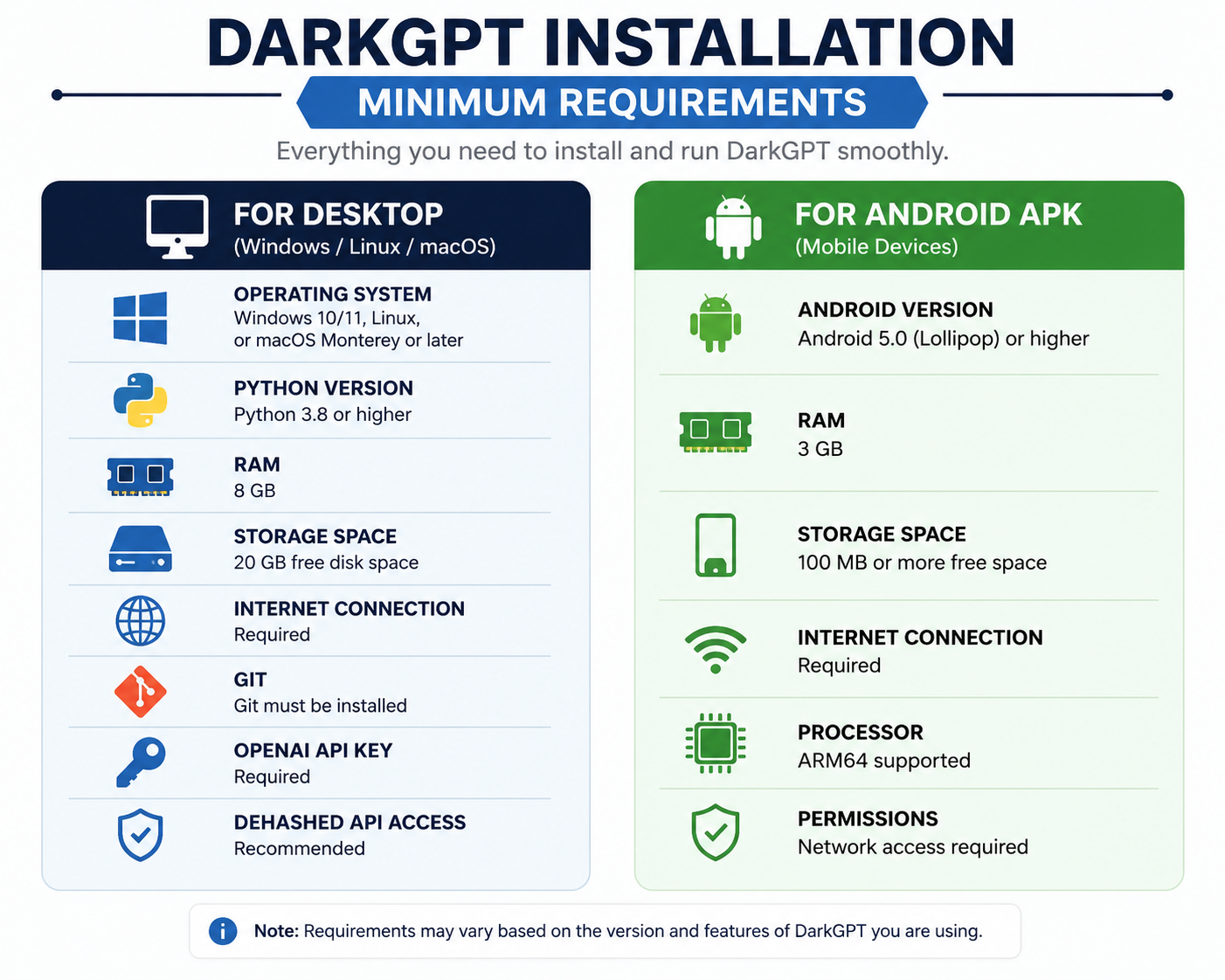 Most publicly available DarkGPT installation guides recommend a fairly standard development environment. According to GitHub documentation and installation walkthroughs, the tool has been tested primarily on Python-based systems. (GitHub)
Minimum System Requirements
| Requirement | Minimum Specification |
| Operating System | Windows, Linux, or macOS |
| Python Version | Python 3.8+ |
| RAM | 8 GB |
| Storage Space | 20 GB free disk space |
| Internet Connection | Required |
| Git Installed | Yes |
| OpenAI API Key | Required |
| Dehashed API Access | Recommended |
Most DarkGPT repositories also recommend stable internet access because the tool relies heavily on external API communication.
Recommended System Requirements
| Requirement | Recommended Specification |
| Operating System | Linux or Windows 11 |
| Python Version | Python 3.10+ |
| RAM | 16 GB |
| Storage Space | 50 GB SSD |
| Processor | Multi-core CPU |
| Internet Connection | High-speed broadband |
| Virtual Environment | Recommended |
| Docker Support | Optional |
Higher RAM and SSD storage improve performance when handling large datasets or running multiple OSINT workflows simultaneously.
DarkGPT APK System Requirements
Alongside desktop-based installations, mobile APK versions associated with DarkGPT are also becoming popular online. These versions generally function more like AI chatbot assistants rather than advanced OSINT investigation tools. (App Store)
Minimum Requirements for DarkGPT APK for Android
| Requirement | Minimum Specification |
| Android Version | Android 5.0+ |
| RAM | 3 GB |
| Storage Space | 100 MB+ |
| Internet Connection | Required |
| Processor | ARM64 supported |
| Permissions | Network access |
Some APK distributions report package sizes around 16 MB, although additional storage is recommended for updates and cached data. (Apktodo)
APK files are designed specifically for Android devices, so there is no direct “DarkGPT APK” version for Apple devices running iOS or macOS.
For Apple users, DarkGPT-related tools are typically accessed through:
- web-based interfaces
- browser dashboards
- Python installations on macOS
- iOS AI chatbot apps available through the Apple App Store
How DarkGPT Installation Typically Works
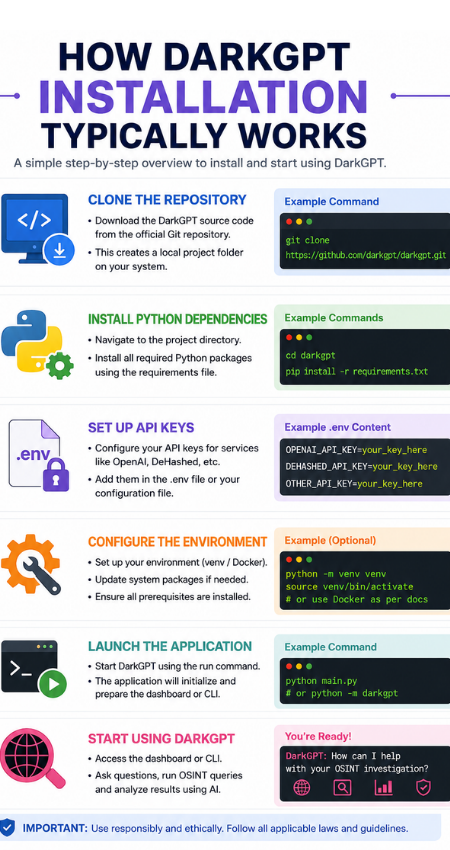
Based on public repositories and installation walkthroughs, the DarkGPT installation process usually follows a sequence similar to other Python-based OSINT frameworks. (GitHub)
- Cloning the Repository
The first step generally involves cloning the project repository using Git. This creates the local project workspace and downloads:
- source files
- configuration templates
- dependency lists
- environment setup files
Most guides use standard Git commands for initialization.
- Installing Dependencies
The next stage involves installing required Python packages. This is commonly done using:
- pip dependency installation
- requirements files
- virtual environments
Dependencies often include:
- API request libraries
- OpenAI integration packages
- OSINT processing modules
- authentication handlers
This stage is important because missing packages can break API communication and workflow automation.
- Configuring API Keys
This is usually the most critical part of DarkGPT installation. Many implementations rely heavily on:
- OpenAI APIs
- breach intelligence APIs
- authentication credentials
Configuration files often contain:
- OPENAI_API_KEY
- DEHASHED_API_KEY
- username credentials
- endpoint configurations
Without proper API setup, the conversational AI layer cannot interact with external breach intelligence systems.
- Launching the Interface
Once dependencies and environment variables are configured, the application can typically be initialized using Python runtime commands.
Depending on the version, the interface may include:
- command-line interaction
- conversational search prompts
- breach analysis dashboards
- AI-assisted OSINT querying
This is where the user begins interacting with the AI layer directly.
Read: Dark GPT APK 12.5.6 For Android – The Review Hive
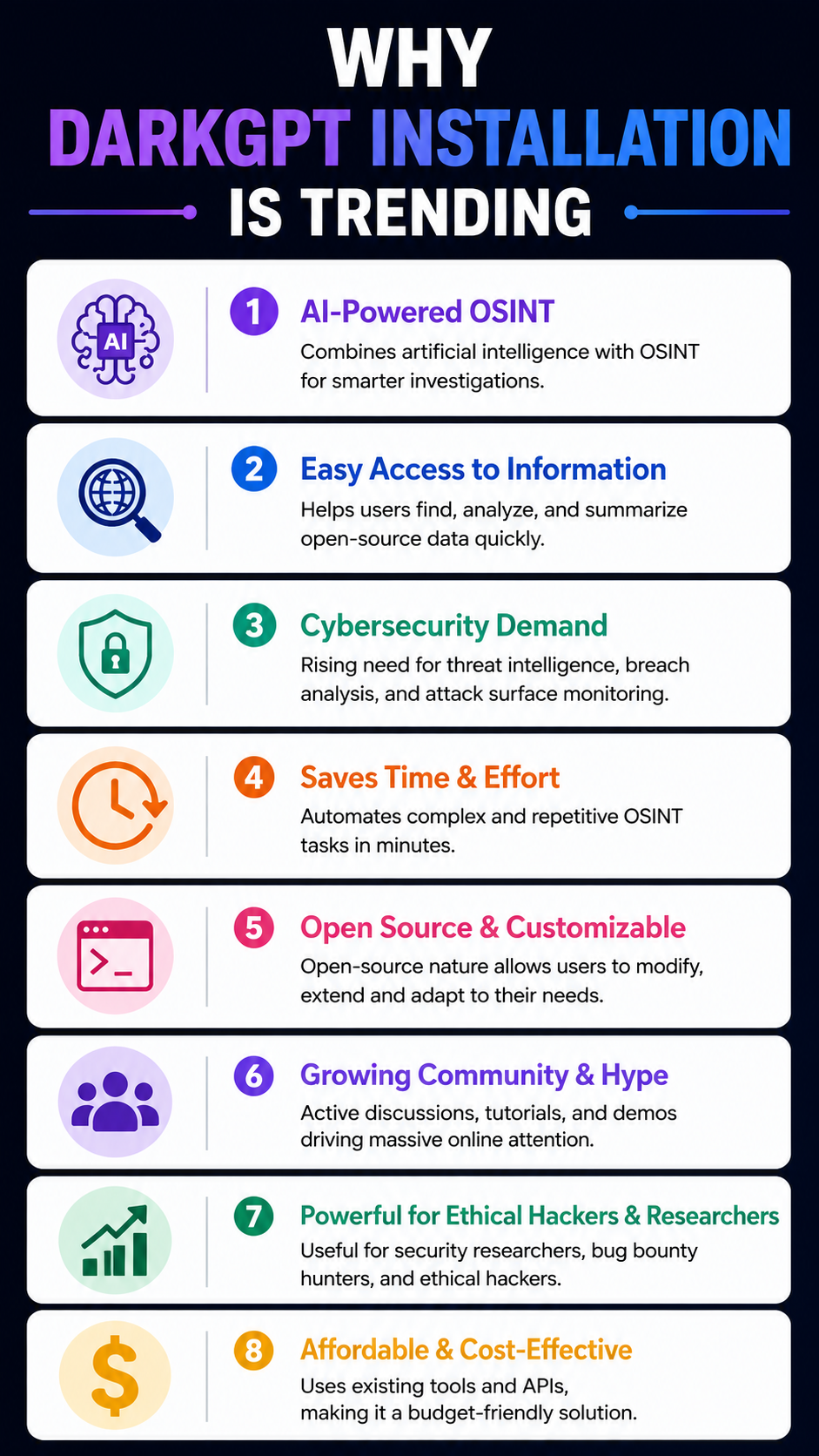
Why DarkGPT Installation Is Trending
- The Rise of AI in Cybersecurity
Artificial intelligence is no longer limited to chatbots and content generation. Cybersecurity teams are now exploring how AI can improve investigations, automate repetitive tasks, and simplify threat intelligence workflows. This shift is one reason why searches related to “DarkGPT Installation” have increased rapidly over the last year.
Many professionals are curious about how AI-powered OSINT tools work and whether they can improve cybersecurity operations.
- AI Makes OSINT Easier for Beginners
Traditional OSINT investigations can feel overwhelming for beginners. Researchers often need to:
- learn advanced search operators
- filter large datasets
- analyze breach information manually
- understand technical query syntax
DarkGPT installation is attracting attention because AI-assisted tools simplify that process.
Instead of writing complex commands, users can interact with the system using conversational prompts. That makes OSINT workflows feel more accessible, especially for amateur researchers and cybersecurity learners.
- Growing Interest in Breach Intelligence
Data breaches have become a major cybersecurity concern worldwide. Businesses constantly monitor:
- leaked credentials
- exposed employee accounts
- compromised databases
- phishing risks
Tools associated with DarkGPT are often promoted as AI-assisted breach intelligence solutions. This has increased curiosity around DarkGPT installation among cybersecurity professionals and researchers.
- The Influence of Social Media and YouTube
Part of the popularity surrounding DarkGPT installation comes from internet culture itself. YouTube videos, Reddit discussions, Telegram groups, and social media posts frequently describe DarkGPT as:
- an “uncensored AI”
- a “dark web AI tool”
- an advanced OSINT assistant
- a controversial cybersecurity platform
The dramatic branding creates curiosity instantly. For many readers, the name “DarkGPT” sounds mysterious and powerful, which naturally drives more searches and discussions online.
- Businesses Are Exploring AI Automation
Modern cybersecurity teams deal with enormous amounts of data every day. Security analysts often struggle with:
- alert fatigue
- repetitive investigation tasks
- large intelligence datasets
- manual reporting workflows
AI-assisted tools can help automate parts of these processes. This is another reason DarkGPT installation is trending. Organizations are increasingly interested in conversational AI systems that can simplify investigations and improve analyst productivity.
- AI-Powered Phishing Is Increasing
Interest in DarkGPT installation is also linked to growing concerns around AI-assisted cybercrime.
According to the Hoxhunt Phishing Trends Report 2026, AI-generated phishing attacks are becoming more convincing and harder to identify. Cybersecurity professionals are now studying how generative AI could impact phishing, social engineering, and scam automation. As discussions around AI-powered cyber threats continue growing, tools like DarkGPT naturally attract more attention online.
- Curiosity Around “Unrestricted AI”
Many mainstream AI systems contain built-in restrictions and safety filters. Some users become curious about what happens when those restrictions are removed.
That curiosity has fueled interest in:
- unrestricted AI systems
- uncensored chatbots
- AI-assisted hacking discussions
- controversial AI tools
DarkGPT installation benefits from that broader internet fascination with “forbidden AI” and unrestricted technology.
The Ethical Concerns Around DarkGPT Installation
The growing popularity of DarkGPT installation also raises serious ethical concerns.
There is a major difference between:
- ethical OSINT research
and - unauthorized exploitation of leaked information
AI-assisted breach intelligence tools operate in a sensitive area where privacy, legality, and cybersecurity intersect. Organizations using these tools should ensure:
- legal compliance
- authorized access
- ethical investigation practices
- responsible disclosure policies
Here we look at a few growing ethical concerns.
- Privacy Risks
AI-assisted OSINT tools often process sensitive information such as leaked credentials, email addresses, and breach data. Without proper safeguards, these tools can unintentionally expose personal or organizational information.
- Unauthorized Data Access
There is a major ethical difference between authorized cybersecurity research and accessing leaked information without permission. Organizations using AI-assisted breach intelligence tools must ensure legal and ethical compliance at every stage.
- Misuse of Generative AI
Tools associated with DarkGPT can potentially be misused for phishing, scam generation, or social engineering workflows. The same AI capabilities that assist defenders can also be abused by attackers.
- Accuracy and Misinformation
AI-generated analysis is not always reliable. Incorrect summaries, false positives, or misleading threat intelligence can create confusion during cybersecurity investigations if outputs are not verified manually.
- Ethical Boundaries in OSINT
Open-Source Intelligence does not automatically mean unrestricted intelligence gathering. Researchers and organizations must define clear ethical boundaries around how data is collected, analyzed, and stored.
- Dependence on AI Automation
Overreliance on AI-assisted investigation tools can reduce critical thinking during threat analysis. Human oversight remains essential, especially when handling breach intelligence and incident response workflows.
- Data Retention Concerns
Many AI-assisted tools rely on external APIs and cloud processing. Organizations must carefully evaluate how sensitive investigation data is stored, transmitted, and retained across third-party platforms.
To Sum Up
The discussion surrounding DarkGPT reveals something much larger than a single AI-assisted OSINT tool. It reflects the growing intersection between:
- artificial intelligence
- cybersecurity
- breach intelligence
- automation
- internet culture
From what I observed, DarkGPT installation is less about deploying a mysterious underground AI system and more about integrating conversational AI into modern investigation workflows. Cybersecurity teams are already moving toward AI-assisted operations because traditional analysis methods struggle to keep pace with modern threat volumes. At the same time, the internet continues turning AI-related cybersecurity discussions into mythology, amplified by dramatic branding, viral screenshots, and fear-driven narratives. Somewhere between practical cybersecurity automation and internet fascination, DarkGPT became one of the most talked-about AI names online. And that conversation is only getting started.
Key Points
- DarkGPT installation typically involves Python environments, API integrations, and breach intelligence tools.
- Many “DarkGPT” implementations appear to be AI-powered OSINT interfaces rather than autonomous cybercrime systems.
- Businesses and cybersecurity researchers are increasingly exploring AI-assisted investigation workflows.
- DarkGPT APK versions are also gaining attention among mobile users interested in AI-powered assistants.
- Ethical concerns around DarkGPT include privacy risks, unauthorized data access, and misuse of leaked information.
FAQs
What is DarkGPT installation?
DarkGPT installation refers to the setup process for AI-assisted OSINT and breach intelligence tools marketed under the “DarkGPT” name. Most installations involve Python environments, API integrations, and conversational AI workflows.
What are the system requirements for DarkGPT?
Most installation guides recommend:
- Python 3.8+
- 8 GB RAM minimum
- 20 GB free storage
- internet access
- OpenAI API integration
Higher specifications improve performance during OSINT investigations. (GitHub)
What are the requirements for DarkGPT APK?
Most APK versions require:
- Android 5.0+
- ARM64 architecture
- internet connectivity
- approximately 100 MB free storage
Requirements may vary depending on the APK version.
Is DarkGPT an actual AI model?
Many publicly available DarkGPT implementations appear to function more like GPT-powered interfaces or OSINT wrappers rather than independently trained AI models.
Does DarkGPT require API keys?
Yes. Most installation guides reference API integrations such as:
- OpenAI API keys
- Dehashed API credentials
- environment variable configuration
Is DarkGPT illegal?
The legality depends on how the tool is used. Ethical OSINT and authorized breach analysis may be legal, while unauthorized access or misuse of leaked information can violate cybersecurity and privacy laws.
Is DarkGPT connected to cybercrime?
Some online discussions associate DarkGPT with unrestricted AI and cybercrime concerns. However, many publicly available implementations appear to function as AI-assisted investigation or OSINT tools rather than autonomous hacking systems.