
Cybersecurity Tech Recommended by Cyber Insurer Claims Data That Reduces Risk

Share
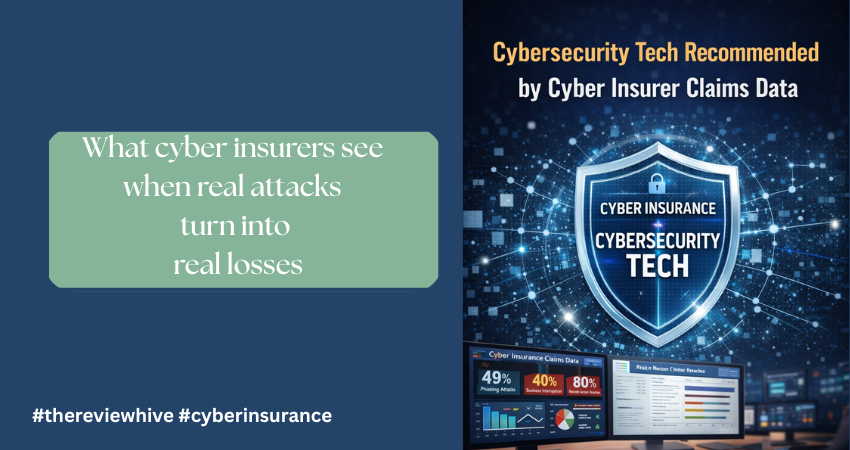
Cyber insurance claims data offers a rare view into what truly fails and what actually works during a cyber incident. In the first half of 2025, phishing-related attacks were responsible for 49% of all cyber insurance payouts, up sharply from 18% in 2024. Business interruption costs accounted for nearly 40% of total insured losses, often exceeding ransom payments themselves. In several claims datasets, compromised remote access paths were linked to up to 80% of ransomware entry points, while claims related to third-party outages declined by 50%. These numbers explain why cybersecurity tech recommended by cyber insurer claims data has shifted away from perimeter-heavy defenses toward identity, access control, and response-focused technologies.
TL;DR
Cybersecurity tech recommended by cyber insurer claims data highlights the controls that consistently reduce real financial loss. Claims from 2024 and 2025 show that identity and access management, phishing-resistant MFA, zero-trust networking, managed detection and response, and immutable backups significantly lower breach impact. Tools only reduce claims when they are enforced, monitored, and tested. Partial implementation does not reduce risk.
Importance of Cyber Insurance Claims Data
Most cybersecurity guidance focuses on preventing breaches. Cyber insurers focus on what happens after prevention fails. They analyze thousands of real incidents across industries, company sizes, and regions. Each claim shows how attackers entered, how far they moved, how long they stayed, and what ultimately drove financial loss.
This is why cybersecurity tech recommended by cyber insurer claims data is different from vendor-driven advice. It is based on outcomes, not promises. When a security control repeatedly limits damage, shortens downtime, or reduces payout amounts, insurers factor that into underwriting decisions. When controls fail consistently, insurers stop trusting them, regardless of popularity.
What Changed in Recent Claims Data
Claims analysis from 2024–2025 shows clear shifts in attacker behavior and loss drivers:
- Phishing overtook ransomware as the leading cause of payouts
- Business interruption became the largest cost category
- Remote access remained a primary ransomware entry vector
- Third-party outage claims declined significantly
These trends reshaped cybersecurity tech recommended by cyber insurer claims data, placing identity, access control, and operational resilience ahead of traditional perimeter defenses.
Role-Based Access Control Is Now a Core Requirement
Role-based access control consistently appears in lower-severity claims. Insurers now consider it a foundational control, not an optional enhancement.
Claims data shows attackers rarely stop at initial access. Once credentials are compromised, attackers escalate privileges and move laterally. Excessive permissions allow small breaches to become large ones. Role-based access control limits what attackers can reach, even after entry.
This is why cybersecurity tech recommended by cyber insurer claims data assumes breaches will happen and focuses on limiting damage rather than chasing perfect prevention.
Phishing Is Driving the Majority of Losses
Phishing has become the most expensive attack vector. Nearly half of all cyber insurance payouts in 2025 were tied to phishing-related incidents. These include credential theft, financial fraud, ransomware deployment, and cloud account takeover.
Attackers now use AI-generated emails, cloned login portals, and MFA fatigue techniques. Traditional awareness training and basic MFA no longer provide sufficient protection. As a result, cybersecurity tech recommended by cyber insurer claims data prioritizes phishing-resistant authentication and identity protection.
Strong MFA Must Be Universal, Not Partial
Claims repeatedly show that MFA failures are rarely due to technical flaws. They occur because MFA is applied inconsistently. Employee logins may be protected, while service accounts, legacy systems, or admin interfaces are not.
Insurers now expect strong MFA across email, cloud consoles, administrative accounts, and remote access paths. From a claims perspective, MFA only works when it cannot be bypassed. This is why cybersecurity tech recommended by cyber insurer claims data emphasizes enforcement over adoption metrics.
VPNs Remain a Ransomware Weak Point
Remote access continues to be one of the most abused attack surfaces. Claims data shows VPN login portals appear in roughly 6% of reported incidents, and compromised remote access credentials account for up to 80% of ransomware entry points in some environments.
VPNs grant broad network access once authenticated. Attackers exploit stolen credentials, unpatched gateways, and weak segmentation. This exposure explains why cybersecurity tech recommended by cyber insurer claims data increasingly discourages VPN-heavy architectures.
Zero-Trust Networking Reduces Blast Radius
Zero-trust models remove implicit trust based on network location. Access decisions depend on identity, device posture, and session context.
From an insurer’s perspective, zero-trust limits blast radius. Even with valid credentials, attackers cannot freely explore the environment. Claims data shows reduced dwell time and lower loss severity in organizations using identity-based access models. This shift is now reflected in underwriting requirements and policy conditions.
Managed Detection and Response Lowers Claim Severity
Detection alone does not stop attacks. Response does. Claims data consistently shows organizations using Managed Detection and Response experience lower losses.
MDR services actively monitor alerts, investigate anomalies, and respond in real time. They shorten attacker dwell time and prevent escalation into ransomware or large-scale data loss. This is why cybersecurity tech recommended by cyber insurer claims data prioritizes managed monitoring over standalone detection tools.
EDR Without Monitoring Does Not Change Outcomes
Endpoint Detection and Response tools are widely deployed, but many claims still escalate because alerts are ignored or misunderstood. Insurers increasingly differentiate between having a tool and operating it effectively.
Technology without staffing does not reduce claims. MDR fills this operational gap, which is why insurers view it as a critical component of cybersecurity tech recommended by cyber insurer claims data.
Immutable Backups Are Essential for Recovery
Ransomware costs are no longer driven primarily by ransom payments. Business interruption is now the largest loss category, accounting for roughly 40% of insured losses.
Immutable backups allow organizations to restore systems without negotiating with attackers. Claims data shows faster recovery and lower costs when backups are isolated and protected. However, insurers also report failures when organizations do not test restoration. That is why cybersecurity tech recommended by cyber insurer claims data includes recovery testing as a requirement.
Legacy Systems Increase Claim Frequency
Outdated systems appear disproportionately in claims. They lack modern authentication, cannot integrate with identity controls, and often miss security patches.
Legacy infrastructure creates blind spots attackers exploit. Insurers now penalize unsupported systems or require remediation plans during underwriting. Modernization is no longer optional. It directly affects insurability, reinforcing why cybersecurity tech recommended by cyber insurer claims data stresses upgrade and decommissioning strategies.
Security Culture Still Influences Outcomes
Technology reduces risk, but people shape outcomes. Claims data shows organizations with incident response plans, tabletop exercises, and defined roles recover faster and limit damage more effectively.
Prepared teams make faster decisions under pressure. Faster containment leads to lower losses. This human factor remains an important part of cybersecurity tech recommended by cyber insurer claims data.
Use the Tools You Already Have
One of the clearest lessons from claims analysis is underutilization. Many organizations own capable tools that are poorly configured or rarely monitored.
Logs are not reviewed. Alerts are ignored. MFA is not enforced everywhere. Backups are never tested. From an insurer’s perspective, unused controls provide no protection. Operational maturity matters more than tool count, which is why cybersecurity tech recommended by cyber insurer claims data favors execution over expansion.
Key Points
- Phishing caused 49% of cyber insurance payouts in 2025
- Business interruption accounts for around 40% of insured losses
- Remote access is linked to up to 80% of ransomware entry points
- Role-based access control limits breach impact
- MFA must be phishing-resistant and enforced everywhere
- Zero-trust reduces lateral movement
- MDR lowers dwell time and loss severity
- Immutable backups speed recovery
- Legacy systems increase claim frequency and cost
FAQs
What does cybersecurity tech recommended by cyber insurer claims data mean?
It refers to security controls proven to reduce financial loss based on real insurance payout data, not vendor testing.
Why are identity and access controls prioritized?
Claims show attackers often use valid credentials. Identity controls limit damage after access is gained.
Why has phishing become the top payout driver?
AI-driven phishing bypasses weak MFA and awareness training, leading to fraud, ransomware, and account takeover.
Are VPNs unsafe?
VPNs are frequently abused when misconfigured or unpatched, making them a common ransomware entry point.
Do backups really reduce losses?
Yes, but only when they are immutable and regularly tested.
Is MDR better than in-house monitoring?
Claims data suggests actively managed detection reduces dwell time and prevents escalation, especially without a 24/7 SOC.
To Sum UP
Insurers price cyber risk based on outcomes, not assumptions. Cybersecurity tech recommended by cyber insurer claims data shows which defenses consistently reduce damage when attacks succeed. In 2026, resilience matters more than perfection. Organizations that align security strategy with insurer-validated evidence do not just improve defense. They improve survival.