
How Endpoint Detection and Response Is Strengthening Business Cybersecurity

Share
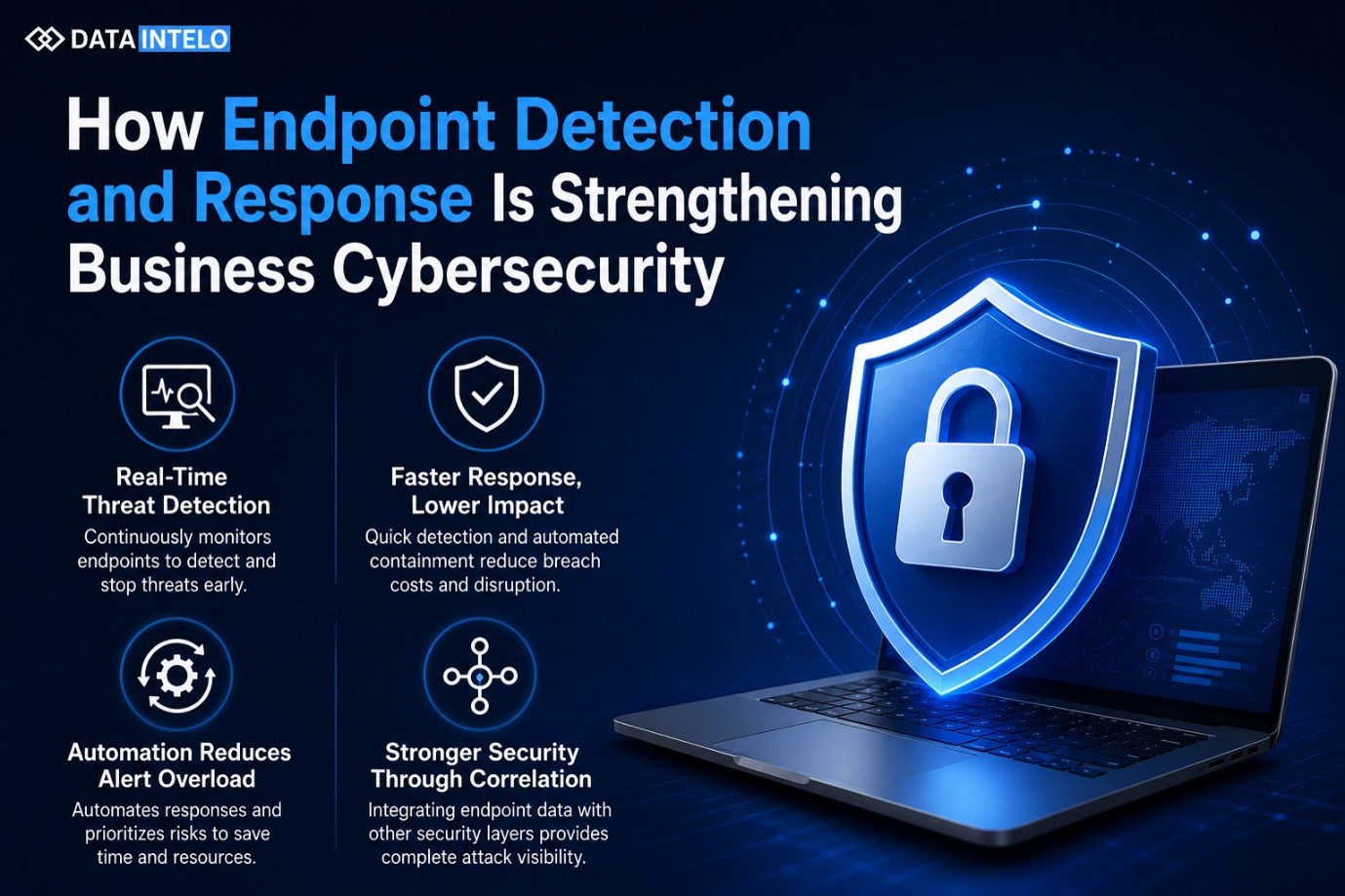
Today, companies have changed their approach from protecting a static business network to tracking thousands of devices, applications, identities, and cloud environments on the cyber battlefield. The primary technology that has made it possible is EDR – Endpoint Detection and Response – which tracks events on laptops, desktops, servers, and other endpoints.
There are many reports available today stating that the average cost of a breach is $4.44 million globally in 2025. Additionally, EDR systems help companies enhance their capabilities in the field of identification and response to the new demands of the digital environment.
Rising Demands on Business Connectors
Business endpoints are still some of the most appealing targets as they grant access to applications, credentials, and sensitive data. As claimed by Data Intelo, the global Endpoint Detection and Response market was valued at $12.8 billion in 2025 and will witness growth to $67.9 billion with a CAGR of 24.9% between 2026 and 2033. Such rapid growth shows that there is a need for continuous monitoring of endpoints in organizations dealing with more complicated digital environments and systems.
Ransomware exposure also proves the necessity of endpoint security. In 2025, 24% of businesses reported that they were attacked by ransomware, while in 2024, the number of such reports was only 18.6%. Compromised endpoints make up around 26% of all reported ransomware access methods.
Behaviour Trackers Are Better than Conventional Antivirus
Traditional antivirus solution usually rely on detecting pre-known virus patterns, but modern-day attackers now utilize legitimate tools and stolen credentials. The EDR system is capable of monitoring different events and allowing analysts to find out suspicious combinations instead of just suspicious files.
For instance, an unusual sign-in sequence with a PowerShell command and another unexpected connection becomes three interrelated signals. Although every signal may appear normal by itself, the order of events can tell about some compromise. As per the latest threat hunting research, about 76% of attacks from nations included the use of ‘living off the land’ methods, which shows the necessity of watching legitimate tools for their inappropriate use.
Swift Detection Can Minimize Monetary Loss
The financial repercussions of delayed discovery are still severe. In the year 2024, the average global cost of a data breach was $4.88 million and in 2025, it dropped down to $4.44 million making it a 9 percent decline across the two years. The two reasons for this drop are faster detection and containment of breaches.
The functioning of the EDR provides timely data at the endpoint, which reflects what processes, files, authentication attempts, and communications have taken place. Although there could be hundreds of incidents on the timeline of an event, the centralized telemetry allows the investigator to arrange events in the timeline correctly.
Ransomware Defense Becomes More Challenging
Ransomware has significantly advanced since it was first introduced as a method of encrypting files requiring multiple steps to complete the process such as credentials stealing, privilege escalation, lateral movement, data theft and many more. EDR provides the ability to see these processes and identify unusual activities, privilege changes, access to the files and unusual network traffic.
The cost of recovering from ransomware increased to about $1.53 million in 2025 apart from the ransom paid. As for extortion attacks, those that have been publicly announced cost on average $5.08 million each. Such numbers prove how crucial endpoint detection is for the timely response and fight against cyberattacks.
If an organization modifies more than 500 files within a few minutes while observing unusual authentication and process behavior, there is a reason to initiate the investigation.
Automation Assists in Dealing with Huge Alert Volumes
Thousands or millions of security events can be produced by organizations, making it extremely difficult to examine every alert manually. Automation enables EDR platforms to sort suspicious activities and trigger predetermined actions.
According to recent research in threat-hunting, it has been discovered that 61% of respondents categorize the lack of skilled personnel as an obstacles in effective threat-hunting, while 48% want to implement artificial intelligence and machine-learning in their threat-hunting technologies.
EDR automation can accomplish several tasks, such as:
- Isolating a compromised endpoint through one automated response.
- Ending suspicious processes almost instantly.
- Blocking dangerous network connections.
- Gathering forensic data from affected machines.
- Scoring alerts due to multiple indicators of risks.
Automation does not get rid of human assessment but decreases repetitive investigations and shifts attention to more risky incidents.
Linking EDR with Other Data Enhances Incident Awareness
Endpoint information becomes more valuable when it is combined with data regarding identity, email, cloud, and network. An individual suspicious process might not trigger an attack, but the same process occurring after multiple failed login attempts and an unusual cloud login(s) markedly increases the possibility of an attack.
Correlation makes it possible for cybersecurity teams to monitor the entire cycle of the attack instead of checking separate alerts. It also enables threat hunting by letting investigators search historical data on endpoint activities for indicators of certain attack types.
Recent studies identified EDR/XDR as the most important technology for threat hunting, emphasizing the role of endpoint telemetry in comprehensive detection systems.
EDR is Encountering New Challenges Now
The technology used for endpoint protection is still facing challenges from evasion methods that are becoming more advanced. The attackers can disable the existing security controls, make use of weak drivers, insert malignant code and utilize the administrative tools for the purpose of evasion of detection.
In their report regarding the threats faced by the cybersecurity in the first part of 2025, the researchers reported the case of EDR bypassing with the help of weak drivers and data resident in memory. Thus, with the emergence of more numerous evasion methods, the necessity for multiple approaches towards protection from attacks arise.
Hence, in the majority of cases the modern security provisions use a combination of behavioral analysis together with the telemetry data and other kinds of protection methods, apart from the single methods used in the previous devices.
The Future of Business Cybersecurity
The capacity of Endpoint Detection and Response (EDR) has developed to include more than simple malware detection to also cover continuous surveillance, behavioral analysis, and investigation, leading to automated containment of threats. The global EDR industry is anticipated to increase from $12.8B in 2025 to $67.9B in 2033, increasing the importance of endpoint security in larger cybersecurity solutions.
To anticipate upcoming innovation, businesses should take into account the necessity of AI-based scanning and analysis, expeditious automated responses, interoperability, and improved protection against evasive techniques.