
WormGPT vs DarkGPT, Are We Watching the Rise of AI Cybercrime Myths?

Share
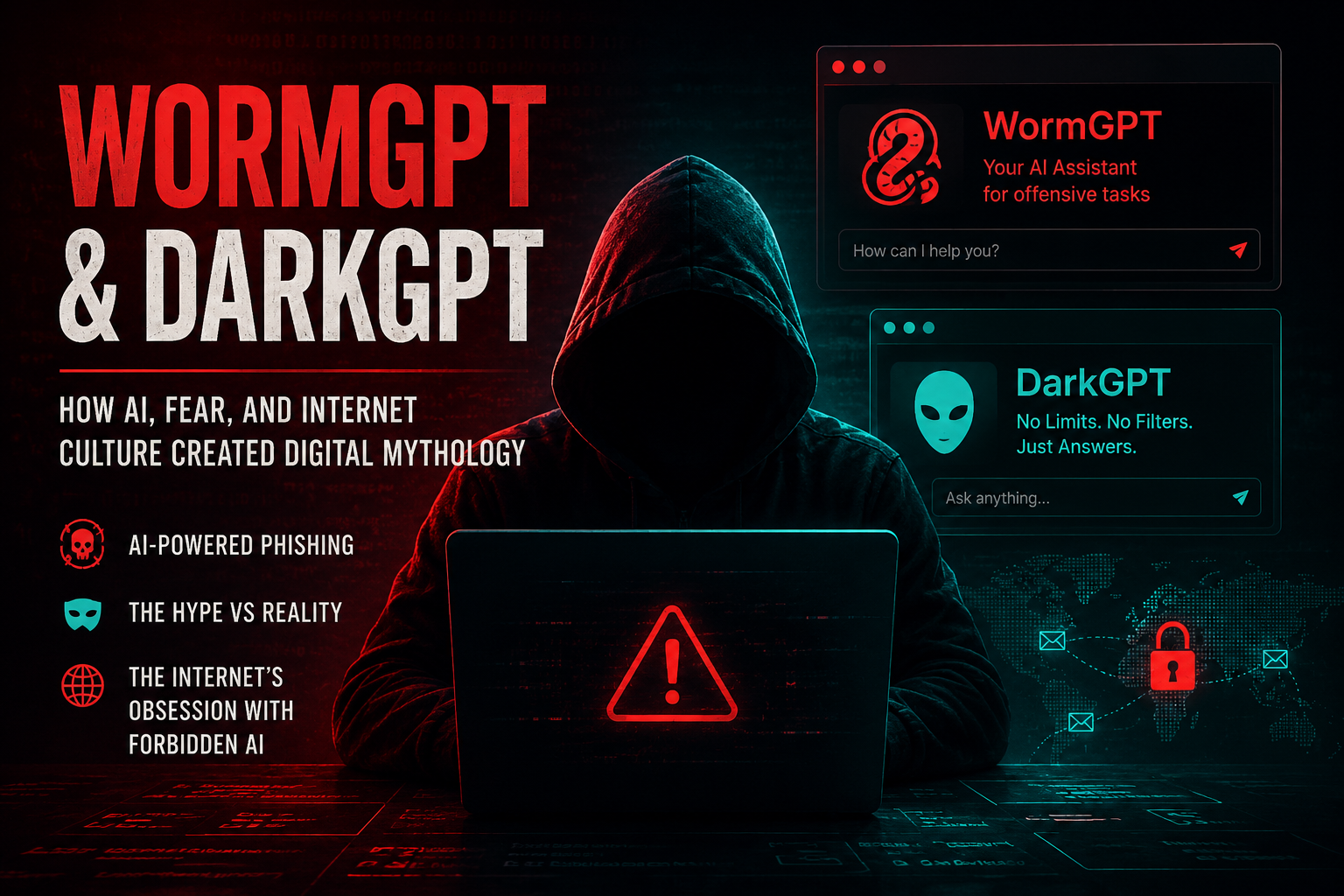
In 2023, screenshots of a chatbot called WormGPT began circulating across cybersecurity forums, Reddit threads, and YouTube videos. The claims were dramatic. An AI tool with no restrictions. A chatbot allegedly capable of writing phishing emails, generating malicious scripts, and automating cyber scams. Soon after, another name entered the conversation, DarkGPT. Within months, the internet was flooded with discussions about “evil AI,” uncensored chatbots, and the dark future of generative technology.
The fear wasn’t entirely irrational. According to the SoSafe 2025 Cybercrime Trends Report, 87% of organizations reported experiencing some form of AI-driven cyberattack within the previous year. Researchers behind the Hoxhunt Phishing Trends Report 2026 also analyzed more than 50 million phishing simulations and real attacks, highlighting how quickly AI-assisted phishing campaigns are evolving. But behind the headlines, hype, and fear-driven content lies a larger question, are these tools truly revolutionary cyber threats, or has the internet turned them into modern digital myths?
TL;DR
WormGPT and DarkGPT became internet sensations because they combined two powerful things, artificial intelligence and fear. While cybersecurity researchers have raised legitimate concerns about AI-generated phishing, scam automation, and social engineering, much of the online discussion surrounding these tools has also been amplified by hype, viral storytelling, and internet culture. The real threat may not be a single “evil AI” chatbot, but how generative AI is making cybercrime faster, cheaper, and more convincing at scale.
The Internet’s Obsession With “Forbidden AI”
Part of the fascination surrounding DarkGPT and WormGPT has little to do with code alone. The real attraction lies in the idea of unrestricted intelligence, an AI system with no filters, no ethical boundaries, and supposedly no limits.
The internet has always been drawn toward things that feel hidden or forbidden. Anonymous hacking forums, dark web marketplaces, leaked databases, and underground digital communities have long existed in a strange space between fear and curiosity. Uncensored AI entered that same cultural space almost instantly.
The timing made the obsession even stronger. As tools like ChatGPT pushed artificial intelligence into the mainstream, millions of people experienced conversational AI for the first time. But alongside excitement came frustration. Some users disliked blocked prompts, restricted responses, and built-in safeguards. The moment people realized mainstream AI had boundaries, curiosity around “AI without rules” began growing online.
That curiosity grew alongside rising concern about AI-assisted cybercrime. The Human Risk Review 2024 by SoSafe found that 79% of security leaders were already worried about cybercriminals using generative AI for social engineering attacks.
Soon, screenshots claiming to show DarkGPT generating phishing emails or WormGPT assisting with malicious scripts started spreading across Reddit threads, Telegram channels, YouTube videos, and X posts. In many cases, the claims spread faster than verification itself. The screenshots didn’t just look dangerous, they looked cinematic.
The internet has repeatedly transformed emerging technology into cultural fear cycles. From anonymous hackers to unrestricted AI, each era has produced its own form of digital mythology.
How AI Fear Evolved Across the Internet
| Period | Dominant Internet Fear | How It Was Viewed Online |
| Early Internet Era | Anonymous hackers and computer worms | Hackers were portrayed as mysterious digital outsiders capable of disrupting systems from anywhere in the world. |
| Dark Web Expansion | Hidden marketplaces and leaked databases | The dark web became associated with secrecy, cybercrime, and underground internet culture. |
| Crypto Boom | Financial scams and online fraud | Rug pulls, phishing attacks, and anonymous financial schemes fueled distrust around digital finance. |
| Generative AI Era | Unrestricted AI systems like WormGPT and DarkGPT | AI is increasingly viewed as unpredictable, difficult to control, and capable of scaling cybercrime operations. |
| Emerging AI Future | Autonomous cybercrime and AI-driven deception | Concerns are shifting toward deepfakes, AI-powered phishing, automated scams, and synthetic identity fraud. |
That aesthetic matters more than most people realize.
Names like “DarkGPT,” “FraudGPT,” and “WormGPT” sound less like software tools and more like digital antagonists pulled from a cyberpunk series. The branding alone creates intrigue. It feeds into a larger internet narrative where AI is no longer viewed as just another technology platform, but as something mysterious, unpredictable, and potentially uncontrollable.
Security researchers have repeatedly warned that generative AI can absolutely assist phishing and social engineering campaigns. But the internet often transforms partially understood technology into mythology. A single viral screenshot can quickly evolve into headlines predicting the future of AI-powered cybercrime.
In many ways, the rise of these AI tools says as much about internet culture as it does about cybersecurity itself.
How WormGPT Became a Cybersecurity Legend
Unlike many cybersecurity threats that emerge quietly, WormGPT arrived with the kind of online narrative usually reserved for internet folklore. It wasn’t introduced through official product launches or mainstream developer communities. Instead, it appeared through screenshots, forum discussions, Telegram posts, and cybersecurity reports that described it as an “unrestricted” AI tool built for malicious activity.
That origin story played a major role in its rapid spread online.
The name itself sounded engineered for attention. “WormGPT” immediately evokes images of malware, self-replicating computer worms, and autonomous cyberattacks. Before most people even understood what the tool allegedly did, the branding had already shaped public perception around it.
Cybersecurity researchers began paying closer attention after reports claimed the chatbot could generate convincing phishing emails and assist with business email compromise campaigns. Some demonstrations showed AI-written scam messages that looked cleaner and more persuasive than traditional phishing attempts.
The concern wasn’t purely theoretical. A research paper titled Evaluating Large Language Models’ Capability to Launch Fully Automated Spear Phishing Campaigns found that AI-generated phishing emails achieved click-through rates comparable to human-crafted spear phishing campaigns. In some test groups, AI-assisted phishing attempts reached engagement rates of 54%, dramatically outperforming many conventional phishing baselines.
But the internet amplified the story far beyond technical discussions.
Soon, YouTube thumbnails warned about “the end of cybersecurity.” LinkedIn posts described AI-powered cybercrime as an unavoidable future. Threads discussing WormGPT spread across Reddit and X, often mixing verified information with speculation, fear, and exaggeration. The tool became larger than the evidence surrounding it.
That’s where the story shifts from cybersecurity into internet culture.
In many ways, WormGPT succeeded because it arrived at the perfect moment. Public anxiety around artificial intelligence was already growing rapidly. People were watching AI generate artwork, write essays, imitate voices, and automate tasks once considered uniquely human. Against that backdrop, the idea of an AI chatbot helping cybercriminals felt less like science fiction and more like an inevitable next step.
The uncertainty surrounding WormGPT only made the fascination stronger. Some researchers argued that certain versions may have been little more than modified open-source language models marketed aggressively in underground forums. Others believed the tool represented an early warning sign of how generative AI could eventually be weaponized.
But online, uncertainty rarely slows momentum. If anything, ambiguity makes digital myths spread faster.
That may explain why WormGPT became more than just a suspected cybercrime tool. It became a symbol of something larger, the fear that artificial intelligence was moving faster than society’s ability to understand or control it.
DarkGPT and the Commercialization of Fear
| Aspect | WormGPT | DarkGPT |
| How it spread online | Cybersecurity reports and underground forum discussions | Social media, AI communities, and viral internet content |
| Public perception | AI tool linked to phishing and cybercrime | “Unrestricted AI” marketed with dark branding |
| Core fear surrounding it | AI-assisted phishing and scam automation | AI without ethical or content restrictions |
| Internet appeal | Seen as a potential cybercrime tool | Seen as rebellious or uncensored AI |
| Verification level | Partially documented by researchers | Often fragmented, cloned, or loosely defined |
| Role in online culture | Symbol of AI-powered cyber threats | Symbol of the internet’s fascination with forbidden technology |
If WormGPT introduced the internet to the idea of AI-powered cybercrime, DarkGPT transformed that fear into a recognizable brand. Unlike WormGPT, which largely spread through cybersecurity reports and underground discussions, DarkGPT quickly evolved into something more public-facing. Websites, GitHub repositories, Telegram channels, AI communities, and social media accounts began using the name to market various “uncensored” chatbot experiences. In many cases, the term became less about a specific technology and more about an identity.
That distinction matters.
The internet no longer treats AI tools as software alone. They are now cultural products, shaped by aesthetics, storytelling, and virality as much as technical capability. DarkGPT fits perfectly into that ecosystem. The name itself feels intentionally provocative, combining the familiarity of mainstream AI branding with the language of secrecy, rebellion, and danger.
And online, fear is highly marketable.
By 2025, AI-driven cybercrime discussions had already intensified across the cybersecurity industry. Findings highlighted in Reuters’ coverage of the Verizon 2026 Data Breach Investigations Report showed that attackers were increasingly using generative AI to accelerate phishing, vulnerability exploitation, and malicious automation. Researchers also noted that software vulnerability exploitation accounted for 31% of breaches analyzed in the report, surpassing stolen credentials for the first time.
YouTube creators discovered that thumbnails featuring terms like “DarkGPT,” “evil AI,” or “uncensored chatbot” generated clicks almost instantly. Social media algorithms amplified dramatic claims faster than cautious analysis. Screenshots spread widely, often without context or verification. Some platforms promoted DarkGPT as a dangerous underground AI system, while others treated it like a novelty for users frustrated with mainstream AI restrictions.
The result was a strange mix of cybersecurity concern, internet curiosity, and digital performance.
In many cases, the branding became more powerful than the software itself. That’s partly because modern internet culture rewards emotional reactions. Fear, outrage, curiosity, and shock travel faster online than technical nuance. A post claiming that “AI can now write malware” attracts far more attention than a detailed explanation about the actual limitations of language models.
This created the perfect environment for names like DarkGPT to thrive.
Some versions promoted online may genuinely use modified open-source models with fewer safeguards. Others may simply be wrappers around publicly available AI systems marketed with darker aesthetics and provocative messaging. But from a viral content perspective, the technical differences often become irrelevant. The mythology surrounding the tool becomes the real product.
In many ways, DarkGPT reflects a larger shift happening across the internet. Cybersecurity is no longer discussed only through technical reports and enterprise threat briefings. It is increasingly packaged as entertainment, driven by dramatic storytelling, fear-driven narratives, and algorithm-friendly controversy.
And artificial intelligence has become the perfect subject for that transformation.
AI Phishing Became More Dangerous the Moment It Became More Human
For years, phishing emails were relatively easy to spot. Strange grammar, awkward formatting, and unnatural wording exposed many scams almost immediately. Generative AI changed that dynamic.
Traditional Phishing vs AI-Assisted Phishing
| Traditional Phishing | AI-Assisted Phishing |
| Generic wording | Personalized messaging |
| Grammar mistakes | Human-like language |
| Limited scalability | Large-scale automation |
| Easier to detect | Harder to identify |
| Static templates | Adaptive content generation |
Analysis referenced in coverage of the Microsoft Digital Defense Report 2025 found that AI-generated phishing emails achieved click-through rates of 54%, compared to roughly 12% for traditional phishing attempts. Researchers noted that AI-generated messages were often more personalized, more convincing, and significantly harder for users to identify.
That shift matters because modern phishing attacks no longer rely on obvious deception alone. AI systems can imitate writing styles, mimic workplace language, and generate emotionally persuasive messages at scale. In many cases, the phishing email no longer looks suspicious. It looks familiar.
This is one reason cybersecurity researchers continue taking AI-assisted cybercrime seriously, even when specific tools like DarkGPT or WormGPT remain difficult to independently verify. The larger threat is already visible.
Are These AI Tools Overhyped?
Despite the panic surrounding tools like DarkGPT, researchers continue warning against exaggerated narratives. Many so-called “evil AI” systems online may simply be modified open-source language models wrapped in aggressive branding and dark aesthetics. The mythology often spreads faster than technical verification itself.
Much of the public conversation surrounding DarkGPT and WormGPT exists in a gray area between legitimate cybersecurity concern and internet amplification.
Myth vs Reality Around DarkGPT and WormGPT
| Online Myth | Reality |
| AI can fully replace hackers | Human expertise is still required |
| DarkGPT is one verified platform | Multiple unrelated tools use the name |
| AI-generated phishing is always advanced | Many attacks remain low quality |
| “Evil AI” is unstoppable | Defensive AI tools are evolving too |
| Every screenshot online is authentic | Many claims remain unverified |
Yet the broader cybersecurity concerns remain real. According to coverage of the Flashpoint 2026 Global Threat Intelligence Report, discussions involving AI-assisted cybercrime reportedly surged by nearly 1,500% between late 2025 and early 2026 across monitored underground communities.
That distinction is important.
The real danger may not be a single chatbot called DarkGPT or WormGPT. The larger concern is how generative AI is lowering the barrier for cybercrime overall. Even moderately skilled attackers can now generate convincing phishing emails, automate scam content, or imitate human communication more efficiently than before.
In that sense, the mythology surrounding these tools may still point toward a very real future problem.
The Netflixification of Cybersecurity
Cybersecurity used to exist mostly in technical blogs, research papers, and enterprise reports. Today, it increasingly behaves like internet entertainment.
Threat actors become characters. Data breaches become story arcs. AI-powered cybercrime becomes a form of digital spectacle designed for clicks, reactions, and endless social media engagement.
The rise of DarkGPT reflects that transformation perfectly. A dramatic AI name paired with screenshots, hacker aesthetics, and predictions about the collapse of online security creates a powerful content formula. It turns cybersecurity into something audiences consume emotionally rather than analytically.
This doesn’t mean the threats are fake. But it does mean that online narratives often exaggerate the scale, sophistication, or immediacy of those threats.
In many ways, cybersecurity is now competing within the same attention economy as conspiracy theories, viral drama, and entertainment media. The more cinematic the threat appears, the faster it spreads online. Artificial intelligence simply accelerated that trend.
To Sum Up
The conversation surrounding WormGPT and DarkGPT reveals something deeper than the existence of a few controversial AI chatbots. It exposes how the internet reacts when emerging technology becomes difficult to fully understand. Some fears surrounding unrestricted AI are justified. Generative AI is already reshaping phishing, social engineering, and cybercrime operations in measurable ways. Research published in Global Cybercrime Damages: A Baseline for Frontier AI Risk Assessment estimates that global cybercrime damages may already exceed $500 billion annually, with researchers warning that AI-assisted attacks could increase those losses significantly over time.
But alongside the real risks, the internet has also created mythology around tools like DarkGPT and WormGPT. Screenshots become legends. Speculation becomes certainty. Fear spreads faster than verification. In many ways, these AI tools reveal less about artificial intelligence itself and more about the modern internet, its fascination with danger, anonymity, and the idea of forbidden technology.
And that fascination is unlikely to disappear anytime soon.
Key Points
- WormGPT and DarkGPT became viral because they combined public fear around AI with the internet’s fascination for “forbidden” technology.
- Security researchers warn that generative AI is making phishing, scam creation, and social engineering attacks more convincing and easier to scale.
- Reports show AI-generated phishing emails are achieving significantly higher engagement rates compared to many traditional phishing campaigns.
- Much of the online discussion surrounding DarkGPT and WormGPT is fueled by hype, viral screenshots, and fear-driven internet culture rather than verified technical analysis alone.
- Many so-called “evil AI” tools may simply be modified open-source language models marketed with darker branding and fewer safeguards.
- The larger cybersecurity concern is not one chatbot itself, but how generative AI is lowering the barrier for cybercrime across the internet.
FAQs
What is WormGPT?
WormGPT is an AI chatbot that gained attention after reports claimed it could generate phishing emails, malicious scripts, and scam content without the restrictions found in mainstream AI tools.
What is DarkGPT?
DarkGPT is a name commonly associated with unrestricted or uncensored AI chatbots. Multiple websites and online communities use the term “DarkGPT” for AI systems marketed as having fewer content limitations.
Is DarkGPT real?
DarkGPT does not appear to be one officially verified platform. Instead, the name is used across multiple AI projects, websites, and chatbot clones promoted online as unrestricted AI systems.
Why are cybersecurity researchers concerned about WormGPT and DarkGPT?
Researchers are concerned because generative AI can assist phishing campaigns, social engineering attacks, scam automation, and malicious content generation. AI lowers the barrier for cybercriminal activity by making attacks easier to create and scale.
Can WormGPT or DarkGPT create malware?
AI chatbots can assist with coding and scripting tasks, but advanced malware creation still requires technical expertise. Most researchers believe these tools currently act more as assistants rather than autonomous cyberattack systems.
Are WormGPT and DarkGPT illegal?
The legality depends on how the tools are developed and used. Using AI for phishing, fraud, malware creation, or cybercrime activities is illegal in many countries.
How is AI changing phishing attacks?
AI-generated phishing emails are becoming more convincing because they can mimic human writing styles, workplace communication, and emotional language more effectively than traditional phishing attempts.
Why did WormGPT and DarkGPT become so popular online?
The popularity of these tools was driven by a mix of cybersecurity fears, viral social media discussions, dark web curiosity, and fascination with unrestricted AI technology.
What are unrestricted AI tools?
Unrestricted AI tools are chatbots or language models designed with fewer safety filters and content moderation controls compared to mainstream AI platforms.
Are DarkGPT and WormGPT overhyped?
Some cybersecurity researchers believe certain online claims surrounding these tools are exaggerated. However, the broader concerns around AI-assisted cybercrime remain very real.