Impacts of AI on Cybersecurity: How Artificial Intelligence Is Reshaping Risk, Defense, and Leadership Decisions

Share
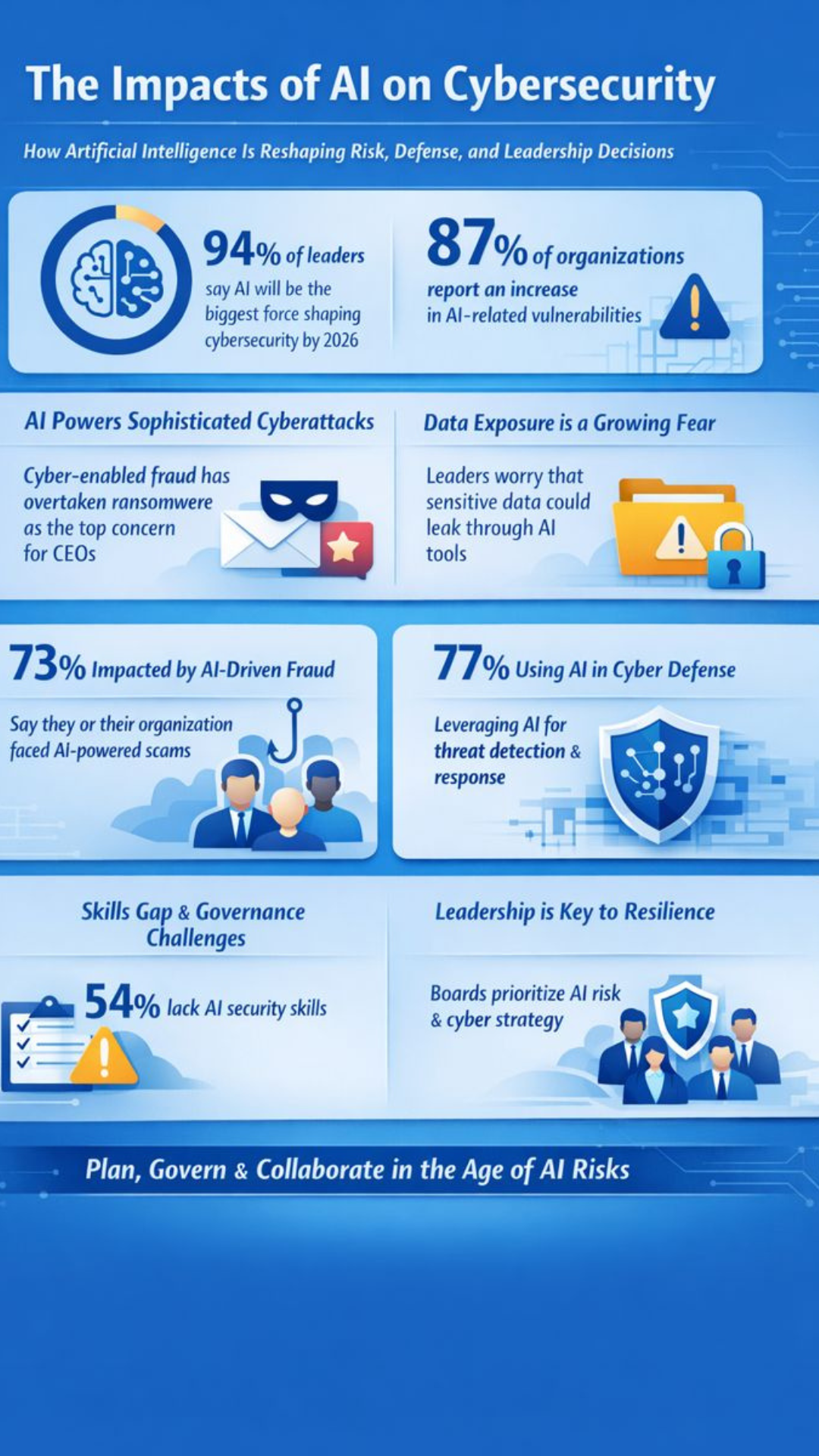
Artificial intelligence is no longer an emerging factor in cybersecurity. It is already changing how attacks are designed, how defenses operate, and how leaders think about risk. According to the World Economic Forum Global Cybersecurity Outlook 2026, 94% of global leaders expect AI to be the single biggest force shaping cybersecurity in 2026. This shift is not theoretical. AI is embedded in phishing kits, fraud campaigns, malware development, and large-scale reconnaissance. At the same time, it is being used by defenders to detect threats faster, automate response, and reduce human overload. What makes this moment different is speed. AI compresses time. Attacks scale faster. Mistakes spread wider. Decisions carry higher consequences.
This article breaks down the real impacts of AI on cybersecurity, grounded in data, leadership perspectives, and operational reality.
Key Points
- AI is reshaping cybersecurity risk and defense at scale.
- The attack surface is expanding with new AI-driven targets and vectors.
- Cyberattacks are becoming faster, more convincing, and harder to detect.
- AI is improving threat detection and incident response capabilities.
- Strong governance and skills are critical to managing AI-driven cyber risk.
AI Has Changed the Nature of Cyber Risk
AI does not simply add new tools to cybersecurity. It alters how risk behaves across systems and organizations. Threats no longer move in linear stages. They adapt as they encounter defenses, often faster than teams can respond. This shift explains why 87% of organizations reported a rise in AI-related vulnerabilities over the past year. The risk is not limited to malicious use. Poorly implemented AI systems, exposed training data, and insecure integrations have become part of the modern attack surface.
As Josephine Teo, Singapore’s Minister for Digital Development and Information, explains:
“Developments in AI are reshaping multiple domains, including cybersecurity. Implemented well, these technologies can assist and support human operators in detecting, defending and responding to cyberthreats. However, they can also pose serious risks such as data leaks, cyberattacks and online harms if they malfunction, or are misused.”
The implication is clear. AI amplifies both capability and consequence. Risk now accumulates faster than traditional security models were designed to handle.
AI Is Making Cyberattacks Faster and More Convincing
AI has fundamentally changed how cybercrime operates. Generative models allow attackers to produce realistic phishing emails, impersonation messages, and fake documents at scale. These messages adapt to language, region, and context, making them far more difficult for users to identify.
This shift is reflected in leadership concerns. The report notes that cyber-enabled fraud has overtaken ransomware as the top cybersecurity worry for CEOs, driven largely by AI-powered social engineering. The impact is widespread. 73% of surveyed respondents said they or someone in their organization had been affected by cyber-enabled fraud, showing that these attacks are no longer isolated or rare.
What makes this trend dangerous is accessibility. AI has lowered the barrier to entry, allowing less skilled attackers to launch highly effective campaigns with minimal effort.
Data Exposure Has Emerged as the Biggest AI Security Fear
While attacker capability remains a concern, leadership attention has moved toward internal risk. Data exposure linked to AI systems is now viewed as one of the most serious cybersecurity threats. Generative AI tools, internal copilots, and automated assistants often process sensitive data, sometimes without clear limits on storage or reuse.
This concern is reflected in organizational behavior. The percentage of organizations actively assessing AI-related security risks has risen sharply, yet gaps remain. Many teams deployed AI tools before defining strong access controls, monitoring, or accountability. As a result, confidential information may flow through systems that security teams cannot fully see or govern.
These exposures are often unintentional, but the damage can be long-lasting. Data leaks tied to AI undermine trust and invite regulatory scrutiny at a time when oversight is tightening globally.
AI Is Reshaping How Cyber Defense Works
On the defensive side, AI has become a core operational capability. The report shows that 77% of organizations now use AI in their cybersecurity programs, most commonly for phishing detection, anomaly detection, and alert prioritization. AI helps teams process massive volumes of data and identify patterns that would otherwise be missed.
This shift has changed how security operations centers function. Routine analysis is increasingly automated, allowing analysts to focus on judgment-driven decisions. Response times have improved, especially against fast-moving threats.
As Arvind Krishna, CEO of IBM, notes:
“Criminals are always willing to use all possible ways to get access to value, much of which is contained in the cyber infrastructure. Consequently, to stay ahead, those of us who defend must use every tool at our disposal – which now includes agentic AI.”
Even so, the report cautions against over-reliance. AI works best when paired with human oversight. Fully automated responses can misjudge context or escalate incidents unnecessarily.
Governance Has Become a Central Cybersecurity Challenge
Many AI-related security failures stem from governance gaps rather than technical flaws. AI systems introduce new identities, permissions, and dependencies that traditional security frameworks struggle to manage. Without clear ownership, AI agents can accumulate excessive access or behave in unexpected ways.
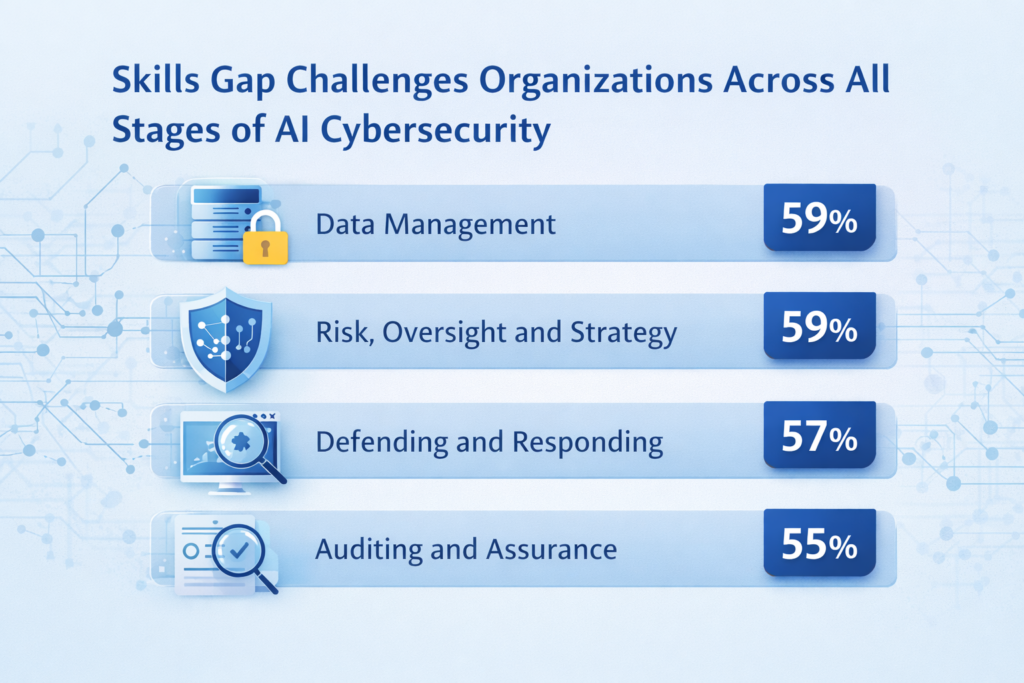
This challenge is compounded by skills shortages. 54% of organizations cite lack of AI security skills as a major obstacle, making it harder to deploy and govern AI responsibly. Effective organizations respond by embedding security-by-design into AI initiatives and treating governance as a continuous process, not a one-time review.
Strong governance turns AI into a measurable asset. Weak governance turns it into a silent risk.
Leadership Perspectives Are Shifting Cybersecurity Strategy
AI has elevated cybersecurity from a technical issue to a leadership priority. Boards are more engaged, and AI-related cyber risk is increasingly discussed alongside financial and operational risk. Highly resilient organizations review AI deployments before they scale and align cybersecurity decisions with business objectives.
As Michael Miebach, CEO of Mastercard, observes:
“Cybersecurity is the foundation for our digital world. It is at the heart of trust and will allow society to fully benefit from the transformations enabled by new technologies like AI and quantum. But it’s not something one can do on their own.”
This reflects a broader understanding that cyber incidents now have systemic impact, affecting customers, partners, and entire ecosystems.
AI Is Deepening the Cybersecurity Divide
AI is also widening gaps across the digital ecosystem. Large enterprises are better positioned to adopt AI-driven security, while smaller organizations and public institutions struggle to keep pace. This imbalance increases systemic risk, especially within supply chains where attackers exploit weaker links.
Henna Virkkunen highlights the urgency:
“As the threat landscape evolves and AI increasingly powers offensive operations in cyberspace, we must step up our work on the resilience of our critical infrastructure and connectivity.”
Closing this gap requires shared intelligence, investment in skills, and coordinated action across sectors.
AI has not simplified cybersecurity. It has made it faster, more interconnected, and less forgiving of mistakes. Prevention alone is no longer enough. Organizations must plan for disruption, rapid recovery, and continuous adaptation. Those that succeed will deploy AI deliberately, invest in people and governance, and treat cybersecurity as a shared responsibility rather than a technical afterthought.
To Sum Up
AI is reshaping cybersecurity at every level. It accelerates attacks, enhances defenses, and raises the cost of poor decisions. The organizations best prepared for this shift are those that combine leadership involvement, measurable governance, and skilled teams. How AI is managed today will determine how resilient digital systems remain tomorrow.
FAQs
How does AI increase cyber risk?
AI accelerates attacks, expands the attack surface, and enables more targeted fraud and impersonation.
Why are data leaks such a concern with AI systems?
AI tools can unintentionally expose sensitive data if governance, access controls, and monitoring are weak.
Can AI replace cybersecurity professionals?
No. AI improves speed and scale, but human oversight and judgment remain essential.
Why are smaller organizations more vulnerable to AI-driven threats?
They often lack the skills and resources needed to secure and govern AI systems effectively.
What should organizations prioritize first when adopting AI?
Strong governance, clear accountability, and continuous security review should come before large-scale deployment.