
Why Hackers No Longer Hack Systems, They Hack Identities

Share
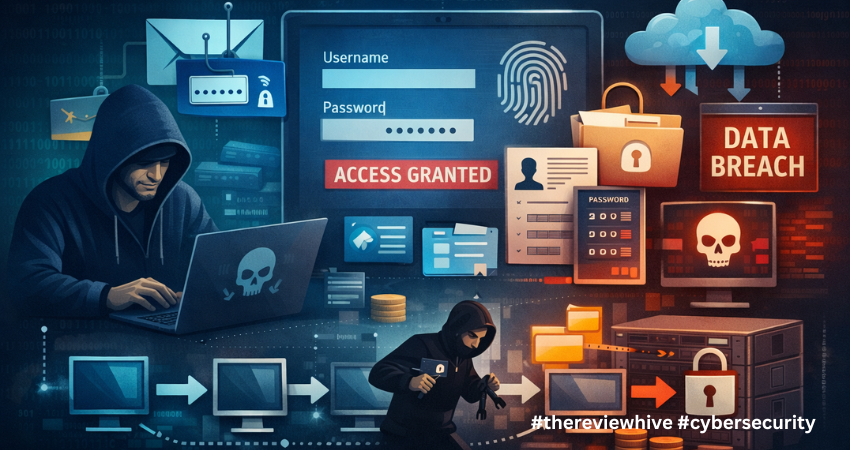
Cyberattacks are no longer driven mainly by software vulnerabilities. They are increasingly driven by identity compromise. According to Sophos, identity-based attacks now account for a majority of incident response cases, with attackers using valid credentials in many breaches. In fact, in over 56% of cases, attackers logged in rather than broke in.
At the same time, Microsoft reports that identity attacks increased by 32%, with billions of password-based attacks happening every month. It also highlights that more than 99.9% of compromised accounts did not have MFA enabled, which shows how often basic protections are still missing.
These numbers show a clear shift. The weakest point is no longer the system. It is identity.
TL;DR
- Hackers are shifting from system exploits to identity-based attacks
- Over 50% of breaches now involve valid credentials
- Billions of password attacks happen every month
- Most compromised accounts lack MFA
- Identity security is now as critical as network and endpoint security
The Shift From Exploiting Systems to Exploiting Access
Traditional attacks focused on systems. The goal was to find a weakness in software and use it to gain entry. But systems have become harder to break.
- Organizations patch faster, reducing exposure windows
- Endpoint detection tools identify suspicious activity earlier
- Networks are segmented, limiting lateral movement
- Security tools are more mature and integrated
So attackers adapted. Instead of fighting security controls, they go around them. They target identity. A valid login gives them what exploitation used to provide, access, persistence, and trust. It also reduces the need for malware in the early stages. According to Sophos: The 2026 Active Adversary Report , identity compromise is now the leading root cause in incident investigations, which confirms that attackers prefer access over exploitation.
Why Identity-based Attack Is the Easiest Way In
There are clear reasons why identity-based attacks have become the preferred method for attackers today. The shift is not accidental. It reflects how modern environments are built and where the least resistance exists.
- It is faster
Stealing credentials through phishing campaigns, infostealer malware, or leaked databases is significantly quicker than identifying and exploiting a system vulnerability. Exploits require time, testing, and often specific conditions to succeed. Credential theft, on the other hand, can be executed at scale with minimal effort. In many cases, attackers gain access within minutes of sending a phishing email or deploying malware. This speed allows them to move quickly before any security controls or alerts are triggered. - It looks legitimate
When attackers use real credentials, they do not appear as outsiders. They appear as valid users. This changes how security systems interpret their activity. Instead of flagging an intrusion, the system sees a successful login followed by normal actions such as accessing email, downloading files, or logging into cloud applications. Because of this, detection is delayed. Security teams may not immediately recognize the activity as malicious, which gives attackers valuable time to explore the environment, escalate privileges, and move across systems without raising suspicion. - It works at scale
Identity-based attacks are highly scalable because they rely on automation and widely available data. According to Microsoft, over 4,000 password attacks per second are observed globally. Attackers use automated tools to test millions of credentials across platforms, making even a small success rate worthwhile. A fraction of successful logins can still translate into thousands of compromised accounts. This makes identity attacks not only efficient but also highly profitable.
Another factor that strengthens this approach is the availability of stolen credentials. Billions of usernames and passwords are already exposed through previous breaches and infostealer campaigns. Attackers do not need to start from scratch. They work with existing data and continuously refine their methods.
The result is clear. Attackers do not need complex tools or advanced exploits when simple access continues to work consistently. Identity has become the easiest way in because it offers speed, scale, and stealth, all at once.
How These Attacks Actually Happen
Identity-based attacks follow patterns that are simple, scalable, and effective. Reports from Verizon and IBM show that over 70% of breaches involve a human element, and phishing and credential abuse remain among the top initial access vectors.
Phishing
Phishing remains the most widely used attack method. According to Verizon, phishing is one of the top causes of breaches involving human error.
- Around 1 in 3 breaches involves phishing or social engineering
- Attackers use fake login pages that mimic trusted platforms
- Modern phishing kits capture credentials and MFA codes in real time
- AI-generated emails are increasing success rates
Attackers rely on urgency to push users into making quick decisions. Once credentials are captured, attackers gain immediate access or store them for later use.
Credential Stuffing
Credential stuffing exploits password reuse. Attackers use leaked credentials from previous breaches and test them across multiple platforms.
According to Microsoft:
- Billions of password attacks happen every month
- Automated tools can test thousands of logins per second
- Even a 0.1% success rate can compromise thousands of accounts
This method is effective because users continue to reuse passwords across services.
MFA Fatigue Attacks
MFA fatigue attacks exploit user behavior. Attackers send repeated MFA requests until a user approves one. In several real-world incidents:
- Attackers gained access after dozens of push notifications
- Users approved requests out of confusion or fatigue
- MFA became ineffective due to user response, not technology failure
This shows that security controls depend heavily on user awareness.
Session Hijacking
Session hijacking bypasses authentication entirely. Instead of stealing passwords, attackers steal session tokens.
- This allows attackers to bypass MFA completely
- Sessions can remain active for hours or days
- No login event means fewer detection signals
According to industry observations, session-based attacks are increasing, especially in cloud environments where session persistence is common.
Infostealer Malware
Infostealers are fueling identity-based attacks at scale. These tools collect:
- Saved credentials
- Browser autofill data
- Session cookies and tokens
Security research shows that millions of credentials are traded on underground markets every year, many sourced from infostealer infections. One compromised device can expose access to multiple platforms, including enterprise systems.
Why These Methods Continue to Work
These attack methods continue to succeed not because they are new, but because the same gaps still exist across organizations. Password reuse remains common, which makes credential-based attacks like credential stuffing highly effective even today. Multi-factor authentication(MFA) is widely recommended, but it is still not enforced consistently across all users, systems, and third-party access points, leaving critical entry points exposed. In many environments, identity monitoring is limited or reactive, which means unusual login behavior or access patterns are not flagged early enough.
Attackers understand these weaknesses well. Instead of developing complex exploits, they refine and scale techniques that already work. According to IBM, credential theft and phishing continue to rank among the leading causes of breaches year after year. This consistency is what makes the problem serious. It shows that even as security tools evolve, basic identity-related weaknesses remain unaddressed, allowing attackers to operate with a high level of success.
Another reason these methods persist is the growing complexity of modern environments. With cloud platforms, remote access, and multiple SaaS applications in use, identities are spread across systems, often without centralized visibility or control. This fragmentation makes it harder for organizations to enforce consistent security policies, while giving attackers more opportunities to find weak points. As long as these gaps remain, identity-based attacks will continue to be one of the most reliable paths into an organization.
What This Means for Organizations
Each of these attack methods targets a different stage of how identity is created, used, and maintained inside an organization. Phishing attacks focus on the point where users enter their credentials, exploiting trust and urgency. Credential stuffing takes advantage of password reuse across platforms, turning previously leaked data into new access opportunities.
MFA fatigue attacks target user behavior, where repeated prompts lead to approval without verification. Session hijacking shifts the focus to active sessions, allowing attackers to bypass authentication altogether. Infostealer malware goes even deeper by extracting stored credentials, tokens, and browser data directly from user devices.
What this shows is that identity risk does not exist at a single point. It spans the entire access lifecycle, from login to session management to data storage. Focusing on just one control, such as MFA or password policies, is not enough to stop these attacks.
Organizations need a layered approach to identity security that covers every stage of access. This includes securing how credentials are entered, enforcing strong authentication, monitoring behavior after login, protecting active sessions, and reducing the exposure of stored data. It also requires visibility across cloud platforms, endpoints, and applications, so that identity misuse can be detected early.
Because once identity is compromised, the attacker is no longer trying to break in. They are already inside, operating with the same level of trust as a legitimate user. At that point, the challenge shifts from prevention to containment, and that is always harder to manage.
What Happens After the Login
This is where identity-based attacks become more dangerous, because the attacker is no longer trying to gain access. They already have it. Once inside, they do not behave like an obvious intruder. They act like a legitimate user, using real credentials, trusted tools, and normal access paths. This makes their activity harder to detect and gives them time to understand the environment before taking any disruptive action.
The first step is usually quiet reconnaissance. Attackers explore what the compromised account can access, which systems are connected, and where higher privileges might exist. From there, they begin to expand their reach in a controlled way.
They access email and cloud platforms to gather internal information such as conversations, shared files, and credentials stored in messages or documents. This helps them map relationships and identify high-value targets. They then attempt to escalate privileges by exploiting weak access controls or misconfigured roles, moving from a standard user account to administrative access.
Once they gain higher privileges, they move laterally across systems using legitimate credentials and tools. This allows them to access additional servers, applications, and data without triggering traditional security alerts. At the same time, they begin extracting sensitive data in small volumes to avoid detection, focusing on intellectual property, financial records, or customer information.
To maintain access, attackers often disable or weaken security controls. This may include turning off monitoring tools, modifying logs, or creating new accounts that can be used later. These actions are designed to ensure persistence, even if the original compromised account is discovered.
Only after establishing control do they move to the final stage, which could involve deploying ransomware, initiating data extortion, or causing operational disruption. By this point, the attacker is deeply embedded in the environment.
According to IBM, the average time to identify and contain a breach is over 200 days. This extended dwell time gives attackers ample opportunity to move, adapt, and maximize impact before being detected.
Why Traditional Security Is Not Enough
Traditional security models were designed to detect and block external threats, things like malware, suspicious files, or exploit attempts targeting known vulnerabilities. But identity-based attacks do not follow that pattern. When an attacker signs in using valid credentials, there is no exploit being triggered, no malicious file to scan, and no obvious anomaly at the point of entry. The activity appears legitimate because, technically, it is a valid login.
This is where the gap becomes clear. Most security tools are built to detect what looks abnormal at the system level, not what looks suspicious at the identity level. So when access is granted based on correct credentials, those defenses are often bypassed entirely. The attacker is no longer seen as an intruder. They are treated as a user.
That creates a serious blind spot. By the time unusual behavior is detected, if it is detected at all, the attacker may have already moved across systems, accessed sensitive data, or escalated privileges.
This is why identity is no longer just part of security. It has become the security boundary itself.
What Organizations Need to Do Differently
If identity is now the main attack surface, then identity security must become a core part of the cybersecurity strategy. Many organizations still treat it as a secondary control, which leaves critical gaps.
To reduce the risk of identity-based attacks, organizations need to rethink how access is granted, monitored, and validated.
- Enforce strong MFA everywhere
Multi-factor authentication is one of the most effective defenses, but only when implemented properly. SMS-based MFA can be intercepted or bypassed, so organizations should adopt phishing-resistant methods such as hardware keys or secure authenticator apps. MFA should be enforced across all users, especially administrators, remote access systems, and cloud platforms. Even one unprotected account can become an entry point. - Adopt least-privilege access as a standard
Users and systems should only have the access they need. This reduces the impact of compromised accounts and limits how far attackers can move. Privileged access should be temporary and monitored. Long-standing administrative privileges increase risk and are often exploited quickly. - Monitor identity behavior continuously
Authentication should not be treated as a one-time event. Organizations need visibility into user behavior after login. Unusual patterns such as login anomalies, unexpected data access, or abnormal usage should trigger alerts. Continuous monitoring helps detect threats that bypass initial controls. - Protect sessions, not just logins
Attackers increasingly target session tokens. Once a session is compromised, MFA becomes irrelevant. Organizations need to monitor active sessions, enforce expiration policies, and revoke sessions when suspicious activity is detected. - Strengthen phishing and email defenses
Phishing remains a primary entry point. Organizations should combine advanced email filtering with realistic user training. Employees need to recognize modern phishing techniques, not just basic examples. - Invest in identity threat detection and response (ITDR)
Traditional tools focus on endpoints and networks. ITDR focuses on identity misuse. It provides visibility into suspicious login behavior, privilege escalation, and lateral movement, allowing faster detection and response. - Implement a Zero Trust approach
Zero Trust ensures that no user or device is trusted by default. Every access request is evaluated based on context, including identity, device, and behavior. This reduces the risk of attackers moving freely within the environment. - Audit identity configurations regularly
Misconfigurations are a common cause of breaches. Regular audits help identify excessive permissions, inactive accounts, and weak policies before they are exploited.
To Sum Up
Cybersecurity has shifted from protecting systems to protecting access. Attackers no longer need to break through defenses when they can log in using valid credentials. This makes identity the most critical layer in modern security. Organizations that fail to strengthen identity protection will continue to face breaches that are harder to detect and faster to execute. The focus now must be on verifying access continuously, limiting privileges, and responding quickly to suspicious behavior. Because in today’s threat landscape, identity is the new perimeter.
FAQs
- What does it mean when hackers target identities instead of systems?
It means attackers gain access using stolen or abused credentials rather than exploiting software vulnerabilities. They log in as legitimate users, which allows them to move inside systems without triggering traditional security alerts. - Why are identity-based attacks increasing?
Identity attacks are faster, easier to scale, and harder to detect. Attackers do not need advanced skills when basic methods like phishing, credential theft, and weak authentication still work consistently. - What are the most common identity-based attack methods?
The most common methods include phishing, credential stuffing, MFA fatigue attacks, session hijacking, and infostealer malware. Each method targets a different stage of how users access systems. - Why are valid logins harder to detect than traditional attacks?
Because the activity appears legitimate. Security tools are designed to detect anomalies like malware or exploits, but when attackers use real credentials, their actions often look like normal user behavior. - How quickly can attackers move after gaining access?
In many cases, attackers begin exploring systems and attempting privilege escalation within hours of gaining access. This rapid movement makes early detection critical. - Can MFA stop identity-based attacks completely?
Strong, phishing-resistant MFA can prevent most automated attacks, but weak or poorly implemented MFA can still be bypassed through methods like MFA fatigue or session hijacking. - What happens if an attacker compromises an identity?
Once inside, attackers can access systems, escalate privileges, move across networks, steal sensitive data, and even deploy ransomware. At that point, they are operating as a trusted user. - What is the biggest risk organizations face today?
The biggest risk is not just system vulnerabilities, but compromised identities. Once an identity is exposed, attackers gain trusted access, which is much harder to detect and contain. - How can organizations reduce the risk of identity-based attacks?
Organizations need strong MFA, least-privilege access, continuous identity monitoring, session protection, and identity threat detection. A layered approach is essential because no single control can stop all attack methods.