
Types of Threat Intelligence

Share
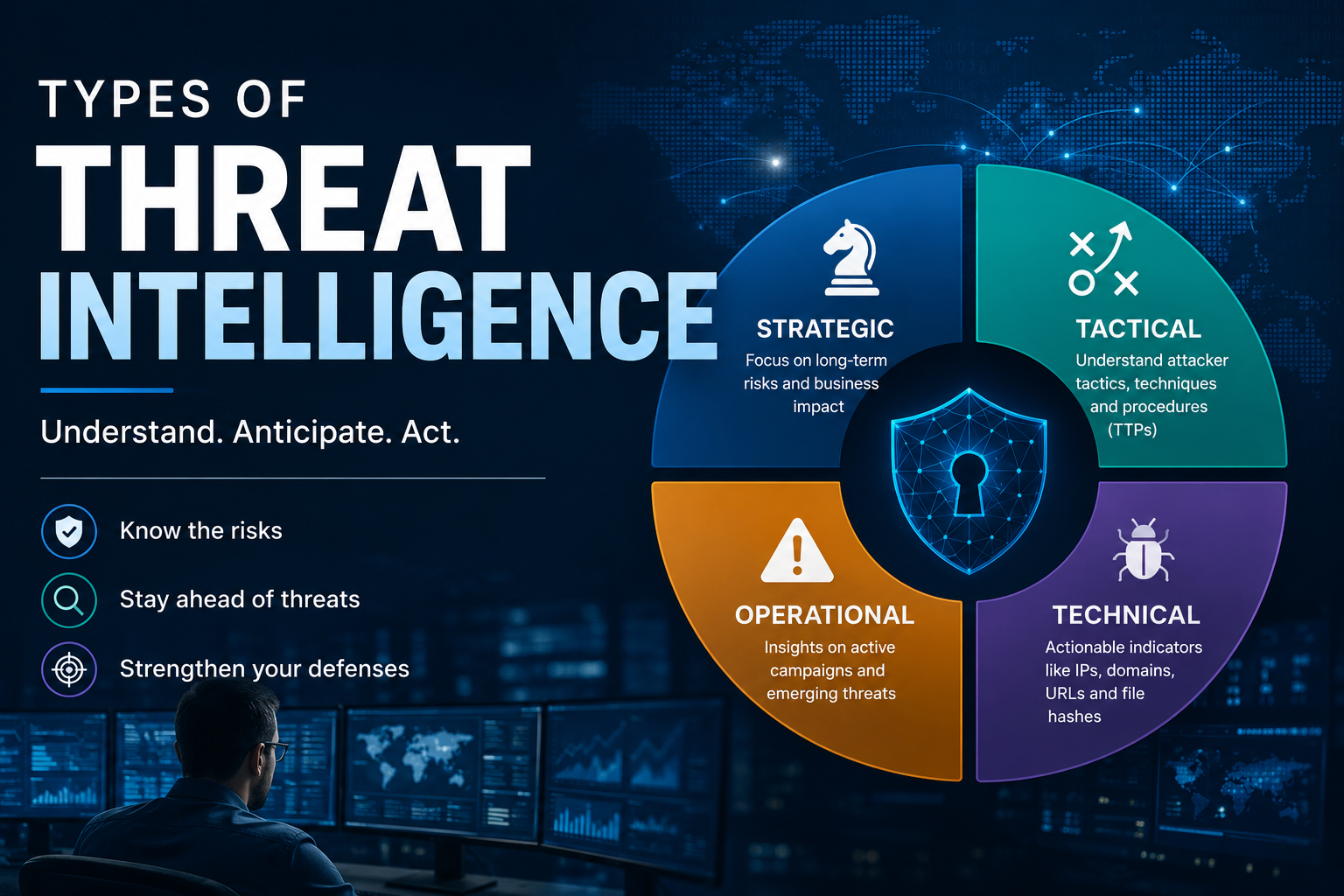
Cyber threats are no longer just an IT problem. They affect business operations, customer trust, regulatory compliance, and revenue. Over the past few years, I’ve noticed a significant shift in how organizations approach cybersecurity. Rather than reacting to incidents after they occur, businesses are investing in cyber threat intelligence to identify risks before they become costly problems.
Understanding the different types of threat intelligence is important because each type serves a different purpose. Some help executives make strategic decisions, while others help security teams detect and stop attacks in real time.
In this article, I’ll explain the four primary types of threat intelligence, how organizations use them, and why they are essential for building a strong cybersecurity program.
Key Takeaways
- The four primary types of threat intelligence are strategic, tactical, operational, and technical intelligence.
- Strategic threat intelligence helps executives understand cyber risks and business impact.
- Tactical threat intelligence focuses on attacker tactics, techniques, and procedures.
- Operational threat intelligence provides insight into active cyber campaigns and emerging threats.
- Technical threat intelligence delivers actionable indicators for threat detection and response.
- The most effective cybersecurity programs combine all four intelligence types to improve security posture and reduce organizational risk.
- A well-structured cyber threat intelligence program helps organizations make informed decisions, prioritize resources, and respond to threats more effectively.
Importance of Threat Intelligence
Modern cyberattacks are becoming more sophisticated and more frequent. According to IBM’s 2025 Cost of a Data Breach Report, the global average cost of a data breach reached $4.44 million. Even though this represents a slight decrease from previous years, the financial impact remains substantial for organizations of all sizes. Organizations that identify and contain threats more quickly experience significantly lower costs.
The Verizon 2026 Data Breach Investigations Report found that 31% of breaches now begin with vulnerability exploitation, surpassing stolen credentials as the most common attack vector for the first time. The report also highlights how attackers are increasingly using artificial intelligence to accelerate attacks and reduce defenders’ response windows from months to hours.
These trends make threat intelligence more valuable than ever.
What Are the Types of Threat Intelligence?
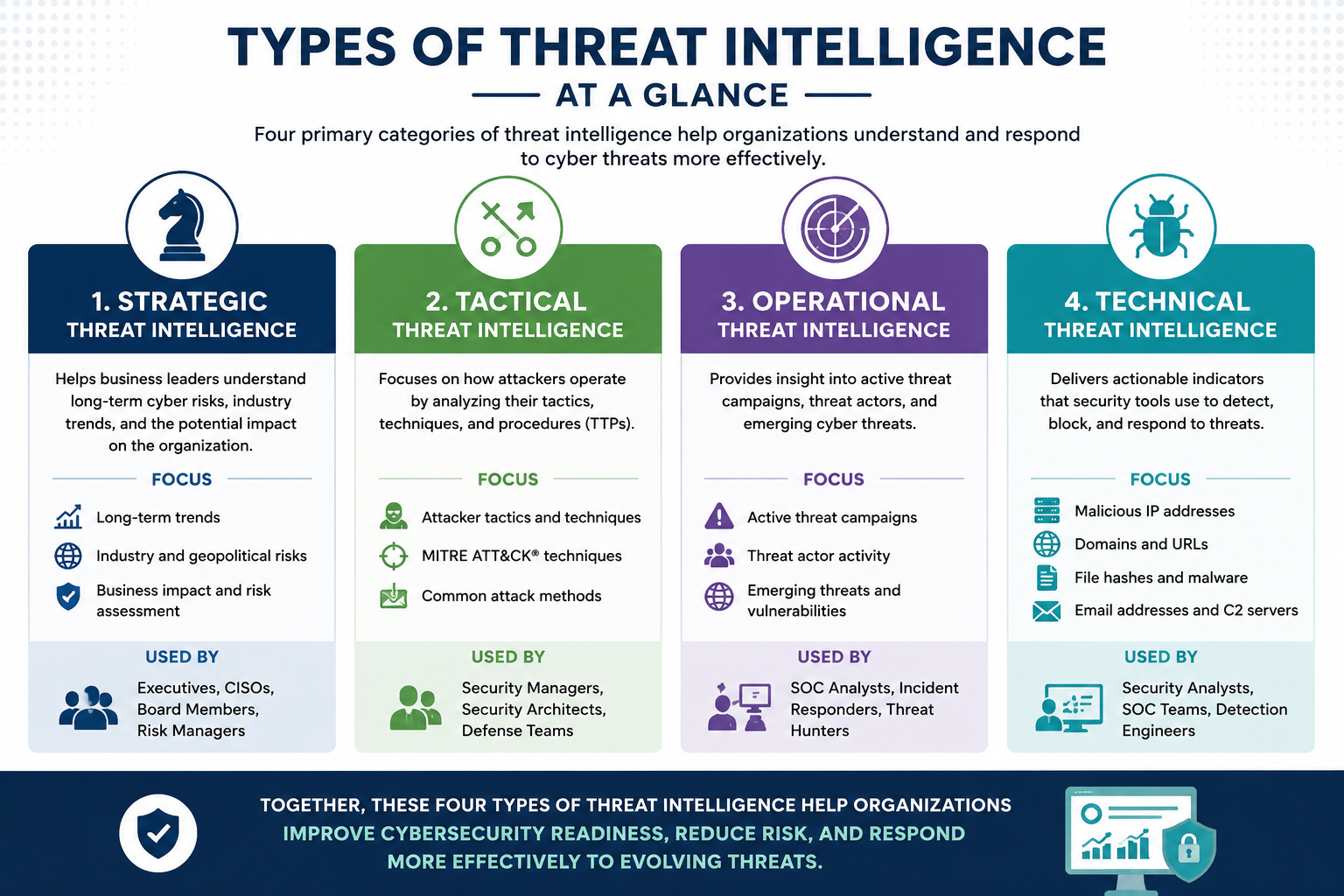
Threat intelligence is generally divided into four categories:
- Strategic Threat Intelligence
- Tactical Threat Intelligence
- Operational Threat Intelligence
- Technical Threat Intelligence
Each type addresses different business and security needs.
| Type | Primary Audience | Purpose |
| Strategic Intelligence | Executives and board members | Business risk assessment |
| Tactical Intelligence | Security managers and architects | Understanding attacker behavior |
| Operational Intelligence | SOC analysts and incident responders | Monitoring active threats |
| Technical Intelligence | Security analysts and engineers | Detecting and blocking attacks |
Let’s examine each category in detail.
Strategic Threat Intelligence
Strategic threat intelligence provides a high-level view of the threat landscape. It focuses on long-term risks, industry trends, and business impact rather than technical details.
This type of intelligence is designed for decision-makers who need to understand how cyber threats could affect the organization’s objectives.
What Strategic Intelligence Includes
- Industry-specific threat trends
- Nation-state cyber activity
- Regulatory developments
- Emerging attack patterns
- Business risk assessments
Real-World Business Use Case
Imagine a healthcare organization operating across multiple regions. Strategic intelligence reveals that ransomware groups are increasingly targeting healthcare providers because patient data is valuable and service disruptions create pressure to pay ransoms.
Armed with this information, executives may decide to increase cybersecurity investments, improve backup systems, and expand incident response capabilities before becoming a target.
Benefits
- Supports budget planning
- Improves risk management
- Guides cybersecurity strategy
- Helps leadership make informed decisions
Strategic intelligence answers the question:
“What cyber risks could impact our business?”
Tactical Threat Intelligence
Tactical threat intelligence focuses on how attackers operate. Instead of looking at broad trends, it examines attacker tactics, techniques, and procedures, often called TTPs.
Security teams use this intelligence to strengthen defenses and improve detection capabilities.
What Tactical Intelligence Includes
- Attack methodologies
- Adversary behavior patterns
- MITRE ATT&CK techniques
- Phishing methods
- Credential theft techniques
Real-World Business Use Case
A financial institution notices an increase in phishing attempts targeting employees. Tactical intelligence reveals that a specific threat group is using QR-code phishing campaigns to bypass traditional email security controls. The organization responds by updating employee awareness training, modifying email filtering policies, and creating new detection rules.
Benefits
- Improves defensive controls
- Enhances employee awareness programs
- Supports threat hunting activities
- Reduces attack success rates
Tactical intelligence answers the question:
“How do attackers operate?”
Operational Threat Intelligence
Operational threat intelligence focuses on active threats and ongoing campaigns. It is often collected from multiple intelligence sources, including security researchers, dark web monitoring, incident reports, and intelligence-sharing communities.
This intelligence is highly time-sensitive.
What Operational Intelligence Includes
- Active ransomware campaigns
- Threat actor activities
- Planned attacks
- Emerging vulnerabilities
- Dark web discussions
Real-World Business Use Case
A manufacturing company receives intelligence indicating that a ransomware group is actively targeting industrial organizations using a recently disclosed vulnerability. The organization’s security team immediately scans systems for exposure, deploys patches, and increases monitoring around critical assets. Because the threat was identified early, the company avoids a potential incident.
Benefits
- Faster response to emerging threats
- Improved incident preparedness
- Enhanced threat hunting
- Better situational awareness
Operational intelligence answers the question: “What threats are targeting us right now?”
Technical Threat Intelligence
Technical threat intelligence is the most detailed and actionable type of intelligence. It consists of Indicators of Compromise (IOCs) and technical artifacts that security tools can use directly. This intelligence often has a short lifespan because attackers frequently change infrastructure and tactics.
Common Technical Indicators
- Malicious IP addresses
- Domains
- URLs
- File hashes
- Command-and-control servers
- Email addresses
Real-World Business Use Case
A retail company receives a threat intelligence feed containing indicators associated with a newly discovered malware campaign.
The security team automatically imports these indicators into firewalls, endpoint protection systems, and SIEM platforms.
As a result, malicious traffic is blocked before attackers gain access to the environment.
Benefits
- Rapid threat detection
- Automated blocking capabilities
- Improved incident investigation
- Faster remediation
Technical intelligence answers the question: “What specific indicators should we block or monitor?”
How the Four Types Work Together
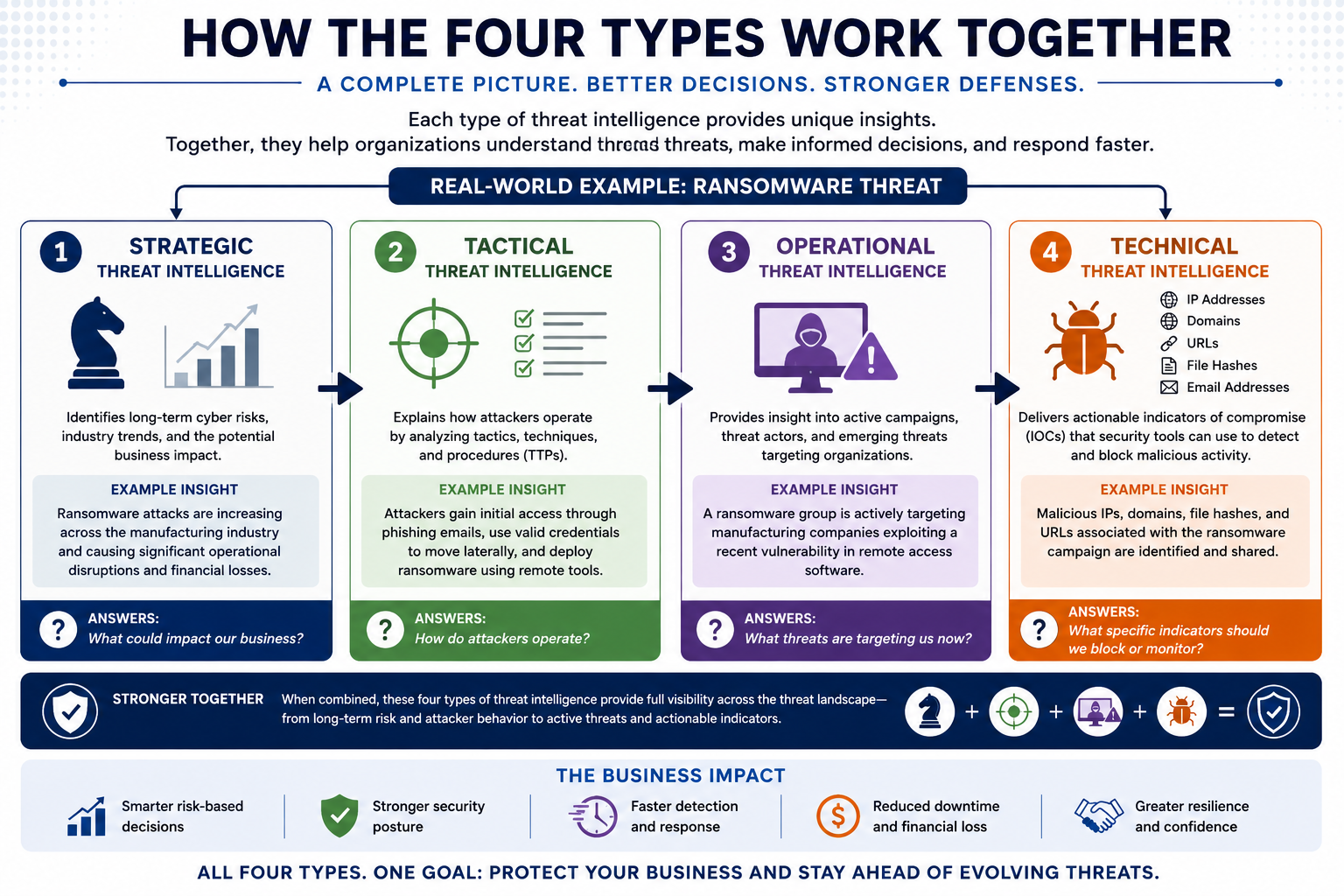 One of the biggest misconceptions is the belief that organizations should choose one type of intelligence over another. In reality, effective cybersecurity programs use all four.
Consider a ransomware threat:
- Strategic intelligence identifies ransomware as a growing business risk.
- Tactical intelligence explains how ransomware groups gain access.
- Operational intelligence warns of an active campaign targeting the industry.
- Technical intelligence provides the IP addresses, domains, and malware hashes used in the attack.
Each intelligence type supports a different layer of decision-making. Together, they provide a complete picture.
Threat Intelligence and Business Risk Reduction
Threat intelligence is not simply about collecting data. Its value comes from enabling faster and better decisions. Research continues to show that proactive security measures reduce breach impact. IBM’s 2025 report found that organizations using AI-powered security capabilities achieved faster breach containment times, helping reduce overall breach costs. The average breach lifecycle fell to 241 days, the lowest level recorded in nearly a decade.
For business leaders, this translates into:
- Lower financial losses
- Reduced operational disruption
- Improved regulatory compliance
- Better customer trust
- Faster incident recovery
Common Challenges Organizations Face When Using Threat Intelligence
While understanding the types of threat intelligence is important, implementing an effective intelligence program is often more difficult than many organizations expect. I’ve seen businesses invest in threat feeds and security tools only to discover that collecting intelligence is much easier than turning it into meaningful action.
Below are some of the most common challenges organizations encounter when working with cyber threat intelligence.
- Information Overload
One of the biggest challenges in any threat intelligence program is the sheer volume of data available. Organizations receive information from commercial threat feeds, open-source intelligence (OSINT), government advisories, industry sharing groups, security vendors, and internal monitoring systems.
The problem is that not every alert, indicator, or report is relevant to the business. Security teams can quickly become overwhelmed by thousands of indicators of compromise (IOCs), vulnerability notifications, and threat reports every day. Without proper filtering and prioritization, analysts may spend valuable time investigating low-risk events while missing threats that pose a genuine risk to the organization.
To overcome this challenge, organizations should align intelligence collection with specific business objectives and focus on threats that directly affect their industry, technology stack, and operational environment.
- Poor Intelligence Quality
Not all intelligence is created equal. Some threat feeds contain outdated, inaccurate, or duplicated information. If security teams rely on low-quality data, they risk generating false positives and wasting resources.
For example, a malicious IP address identified last month may no longer be associated with threat activity today. Blocking outdated indicators can create unnecessary operational issues while providing little security value.
An effective cyber threat intelligence strategy requires continuous validation of intelligence sources. Organizations should evaluate intelligence providers based on accuracy, timeliness, relevance, and the ability to provide actionable insights rather than raw data alone.
- Rapidly Changing Threat Landscape
Cybercriminals constantly adapt their tactics to avoid detection. Attackers frequently change infrastructure, domains, malware variants, and attack methods. This creates a significant challenge for organizations relying heavily on technical threat intelligence. Indicators such as IP addresses, URLs, and file hashes often have a short lifespan. By the time an organization receives and deploys an indicator, attackers may have already moved to new infrastructure.
This is why many mature security programs combine technical intelligence with tactical threat intelligence, which focuses on attacker behavior and tactics rather than individual indicators. Understanding how attackers operate often provides longer-lasting defensive value.
- Lack of Skilled Personnel
Many organizations struggle to find cybersecurity professionals with experience in intelligence analysis. Threat intelligence requires more than technical expertise. Analysts must understand attacker motivations, geopolitical developments, industry risks, and emerging cybercrime trends.
Even organizations with experienced security teams may lack dedicated threat intelligence specialists. Without the right expertise, businesses may collect large amounts of intelligence but fail to translate it into actionable recommendations. This reduces the overall value of the threat intelligence lifecycle and can limit the organization’s ability to proactively identify risks. Investing in training, intelligence-sharing communities, and threat intelligence platforms can help bridge this skills gap.
- Integration Challenges
Another common issue is the inability to integrate intelligence into existing security operations. Many organizations subscribe to intelligence feeds but fail to connect them with critical security tools such as:
- SIEM platforms
- Security orchestration and automation tools (SOAR)
- Endpoint detection and response solutions (EDR)
- Firewalls
- Vulnerability management systems
When intelligence remains isolated in reports or dashboards, it provides limited value.
Successful organizations ensure that cyber threat intelligence becomes part of daily security operations. Intelligence should directly support threat detection, incident response, vulnerability prioritization, and risk management activities.
- Difficulty Measuring Return on Investment (ROI)
Business leaders often ask an important question:
“How do we measure the value of threat intelligence?”
Unlike traditional security controls, the success of a threat intelligence program is not always easy to quantify. Preventing an attack is harder to measure than responding to one. As a result, some organizations struggle to justify investments in intelligence capabilities.
To address this challenge, organizations should establish measurable outcomes such as:
- Reduced incident response times
- Faster threat detection
- Lower false-positive rates
- Improved vulnerability remediation timelines
- Reduced security incident frequency
These metrics help demonstrate how types of threat intelligence contribute to overall business resilience and risk reduction.
- Limited Context Around Threats
Receiving an alert about a malicious domain or suspicious IP address is useful, but without context, security teams may struggle to understand its significance.
For example, knowing that an IP address is malicious provides limited value unless analysts also understand:
- Which threat actor is using it
- What attack campaign it supports
- Which industries are being targeted
- What tactics are associated with the activity
This is where combining strategic threat intelligence, tactical threat intelligence, operational threat intelligence, and technical threat intelligence becomes critical.
Context transforms raw data into actionable intelligence and enables organizations to make informed decisions.
- Intelligence Sharing Barriers
Many industries benefit from information-sharing communities and sector-specific intelligence groups. However, organizations often hesitate to share threat information because of privacy concerns, legal considerations, or reputational risks.
This lack of collaboration can limit visibility into emerging threats.
Organizations that actively participate in intelligence-sharing initiatives often gain earlier warning of attacks targeting their industry. These collaborative efforts strengthen the overall effectiveness of cyber threat intelligence and help businesses stay ahead of evolving threats.
The value of types of threat intelligence depends on how effectively organizations collect, analyze, prioritize, and apply intelligence to real-world security decisions. Information overload, poor-quality data, skills shortages, integration challenges, and rapidly evolving threats can all reduce effectiveness. Organizations that address these challenges are better positioned to transform cyber threat intelligence from a collection of data points into a practical tool for reducing cyber risk and improving business resilience.
Best Practices for Using Threat Intelligence
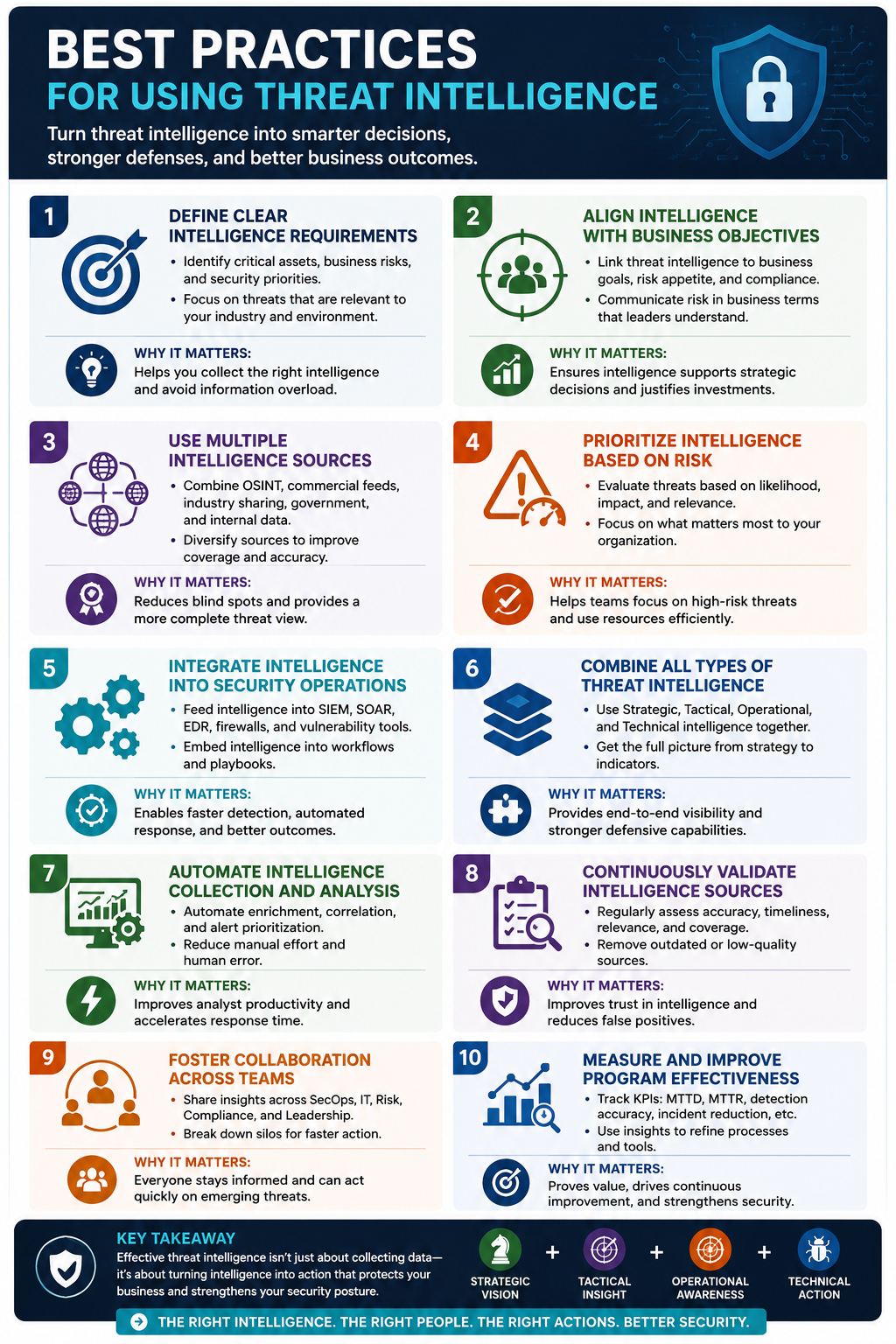
Understanding the types of threat intelligence is only the first step. To gain real value from a cyber threat intelligence program, organizations must ensure that intelligence supports business goals and security operations. Simply collecting threat data does not improve security. The true value comes from turning intelligence into informed decisions and actionable outcomes.
Here are some best practices that can help organizations maximize the effectiveness of their threat intelligence program.
- Define Clear Intelligence Requirements
One of the most common mistakes organizations make is collecting every piece of intelligence they can find without defining what information they actually need. Before investing in intelligence feeds or platforms, organizations should identify their most critical assets, business risks, and security priorities.
For example, a financial institution may focus on banking malware, credential theft, and fraud-related threats, while a healthcare provider may prioritize ransomware, patient data theft, and supply chain attacks.
Clear intelligence requirements help security teams focus on relevant threats rather than drowning in unnecessary information.
- Align Threat Intelligence With Business Objectives
An effective cyber threat intelligence strategy should support broader business goals. Business leaders are less interested in individual indicators of compromise and more concerned about how cyber threats could affect operations, revenue, customer trust, and regulatory compliance.
This is where strategic threat intelligence becomes particularly valuable. It helps decision-makers understand how emerging threats may impact the organization and supports risk-based cybersecurity investments. When intelligence is tied directly to business objectives, it becomes easier to justify security spending and demonstrate value to stakeholders.
- Use Multiple Intelligence Sources
No single intelligence source provides complete visibility into the threat landscape. Organizations should combine intelligence from multiple sources, including:
- Open-source intelligence (OSINT)
- Commercial threat intelligence providers
- Industry information-sharing groups
- Government advisories
- Internal security monitoring systems
- Security research reports
Using diverse sources helps eliminate blind spots and improves the accuracy of intelligence analysis. A well-rounded intelligence program combines external insights with internal telemetry to provide a more comprehensive view of potential threats.
- Prioritize Intelligence Based on Risk
Not every threat deserves the same level of attention. Security teams should prioritize intelligence based on factors such as:
- Industry relevance
- Potential business impact
- Asset criticality
- Likelihood of exploitation
- Existing security controls
For example, a vulnerability actively exploited by attackers and present within the organization’s environment should receive immediate attention. Meanwhile, a low-risk vulnerability affecting systems not used by the organization may require less urgency. Risk-based prioritization helps security teams focus their resources where they can make the greatest impact.
- Integrate Threat Intelligence Into Security Operations
Threat intelligence delivers the most value when it becomes part of daily security operations. Many organizations fail to realize the full benefits of cyber threat intelligence because intelligence remains isolated in reports or separate platforms. Instead, intelligence should be integrated into:
- Security Information and Event Management (SIEM) systems
- Endpoint Detection and Response (EDR) platforms
- Security Orchestration, Automation, and Response (SOAR) tools
- Vulnerability management solutions
- Incident response workflows
This integration enables faster detection, automated response actions, and more efficient threat investigations.
- Combine All Types of Threat Intelligence
The most mature organizations understand that each of the types of threat intelligence serves a different purpose. Relying solely on technical threat intelligence can result in short-term visibility but limited strategic insight. Similarly, focusing only on strategic intelligence may leave security teams without actionable indicators.
A balanced approach combines:
- Strategic Threat Intelligence for business decision-making
- Tactical Threat Intelligence for understanding attacker behavior
- Operational Threat Intelligence for monitoring active campaigns
- Technical Threat Intelligence for threat detection and response
Together, these intelligence categories provide a complete picture of the threat environment.
- Automate Intelligence Collection and Analysis
As threat volumes continue to grow, manual processes become increasingly difficult to manage. Automation can help organizations:
- Enrich threat indicators
- Correlate intelligence from multiple sources
- Prioritize alerts
- Reduce false positives
- Accelerate incident response
Automation allows analysts to spend less time processing data and more time investigating meaningful threats.
However, automation should support human decision-making rather than replace it. Experienced analysts remain essential for interpreting intelligence and assessing business impact.
- Continuously Validate Intelligence Sources
Threat intelligence is only as good as the quality of the data being used. Organizations should regularly evaluate intelligence providers based on:
- Accuracy
- Timeliness
- Relevance
- Coverage
- Actionability
Outdated or inaccurate intelligence can create unnecessary workload and reduce trust in the program.
Periodic reviews help ensure that intelligence sources continue to provide value and support organizational goals.
- Foster Collaboration Across Teams
Cybersecurity is no longer solely the responsibility of the IT department. Threat intelligence becomes more effective when information is shared across multiple business functions, including:
- Security operations
- Risk management
- Compliance teams
- Executive leadership
- Incident response teams
Collaboration ensures that intelligence is understood in both technical and business contexts.
For example, intelligence about an emerging ransomware campaign may influence patch management priorities, incident response planning, executive risk discussions, and employee awareness initiatives.
- Measure and Improve Program Effectiveness
Organizations should continuously evaluate the effectiveness of their threat intelligence program. Key performance indicators may include:
- Mean Time to Detect (MTTD)
- Mean Time to Respond (MTTR)
- Reduction in successful attacks
- Vulnerability remediation speed
- Threat detection accuracy
- Incident response efficiency
Measuring outcomes helps organizations identify gaps, improve processes, and demonstrate the value of cyber threat intelligence investments.
The most effective organizations do not treat threat intelligence as a collection of reports or threat feeds. They integrate intelligence into decision-making, security operations, risk management, and incident response processes. By leveraging all types of threat intelligence, aligning intelligence with business objectives, and continuously improving their approach, organizations can strengthen their security posture and stay ahead of evolving cyber threats.
To Sum Up
Understanding the different types of threat intelligence is essential for modern organizations. Strategic intelligence helps leaders understand risk. Tactical intelligence explains attacker behavior. Operational intelligence provides visibility into active threats. Technical intelligence delivers the indicators needed for detection and response. No single type is sufficient on its own. The organizations that gain the most value from threat intelligence combine all four to create a complete view of the threat landscape. As cyber threats continue to evolve, businesses that invest in threat intelligence will be better positioned to anticipate risks, respond faster, and protect both their operations and their reputation.
Frequently Asked Questions About Types of Threat Intelligence
What are the four types of threat intelligence?
The four types of threat intelligence are strategic threat intelligence, tactical threat intelligence, operational threat intelligence, and technical threat intelligence. Each serves a different audience and purpose. Strategic intelligence supports business decisions, tactical intelligence explains attacker behavior, operational intelligence identifies active threats, and technical intelligence provides indicators used for threat detection and response.
Which type of threat intelligence is most valuable?
There is no single most valuable type of threat intelligence. Organizations gain the greatest benefit when they use all four types together. Strategic intelligence helps leaders understand risk, tactical intelligence reveals attacker methods, operational intelligence tracks active campaigns, and technical intelligence enables faster threat detection.
What is the difference between tactical and operational threat intelligence?
Tactical threat intelligence focuses on how attackers operate by analyzing their tactics, techniques, and procedures. Operational threat intelligence focuses on specific threat actors, ongoing campaigns, and emerging threats that may target an organization. Tactical intelligence explains attacker behavior, while operational intelligence provides visibility into current threat activity.
Who uses strategic threat intelligence?
Strategic threat intelligence is primarily used by executives, CISOs, board members, risk managers, and business leaders. It helps organizations understand industry trends, cyber risks, regulatory challenges, and long-term threats that may affect business operations and security investments.
Why is threat intelligence important?
Threat intelligence helps organizations proactively identify cyber threats before they cause damage. It supports faster incident response, better risk management, improved threat detection, and stronger cybersecurity decision-making. Effective cyber threat intelligence enables organizations to stay ahead of attackers and reduce the likelihood of successful cyberattacks.
How do organizations use threat intelligence?
Organizations use threat intelligence to identify risks, prioritize vulnerabilities, strengthen security controls, monitor active threats, and improve incident response. Businesses integrate cyber threat intelligence into security operations centers (SOCs), vulnerability management programs, threat hunting activities, and executive risk assessments.
Which type of threat intelligence helps detect cyberattacks?
Technical threat intelligence plays the biggest role in detecting cyberattacks. It provides indicators of compromise (IOCs) such as malicious IP addresses, domains, URLs, email addresses, and malware hashes that security tools can use to identify and block suspicious activity.