
Security Analytics Solutions Powering Smarter Threat Detection

Share
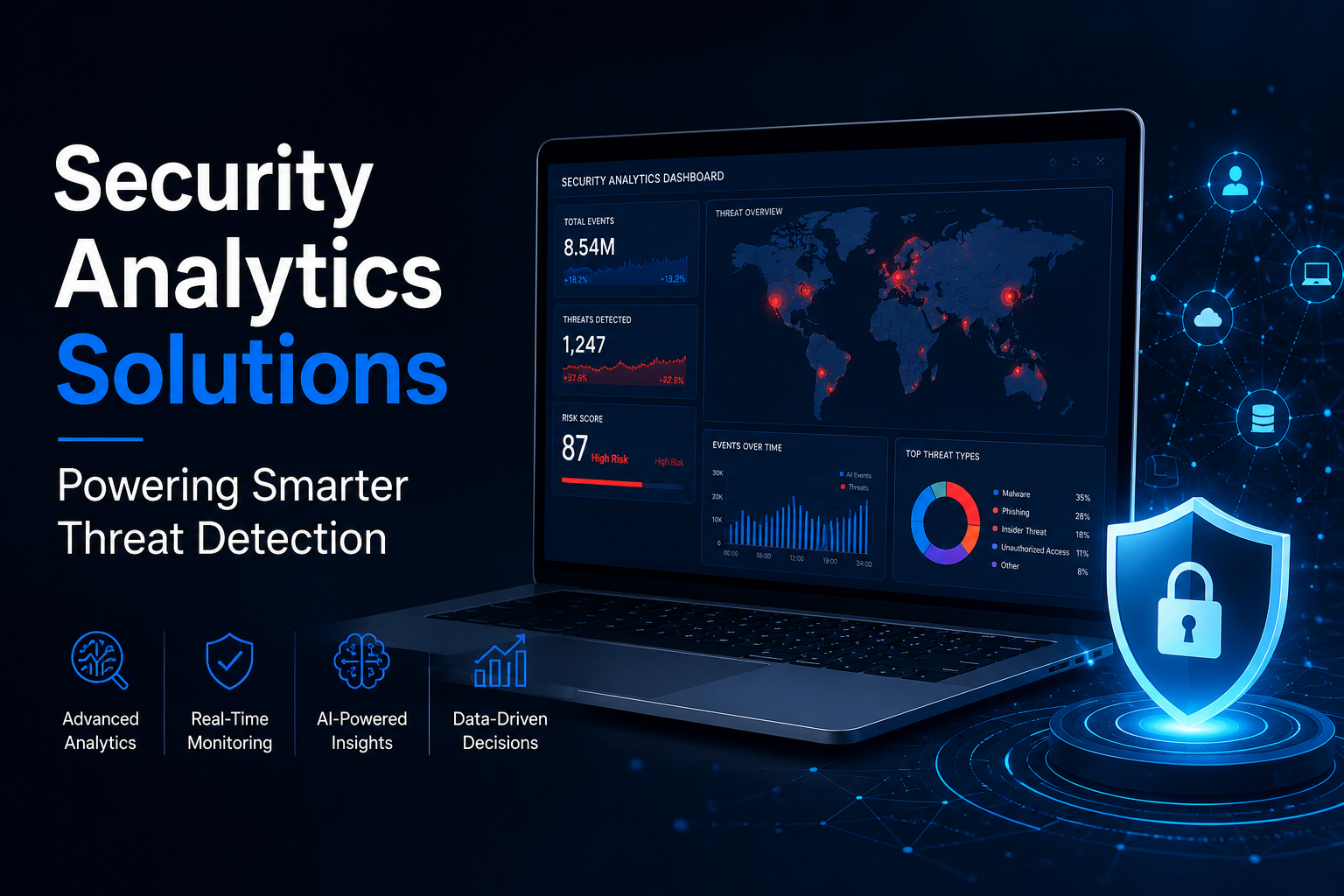
The speed of cyber-attacks is increasing and rapidly getting out of control. The average time for an eCrime breakout in 2025 was down to 29 minutes, up 65% from 2024. AI-enabled attackers accounted for 89% more attacks than in previous years, and 82% of detections came from non-virus based malware; traditional signature detections did not detect these attacks. With statistics like these, it’s easy to see why security analytics solutions have become vital today for the ability to detect modern threats.
Key Points
- Security analytics uses AI, machine learning, and behavioral analysis to detect advanced cyber threats that traditional signature-based security tools often miss.
- Organizations using security analytics can reduce breach detection time from an average of 207 days to about 48 days, enabling much faster incident response.
- Modern security analytics correlates data from networks, endpoints, cloud environments, applications, and user activity to provide complete threat visibility.
- AI-powered analytics reduces false positives by more than 60% and improves anomaly detection accuracy by over 30%, helping security teams focus on real threats.
- With AI-driven attacks becoming more sophisticated and Zero Trust adoption increasing, security analytics has become a critical component of modern cybersecurity strategies.
Security analytics utilize AI, ML (Machine Learning), and large amounts of data to detect abnormal behaviour in order to prevent damage from occurring. According to Data Intelo, the total value of the global market for security analytics is projected to be $22.4 billion in 2025 and increase to $68.9 billion in 2034, with a continuous strong growth rate (CAGR) of 13.3% between the years of 2026 and 2034. More than 70% of all businesses will have adopted their Zero Trust architecture by 2026, which has security analytics as a core component of their solution.
The Security Landscape Requires Increased Speed of Detection
The clock is running quickly for attackers and defenders alike. To date, security teams have been able to find a breach in approximately 207 days (according to their own internal processes). Security analytics allows this time frame to be reduced to about 48 days, a reduction of over 77%. By utilizing AI-powered identity systems such as Okta, your average time to identify a breach is reduced by up to ninety-five percent when you compare detection times from both methods.
Although this will help tremendously with your ability to detect breaches faster, it is still an extremely difficult challenge. In 2025, FortiGuard Labs reported close to 122 billion breach attempts globally; other platforms report close to 800 billion attempted security events per day and 7.2 trillion thwarted attacks annually. Without the aid of analytics tools, security operations centers (SOCs) would be overwhelmed with alerts.
AI-powered analytics reduces false positives by 60%+ while improving anomaly detection accuracy by 30%+. This translates to analysts spending less time on wasted alerts and more time investigating real threats. Cloud-based threat intelligence sharing cuts average detection-to-response time by more than 40% in simulated multi-enterprise environments.
How Security Analytics Works
Data sources such as network traffic, system log files, user behavior, endpoint activity and cloud environment data connect together through Modern Security Analytic tools providing a holistic view of an organization’s IT & Security systems, something that previous security systems & tools could not provide.
Key technologies powering security analytics include:
| Technology | Role in Threat Detection |
| SIEM | Collects and analyzes security data from various sources |
| UEBA | Identifies user and entity behavior anomalies |
| XDR | Correlates threats across endpoints, network, and cloud |
| Machine Learning | Trains on normal behavior to spot deviations |
| AI Agents | Handle 24/7 monitoring and automated incident response |
By using Big Data Analytics, and machine learning (AI) organisations can continuously analyse and learn from vast amounts of both unstructured and structured data thereby improving their ability to identify new type of threats that are emerging. Predictive Analytics allows for an organisation to take proactive steps (i.e….g. strengthening its security controls) prior to actually being attacked.
Real Impact Across Industries
Security analytics are not just theoretical, they produce real quantifiable results; organizations deploying AI-powered identity analytics achieved mean times for detecting identity compromises of days reduced to minutes, and in some cases seconds. Teams have access to automated threat intelligence that allows them to detect threats 48% faster than before while reducing the number of false positives by as much as 55%.
The adoption of industries will be influenced by how they assess their level of risk:
- Financial Institutions take an average of 233 days to identify and mitigate security breaches. When incorporating analytics, this timescale is much more shortened.
- The average cost of a breach in healthcare over the period from 2022-2024 is $9.77 Million. Analytics focus on detecting ransomware before a hospital’s system is completely locked down.
- The majority (94%) of large enterprises have a multi-cloud environment, requiring analytics in order to maintain visibility across all cloud-based services.
According to research, companies that are using a continual threat exposure management are three times less likely to experience breaches compared to other organizations.
Obstacles and Future Considerations
While the advantages of AI are evident, companies are still experiencing issues. As of now, one of the main issues is how difficult it is to integrate different types of information in order to build security programs within organizations. Additionally, the total cost of ownership and a lack of available cybersecurity professionals have been two major barriers to implementation. This talent shortage has placed a strain on the largest companies in the world, as they struggle to fill critical analyst positions.
In 2026, AI will be changing both the offensive and defensive sides of the cybersecurity equation. Attackers will use AI to conduct faster, broader and more effective attacks, while defenders will utilize AI agents to enhance their security operations. In addition, these technologies will present new challenges that include the risk of “Shadow Agents”, or unauthorized AI tools gaining access to corporate information.
API security is converging with AI security as attackers use AI agents to probe APIs for weaknesses invisible to human eyes. According to Wallarm, 97% of all API attacks can be accomplished with only one request.
Conclusion
Security analytics solutions are no longer a luxury – they’re a necessity for your company. Organizations can reduce the time it takes to identify a threat (207 days to 48 days), greatly decrease the number of false positives (60%), and increase how accurately they identify anomalies (30%) by using analytics instead of signatures.
As artificial intelligence progresses, enabling faster and more frequent cyberattacks against organizations, organizations that use AI-powered data analysis tools will enhance their capability to quickly respond to cyber incidents. Organizations adopting a zero trust security framework typically regard security analytics as an important part of their overall cybersecurity strategy.
FAQs
What sets security analytics apart from conventional security solutions?
Traditional methods depend on the use of known threat signatures to identify security events and attacks; however, they fail to identify 60% of the contemporary threat spectrum. In contrast, security analytics adopt an analytical approach (e.g., machine learning, behavioral analysis) to identify anomalies and unknown attack types.
In terms of attack detection type, what does security analytics detect?
Security analytics will identify zero-day exploits (detection rates of 15% without security analytics); advanced persistent threats (detection rates of 25%); and insider threats (detection rates of 35%).
How does security analytics detect threats faster than traditional systems?
Security analytics enable organizations to detect threats at a rate that is 47% faster than they would using traditional methods.
Which data sources will security analytics analyze?
Security analytics utilize a variety of data sources, including data from network devices, endpoints, cloud services, and applications, to collect and correlate.
Is AI going to be necessary for Security & Analysis by 2026?
Definitely! The vast majority of all security tools will include AI (Artificial Intelligence), and since 2026, AI has significantly altered the way organisations plan their security strategy and assess their risk management.
Reference: https://dataintelo.com/report/security-analytics-market