
ScamInfo.ai Research: 38% of Domains Carry High or Critical Risk Ratings

Share
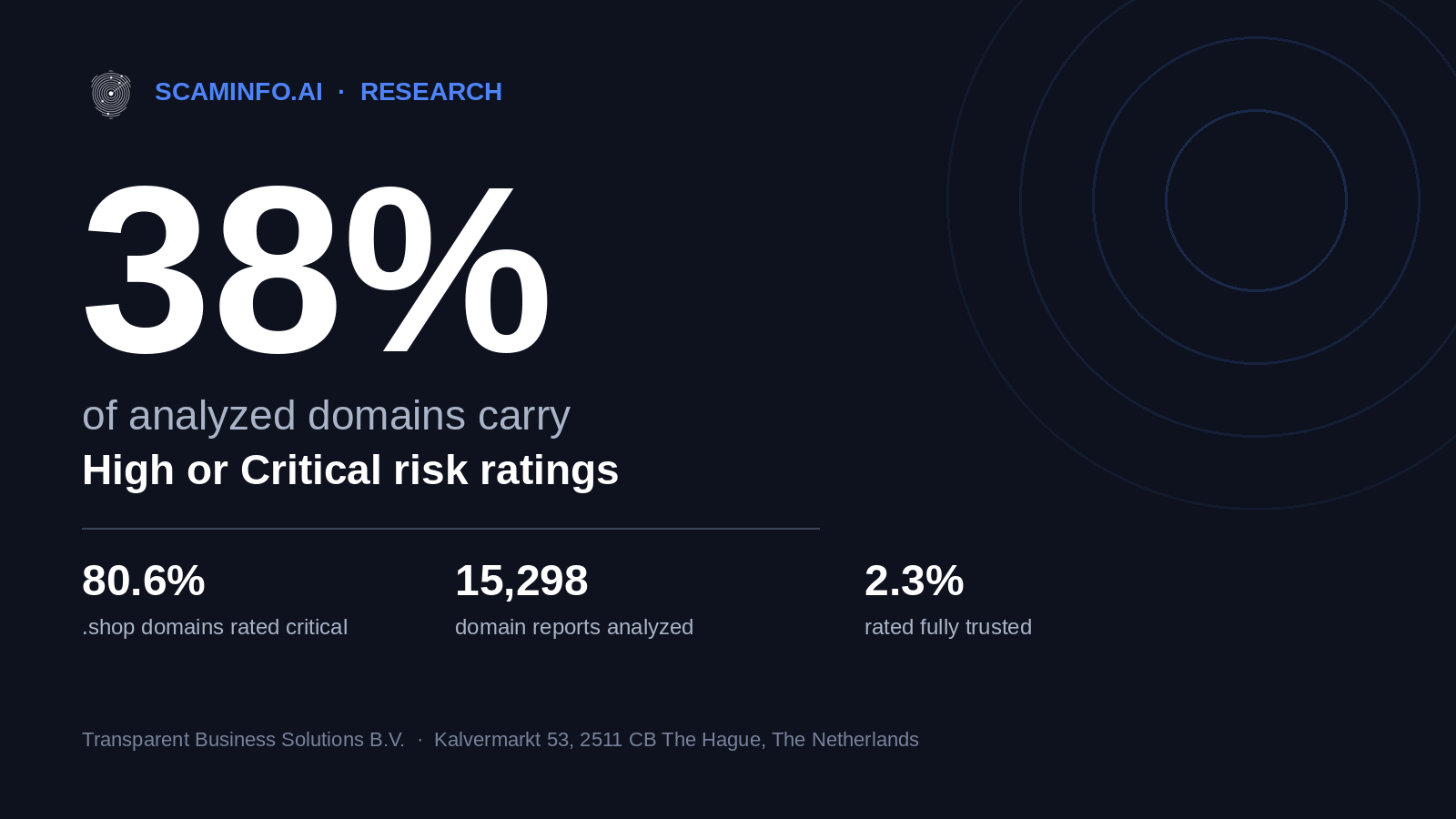
ScamInfo.ai, the domain reputation and scam detection platform, today published new research finding that 38% of domains analyzed on its platform carry a high or critical risk rating. The report also identifies specific domain extensions and site categories that carry disproportionate risk, including a substantially higher rate of critical ratings for .shop, .online, and other newer top-level domains compared to .com.
The findings are based on 15,298 domain risk reports generated by ScamInfo.ai between March 13 and July 1, 2026, covering categories that range from gambling and cryptocurrency to e-commerce and financial services.
Key findings
- 1%of domains analyzed were rated high or critical risk, the platform’s top two danger tiers, while only 2.3% earned a “trusted” rating
- Certain domain extensions carried substantially higher risk than others: .shop domains were rated critical 6%of the time overall, compared to 27.2% for .com domains; restricted to domains still live today, .shop sites were still 7 times more likely to be rated critical than live .com sites
- Among live, categorized domains, trading platforms carried a higher average risk score than gambling and betting sites, the category ScamInfo.ai’s prior research had identified as highest-risk
- Parked domains, pages with no visible content, were rated critical roughly 10 times more often than live e-commerce sites, indicating that dormant-looking domains are not inherently low risk
Which domain extensions carry the most risk
The report breaks down critical-risk rates by top-level domain, limited to extensions with at least 30 domains in the dataset:
| Extension | Domains analyzed | Critical-risk rate |
| .shop | 108 | 80.6% |
| .top | 37 | 67.6% |
| .store | 34 | 61.8% |
| .online | 382 | 60.5% |
| .site | 44 | 59.1% |
| .vip | 43 | 55.8% |
| .club | 55 | 50.9% |
| .com | 10,283 | 27.2% |
The pattern holds even when the comparison is limited to domains still online and active today, where .shop domains carry a critical-risk rate of 16.0% against 2.3% for .com, a 7x difference. The report notes that these newer, lower-cost extensions are easier to register in bulk and carry none of the accumulated reputational history of an established .com domain, and that gambling and adult content operators are disproportionately represented among sites using them.
Investment platforms outrank gambling sites for risk
Among live, categorized domains, the report finds that sites categorized as trading or investment platforms carry a higher average risk score than gambling and betting sites, a category ScamInfo.ai’s earlier research had identified as one of the internet’s highest-risk:
| Category | Domains analyzed (live) | Avg. risk score (0-100) | Critical-risk rate |
| Trading platforms | 87 | 37.4 | 12.6% |
| Gambling & betting | 610 | 36.2 | 7.0% |
| Cryptocurrency (general) | 44 | 31.2 | 13.6% |
| Cryptocurrency exchanges | 28 | 20.3 | 3.6% |
| Adult content | 1,571 | 19.3 | 1.0% |
| E-commerce | 1,707 | 16.9 | 0.3% |
The report also finds that informally categorized “cryptocurrency” sites, such as presale pages and unregistered investment pitches, carry nearly four times the critical-risk rate of dedicated cryptocurrency exchanges, suggesting the exchanges themselves are the comparatively safer segment of the crypto sector. Separately, adult content sites, often assumed to be high-risk, showed one of the lowest average risk scores of any category measured, below e-commerce in several risk bands.
“The takeaway isn’t that one industry is dangerous and another is safe,” said Julia Blokhina, COO of Transparent Business Solutions B.V. “It’s that risk is far more specific and far more measurable than people think, and that’s precisely the gap ScamInfo.ai is designed to close.”
ScamInfo.ai plans to publish this analysis on a regular basis as an ongoing Web Risk Index, allowing the platform to track whether these patterns persist over time.
About ScamInfo.ai
ScamInfo.ai is a domain reputation and scam detection platform operated by Transparent Business Solutions B.V., The Hague, Netherlands. The platform provides free domain risk reports powered by SSL certificate analysis, WHOIS data, threat intelligence data, and AI-powered content analysis, scoring domains on a 0-100 scale across five risk levels: Trusted, Low, Medium, High, and Critical.
Full report: https://scaminfo.ai/knowledge/38-percent-checked-websites-carry-high-riskSource: Scaminfo.ai
Frequently Asked Questions
What percentage of domains analyzed by ScamInfo.ai carry a high or critical risk rating?
38.1% of the 15,298 domains analyzed between March 13 and July 1, 2026 were rated high or critical risk, the platform’s top two danger tiers, while only 2.3% earned a “trusted” rating.
Which domain extensions carry the highest risk?
Newer, lower-cost extensions carry substantially higher risk than .com. “.shop” domains were rated critical 80.6% of the time overall, compared to 27.2% for .com. Even limited to domains still live today, .shop sites remain roughly 7 times more likely to be rated critical than live .com sites.
Are gambling and betting sites still the riskiest category?
No. Among live, categorized domains, trading and investment platforms carried a higher average risk score (37.4) and critical-risk rate (12.6%) than gambling and betting sites (36.2 average score, 7.0% critical-risk rate), which ScamInfo.ai’s earlier research had identified as the highest-risk category.
Are parked or inactive-looking domains safe?
Not necessarily. Parked domains, pages with no visible content, were rated critical roughly 10 times more often than live e-commerce sites, indicating that a dormant appearance does not correlate with lower risk.
What is the ScamInfo.ai Web Risk Index?
It is an ongoing research series ScamInfo.ai plans to publish on a regular basis, tracking domain risk patterns over time across extensions, categories, and risk tiers using data generated by its free domain risk-scoring platform.
What data was this research based on?
The findings are based on 15,298 domain risk reports generated by ScamInfo.ai between March 13 and July 1, 2026, covering categories ranging from gambling and cryptocurrency to e-commerce and financial services.