
Russia Cyber Weapons From Ukraine War Are Now Spreading Globally

Share
When Russia launched its full-scale invasion of Ukraine in February 2022, the conflict quickly expanded beyond traditional military operations. Alongside tanks and missiles, cyber warfare emerged as a parallel battlefield where digital attacks targeted communication systems, government networks, and critical infrastructure.
Ukraine soon became one of the most heavily targeted countries in the world in terms of cyber activity. Government agencies, telecom providers, energy infrastructure operators, and defense organizations faced continuous attempts at disruption and espionage. These attacks were not isolated incidents carried out by independent hackers. Instead, they were part of coordinated campaigns designed to weaken Ukraine’s operational capabilities and gather strategic intelligence.
Several cybersecurity reports illustrate the scale of the digital conflict. Ukraine’s State Service for Special Communications reported 4,315 cyber incidents in 2024, representing a nearly 70 percent increase compared to the previous year. Researchers have also documented more than 650 cyber operations carried out by pro-Russian threat actors against Ukrainian organizations since the invasion began.
These numbers demonstrate that the war is being fought not only on the battlefield but also through persistent cyber operations targeting national infrastructure.
TL;DR
Cyber tools developed during the Russia-Ukraine war are now appearing in broader global cyber campaigns. Techniques originally tested against Ukrainian infrastructure are being reused in espionage operations targeting diplomats, government officials, and organizations worldwide. The war has effectively become a testing ground for cyber warfare capabilities that may influence the global threat landscape for years to come.
Ukraine Cyber War by the Numbers
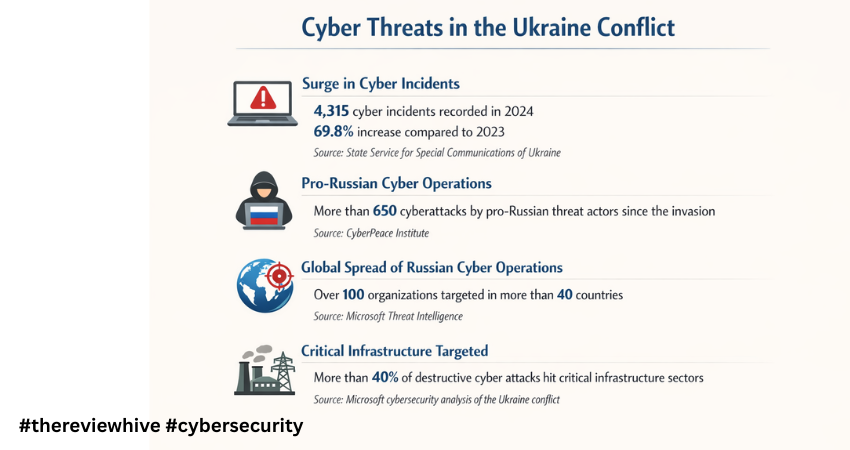
The cyber dimension of the Russia-Ukraine conflict has become one of the most intense digital battlegrounds in modern history. The following statistics highlight the scale of cyber operations connected to the war.
| Cyber Warfare Indicator | Key Data |
| Cyber incidents recorded in Ukraine | 4,315 incidents in 2024 |
| Increase in cyber-attacks | Nearly 70% increase from 2023 |
| Cyber-attacks linked to pro-Russian actors | 650+ documented attacks since 2022 |
| Countries affected by Russian cyber campaigns | 40+ countries |
| Organizations targeted globally | 100+ organizations |
| Infrastructure attacks | 40%+ targeted critical infrastructure sectors |
Sources:
State Service for Special Communications and Information Protection of Ukraine, CyberPeace Institute, Microsoft Threat Intelligence
Russian Threat Groups Linked to Cyber Operations
Several Russian state-linked cyber groups have been associated with operations connected to the Ukraine conflict. These groups have a long history of conducting espionage campaigns against governments, defense organizations, and strategic industries.
One of the most widely known groups is APT28, also called Fancy Bear. This group is commonly linked to Russian military intelligence and has conducted numerous cyber espionage campaigns targeting political institutions, government networks, and defense organizations across Europe and North America.
Another group frequently mentioned in cybersecurity investigations is APT29, also known as Cozy Bear. This group specializes in stealthy intelligence-gathering operations and has targeted diplomatic organizations, research institutions, and government departments. Their operations are often designed to remain undetected for extended periods while collecting sensitive information.
The Sandworm group has been responsible for some of the most aggressive cyber operations attributed to Russia. Security researchers have linked Sandworm to attacks targeting Ukraine’s energy infrastructure and destructive malware campaigns that disrupt civilian systems.
Another active group, Gamaredon, frequently targets Ukrainian government institutions through phishing campaigns and malware designed to steal sensitive documents and communications.
Major Cyberattacks That Shaped the Conflict
The cyber dimension of the Ukraine war has produced several incidents that demonstrate how digital attacks can support broader military objectives.
One of the earliest examples occurred in February 2022 when a cyberattack targeted the Viasat satellite communications network. The attack disrupted satellite internet connectivity used by Ukrainian military communications during the opening phase of the invasion. Thousands of satellite modems across Europe were also affected, showing how cyber operations tied to a regional conflict can quickly impact other countries.
Another significant cyber incident involved WhisperGate malware, which targeted Ukrainian government systems shortly before the invasion began. Although the malware appeared to resemble ransomware, its true purpose was destructive. Instead of encrypting data for ransom, WhisperGate wiped files and damaged systems, making recovery extremely difficult.
A third example involved Industroyer2 malware, which was designed to manipulate industrial control systems used in electricity distribution networks. The attack attempted to disrupt Ukraine’s power grid and could have caused major outages affecting civilian infrastructure if it had succeeded.
These incidents illustrate how cyber operations can directly support military strategy by targeting communication networks and infrastructure systems.
Messaging Platforms Have Become Strategic Targets
More recently, intelligence agencies have warned that Russian cyber operators are attempting to compromise secure messaging platforms used by diplomats, government officials, and military personnel.
Applications such as Signal and WhatsApp are widely used by policymakers because they provide encrypted communication channels. However, attackers often focus on compromising individual user accounts rather than breaking the encryption itself.
If attackers gain access to a messaging account, they may be able to monitor conversations, identify additional targets, and gather valuable intelligence. These communications can include diplomatic discussions, military coordination, and internal policy decisions.
By targeting messaging platforms, attackers gain insight into the communication channels where important strategic decisions are made.
From Battlefield Testing to Global Cyber Campaigns
Cybersecurity researchers often describe war zones as environments where cyber capabilities can be developed and refined under real operational conditions. The Ukraine conflict has provided several years of continuous cyber operations, creating a testing ground for new attack techniques.
Russian cyber units have been able to experiment with malware, phishing strategies, credential-theft techniques, and network intrusion tools against real government and infrastructure systems. When these tools prove effective, they are often reused in new campaigns.
Microsoft’s threat intelligence teams have observed Russian cyber campaigns targeting more than 100 organizations across over 40 countries beyond Ukraine. This expansion shows that cyber capabilities developed during the war are increasingly appearing in global cyber operations.
Why These Cyber Weapons Spread Beyond the War
Cyber capabilities rarely remain limited to the conflict where they were originally developed. Once attackers identify techniques that work effectively, those techniques are often reused in other campaigns.
In some cases, malware frameworks and attack strategies are reused by the same threat groups in different geopolitical operations. In other cases, cyber tools may leak or be copied by other attackers. Criminal organizations and hacktivist communities sometimes adopt techniques that were initially developed by state-sponsored actors.
Underground cybercrime marketplaces also contribute to this spread. Malware frameworks, stolen credentials, and exploitation techniques are often shared or sold in these communities. As a result, cyber weapons that were originally developed for espionage or warfare may eventually reach a much wider range of attackers.
Why Businesses Should Pay Attention
Although many of these cyber operations are associated with geopolitical conflict, the techniques used in such campaigns can easily affect private organizations as well.
Businesses rely on the same communication platforms, cloud infrastructure, and software services used by governments. If attackers successfully compromise these systems, the impact may extend beyond government institutions.
Industries such as telecommunications, finance, logistics, energy infrastructure, and technology providers may face increased risks because they play important roles in national and global supply chains.
This means that organizations located far from the conflict zone should still monitor how geopolitical cyber operations influence the broader cybersecurity threat environment.
Lessons for Cybersecurity Teams
The Ukraine war offers several important lessons for cybersecurity professionals responsible for protecting digital infrastructure.
First, geopolitical conflicts increasingly shape the global cyber threat landscape. Security teams must monitor not only technical vulnerabilities but also international developments that may trigger cyber campaigns.
Second, strong identity security has become critical. Many cyber operations rely on compromised credentials rather than sophisticated malware. Multi-factor authentication and strong access controls can significantly reduce the risk of unauthorized access.
Third, organizations should invest in employee awareness training and continuous monitoring. Phishing campaigns and social engineering attacks remain some of the most common entry points for cyber intrusions.
The Future of Cyber Warfare
The war in Ukraine has demonstrated that cyber warfare is no longer a secondary element of modern conflict. Instead, it has become a central component of national security strategies.
Cyber operations can disrupt communications, gather intelligence, influence public perception, and weaken infrastructure without traditional military engagement. As the conflict continues, the tools and techniques developed in this environment are likely to shape global cyber threats for years to come.
What began as a regional cyber battlefield is gradually influencing the global cybersecurity ecosystem.
To Sum Up
Cyber operations during the Russia-Ukraine war have accelerated the development of new digital attack capabilities. Techniques originally created for the battlefield are now appearing in global cyber campaigns. As these cyber weapons spread, governments and organizations must prepare for a more complex cybersecurity environment shaped by geopolitical conflict.
FAQs
What are cyber weapons in modern warfare?
Cyber weapons are digital tools designed to infiltrate, disrupt, or damage computer networks and infrastructure systems.
Why is the Ukraine war considered a major cyber battlefield?
The conflict involves cyber attacks targeting government networks, infrastructure systems, and communication platforms alongside military operations.
Which Russian hacker groups are linked to cyber attacks in the Ukraine war?
APT28, APT29, Sandworm, and Gamaredon are among the groups frequently linked to cyber campaigns related to the conflict.
Can cyber weapons developed during war affect other countries?
Yes. Once cyber tools are developed and tested successfully, they may be reused in campaigns targeting organizations and governments worldwide.
How can organizations protect themselves from these threats?
Organizations should implement multi-factor authentication, monitor suspicious login activity, train employees about phishing risks, and maintain strong cybersecurity monitoring systems.