IBM X-Force 2025: Manufacturing Tops Cyberattack Targets for Fourth Year

Share
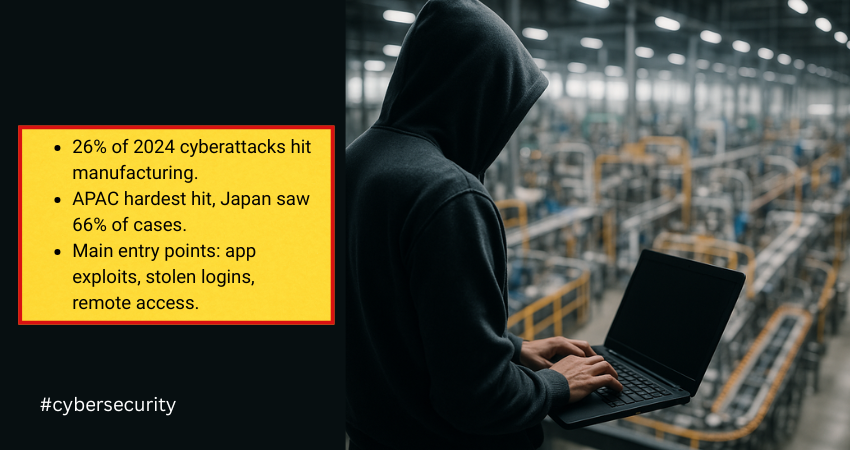
Manufacturing cyberattacks 2025 data from the IBM X-Force Threat Intelligence Index reveals a troubling trend — the manufacturing sector has once again topped the list of targeted industries. In 2024, it accounted for 26% of all cyber incidents investigated by IBM’s security teams. This marks the fourth consecutive year manufacturing has held this position, driven by attackers seeking high-value intellectual property, exploiting legacy systems, and leveraging global supply chain vulnerabilities.
This isn’t just about stolen data or temporary disruptions — attackers are hitting manufacturing because the stakes are higher than ever. The sector’s deep integration into global supply chains, dependence on legacy systems, and troves of intellectual property make it an irresistible target for both financially motivated criminals and state-sponsored actors.
Key Takeaways
- Manufacturing faced 26% of all cyberattacks in 2024, leading the rankings for the fourth year.
- APAC saw the highest concentration, with 40% of manufacturing attacks occurring there.
- Public-facing application exploits, stolen credentials, and unsecured remote services are the top entry points.
- Identity-based attacks and infostealer malware are rising in prevalence.
- Extortion, data theft, and credential harvesting are the most common impacts.
- Zero Trust, rapid patching, and robust identity protections are critical defense measures.
Why Manufacturing Remains a Prime Target
The IBM X-Force 2025 report shows manufacturing’s continued top spot in the cyberattack rankings is no accident. Several interconnected factors make the industry uniquely vulnerable and highly rewarding for threat actors.
1. High-Value Intellectual Property
Manufacturing organizations often hold proprietary designs, formulas, blueprints, and production processes worth millions. These assets can be stolen and sold on the dark web, leaked to competitors, or used by nation-state actors to gain strategic advantage. For example, automotive manufacturers’ CAD files or pharmaceutical production formulas are prime targets because they can be reverse-engineered to undercut market competition. Unlike stolen personal data, which loses value quickly, intellectual property retains its worth for years.
2. Potential for Operational Disruption
Few industries feel the impact of downtime as severely as manufacturing. A single day of halted production can cost millions, delay orders, and damage relationships with suppliers and customers. Attackers know this and leverage it in extortion scenarios — ransomware campaigns against manufacturers often demand higher payouts because the pressure to restore operations is intense. Disruption also affects broader supply chains, amplifying the impact beyond the initial victim.
3. Reliance on Legacy Technology
Many manufacturing plants still run industrial control systems (ICS) and operational technology (OT) that are decades old. These systems often lack modern security features, receive infrequent patching, and can’t easily be taken offline for updates without halting production. Attackers exploit these gaps using known vulnerabilities or by targeting outdated protocols that were never designed with cybersecurity in mind. The result is a broader attack surface that’s difficult to defend.
4. Interconnected and Global Supply Chains
Modern manufacturing is a web of suppliers, logistics providers, and distributors. This interconnectivity creates multiple entry points for attackers — breaching one smaller vendor can provide access to a much larger target. The Salt Typhoon campaign highlighted in IBM’s report is a perfect example: by compromising multiple points in the supply chain, attackers were able to affect critical infrastructure, transportation, and energy sectors. The “what happens to my partners happens to me” reality makes manufacturing particularly vulnerable to indirect attacks.
How Attackers Are Getting In
Attackers targeting manufacturing are no longer relying solely on brute-force hacking. Instead, they’re adopting stealthy and persistent methods that blend into normal network activity. The IBM X-Force 2025 report shows the following trends and techniques:
1. Exploitation of Public-Facing Applications (29%)
Internet-facing applications — from outdated ERP(Enterprising Resource Planning) platforms to exposed APIs — are prime targets. Attackers use automated scanning tools to find vulnerabilities and then exploit them to gain an initial foothold. Once inside, they often:
- Conduct post-compromise scanning to identify other vulnerable assets.
- Escalate privileges to access critical systems like production control servers.
- Move laterally into operational technology (OT) networks.
Example: CVE-2024-21762 in Fortinet FortiOS was heavily discussed on dark web forums and actively exploited within weeks of disclosure.
2. Valid Account Credentials (21%)
The mantra “hackers don’t break in — they log in” is more relevant than ever. Stolen credentials are purchased in bulk from dark web markets or harvested via infostealer malware. Attackers bypass traditional perimeter defenses by:
- Using adversary-in-the-middle (AITM) phishing kits to capture MFA codes.
- Leveraging previously stolen credentials to access cloud-hosted manufacturing applications.
- Exploiting weak or shared passwords across systems.
IBM notes that access-as-a-service markets are thriving, making it easy for even low-skilled attackers to buy valid logins.
3. External Remote Services (21%)
Remote access tools such as RDP, VPNs, and industrial maintenance portals are common in manufacturing — but they’re also a gift to attackers when poorly secured. Common flaws include:
- Outdated VPN firmware with known exploits.
- No multi-factor authentication for remote logins.
- Misconfigured cloud services used for remote monitoring.
4. Phishing as a Shadow Vector (25% of incidents)
While phishing’s success rate is lower than it was two years ago, it’s still a major gateway for manufacturing breaches. Attackers increasingly:
- Deliver infostealer malware like AgentTesla, RisePro, or Lumma Stealer via phishing emails.
- Use PDF attachments with obfuscated malicious URLs to bypass email filters.
- Abuse cloud hosting services (Microsoft Azure Blob Storage, secureserver.net) to deliver trusted-looking phishing links.
5. Supply Chain Compromise
Instead of attacking a manufacturer directly, threat actors target its suppliers or service providers. Once the weaker link is compromised, attackers use trusted access to pivot into the primary target’s environment
6. SEO Poisoning and Malvertising
Some attackers lure manufacturing employees into downloading trojanized software updates by:
- Manipulating search engine rankings to promote malicious websites.
- Running malicious Google or Bing ads for fake versions of popular tools like AnyDesk, Notepad++, or Adobe Reader.
The Shift:
IBM’s analysis shows a growing focus on identity exploitation over traditional malware persistence. Valid accounts allow attackers to “live off the land,” using built-in tools and avoiding detection for weeks or months before launching an attack.
APAC: The Epicenter of Manufacturing Cyberattacks
In 2024, the Asia-Pacific (APAC) region emerged as the most targeted globally, accounting for 34% of all cyber incidents investigated by IBM X-Force. Manufacturing bore the brunt, representing 40% of these attacks within APAC.
Several factors make APAC a hot zone for manufacturing-focused cyber threats:
- Global supply chain role – APAC hosts many of the world’s largest manufacturing hubs.
- High digitalization – Smart factories, IoT devices, and connected machinery expand attack surfaces.
- Varied security maturity – Some nations have advanced defenses, others remain easier targets.
Top Initial Access Methods in APAC Manufacturing Attacks
- External Remote Services (45%) – Heavy reliance on remote monitoring and maintenance systems.
- Exploitation of Public-Facing Applications (18%) – Direct access via unpatched systems.
- Valid Account Credentials – Often sourced from phishing or malware campaigns.
Most Common Attack Goals
- Data Theft (12%) – Intellectual property, design files, and trade secrets.
- Credential Harvesting (10%) – Resold or reused in follow-on attacks.
- Extortion (10%) – Pressure to restore operations or prevent data leaks.
Japan experienced the highest attack volume at 66% of APAC incidents, followed by the Philippines, Indonesia, Korea, and Thailand.
What’s at Stake
The consequences for manufacturing companies are severe:
- Extortion (29%) – Payment demands to avoid leaks or restore systems.
- Data theft (24%) – Stolen IP and customer data sold or misused.
- Credential harvesting (18%) – Fuels future intrusions.
- Brand reputation damage (12%) – Loss of trust and contracts.
Emerging Tactics Against Manufacturing
While ransomware is still a major threat, attackers are increasingly using identity-based intrusions. Logging in with stolen credentials allows them to blend in with legitimate activity, making detection harder.
At the same time, infostealer malware is surging, spread through phishing, SEO poisoning, and trojanized installers. These tools silently collect passwords, financial data, and system details for later exploitation.
Defensive Strategies for 2025 and Beyond
- Prioritize patch management – Close vulnerabilities in exposed systems quickly.
- Adopt Zero Trust principles – Limit privileges, segment networks, and verify every connection.
- Secure remote access – Use MFA, passkeys, and continuous monitoring.
- Harden identity management – Track for compromised credentials and enforce strong password policies.
- Test incident response plans – Ensure readiness for fast containment and recovery.
- Share threat intelligence – Collaborate with peers and ISACs for early detection.
Frequently Asked Questions (FAQs)
- Why is manufacturing targeted more than other industries?
Because it holds valuable intellectual property, relies on legacy systems, and plays a central role in interconnected global supply chains. - What is the most common entry point for attackers?
Exploitation of public-facing applications and stolen credentials are tied for the top spot, each at 29–30% of cases globally. - Why is APAC a hotspot for manufacturing cyberattacks?
Its dominant role in global manufacturing, combined with varied cybersecurity maturity, makes it an attractive region for attackers. - Are ransomware attacks against manufacturing increasing or decreasing?
While ransomware incidents have declined overall, manufacturing remains one of the top sectors targeted by ransomware groups. - How can manufacturing companies defend against these threats?
Implement Zero Trust security, patch vulnerabilities quickly, secure remote access, and strengthen identity management. - What new tactics are attackers using to breach manufacturing systems?
Attackers are increasingly using infostealer malware, SEO poisoning, supply chain compromises, and MFA bypass techniques to gain initial access while avoiding detection.
To Sum Up
Manufacturing’s fourth straight year as the most targeted industry in IBM’s X-Force index underscores an urgent reality: cybercriminals see factories, production lines, and supply chains as high-value targets with weak spots worth exploiting.
The combination of outdated technology, interconnected networks, and valuable intellectual property creates an ideal environment for attacks.
For manufacturing leaders, cybersecurity can no longer be seen as a cost center — it’s a core part of operational resilience. Those who act now to strengthen defenses, share intelligence, and build incident-ready teams will be in the best position to protect both their operations and their place in the global market.