Driver Monitoring Systems Climb From $4.2B to $14.8B: Inside the 15.0% CAGR Surge

Share
The cameras watching drivers are becoming one of the auto industry’s fastest-growing safety technologies. They are also becoming one of its most sensitive data risks.
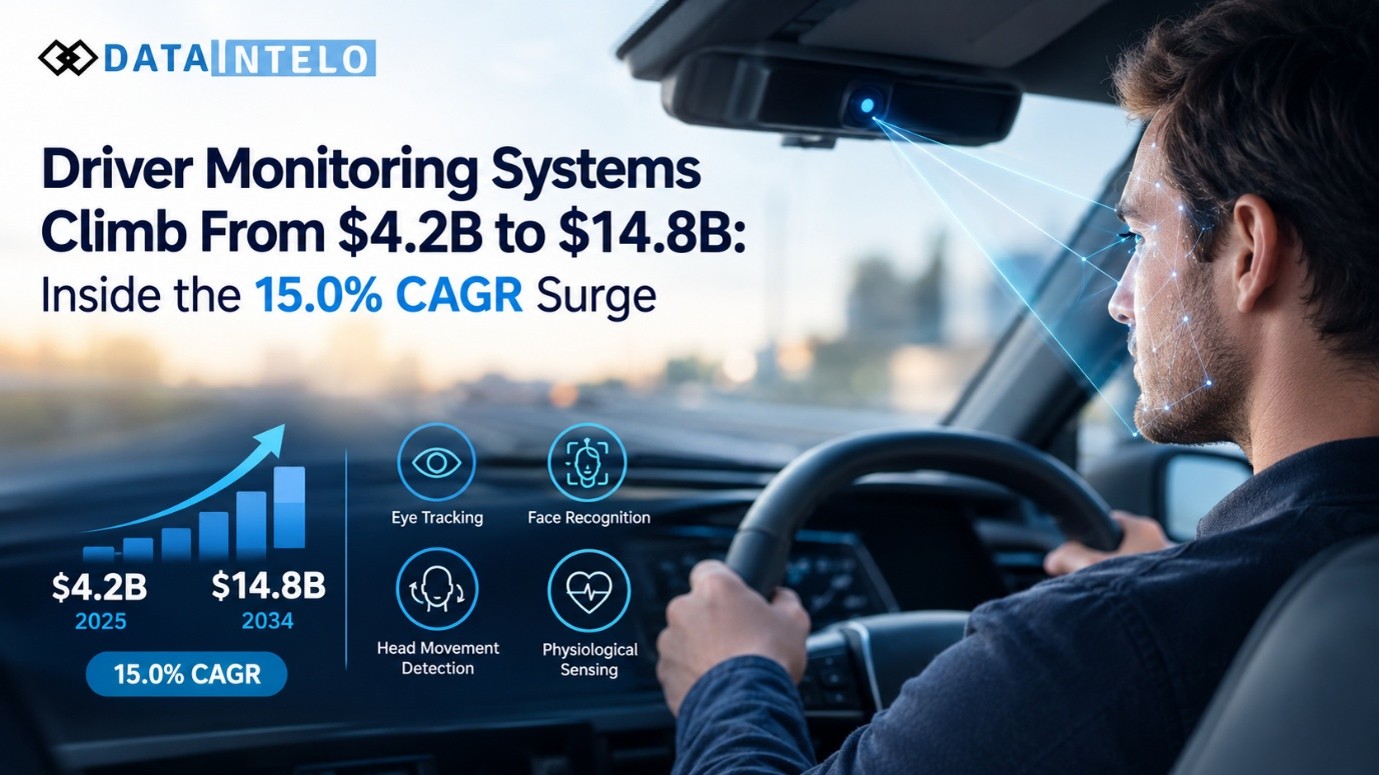
There are not many vehicle features that went from being optional to mandatory as fast as driver monitoring has done. There is a tiny infrared camera installed behind the steering wheel that will follow your gaze, measure blinks per minute, and track your head movements. According to Dataintelo’s estimates, the global driver monitoring systems (DMS) market stood at approximately $4.2 billion in 2025 and is expected to hit $14.8 billion by 2034, growing at a CAGR of 15.0%.
However, there are regulators, insurers, software vendors, and a whole new set of data collected by in-vehicle devices that needs to be regulated by cybersecurity specialists.
What is being measured
In order to measure whether the driver is awake, alert, and knows the person who is behind the wheel, DMS makes use of near-infrared cameras, eye tracking, face recognition, and physiological sensing. According to the report, 58.7% of revenues in 2025 will come from the camera-based systems, while growth will be fuelled by the sensor-based technologies (radar/steering wheel sensing at 16.8% CAGR).
In terms of components, hardware accounted for 52.4% of the revenue, while software represented 17.3% CAGR. This difference in revenue growth is significant, as it signals a change in the product nature as it shifts from components to algorithms and services.
Latest developments
Regulations did most of the work here. With the EU’s General Safety Regulation, drowsiness and attention warning systems have been mandatory in all newly registered passenger cars since July 2024, with advanced driver distraction warnings being mandatory in all newly registered passenger cars since July 2026. Euro NCAP is increasingly giving safety ratings on in-vehicle monitoring systems, pushing manufacturers to install them even if there is no regulatory requirement at that point.
The US is a laggard. US federal regulation ordered NHTSA to develop technology to prevent impaired driving, but rulemaking processes in the US are notoriously sluggish. This is a timing risk the report points out for suppliers who have planned their capacity expansion based on an optimistic timeline from the US.
China and India are driving volumes. The Asia Pacific region leads in 2025 by revenue of nearly $1.6 billion (roughly 37.8% of total market) and is expected to see the fastest regional growth, with 16.2% annually. China’s standards on intelligent connected vehicles and India’s safety rating system are seen as the reasons for early fitment.
Hands-free driving became a requirement for DMS systems. Such technologies as the Super Cruise from GM and the BlueCruise from Ford utilize eye tracking technology to ensure that the driver is still attentive. According to the report, there were roughly 58 million units of cars with automation at level 2 and above in 2025, and that figure is predicted to exceed 210 million by 2034.
Growth factors to follow
- Compliance demand. Legislation creates a demand floor independent of consumer excitement.
- Fleet economics. The study notes a payback period of 12 to 24 months for commercial fleets due to insurance discounts and fewer accidents. Given that, DMS will be adopted by fleets regardless of legislation.
- Lower costs of AI hardware. Car chips are able to process driver states while consuming little energy; at the same time, simple camera modules cost less than $12 each. This makes DMS available to mid-range cars.
- Beyond the driver scope. There is an occupant monitoring that includes child detection. It requires additional sensors and software per car. The total value opportunity is expected to be from $1.8 to $2.4 billion by 2030.
Case Studies: What Fleets are Saying
The article mentions that big American carriers such as J.B. Hunt, Werner Enterprises, and Knight-Swift have been able to reduce safety-critical events by over 40% in less than one year of using machine-based technology for fatigue monitoring. In addition, the article cites studies by the European Transport Safety Council that prove real-time interventions reduce drowsy driving accident risks by up to 45%.
Interpret vendor data cautiously. Such data normally comes from motivated fleets with solid coaching programs. However, this is consistent across the varied resources: Attention Monitoring, along with human intervention, is more successful than either separately.
The areas that boards need to cover without leaving behind: Data and Security
This is where the issue of DMS turns into a cybersecurity issue. The DMS camera collects facial image information and gaze information and, at times, heart rate information. Biometric information is a fact, and there are obligations on how to handle this under GDPR and California’s privacy law.
Four potential dangers exist:
- Biometric data leaks: If a password is compromised, then it can be changed, but one cannot change the face template.
- Secondary use of data: Telematics companies and insurers may try to reuse the driver state data. Without having a good contract in place, there is always a risk of getting involved in legal disputes and damaging one’s reputation.
- Spoofing: The images obtained by the camera can be faked through various means, including through over-the-air update channels.
- Bias: Some of the early devices were not very accurate with respect to particular skin types and facial features.
It should be pointed out that the right regulations are already in place. There is UN Regulation 155 and ISO/SAE 21434, which are concerned with cybersecurity management of the car and privacy-by-design guidelines, which are applied to in-car data. Moreover, there are certain suppliers that developed their devices considering this issue. For example, the 4D radar of Vayyar can detect presence and breathing without generating any images.
Experts’ views and a word about the outlook
The fact of the matter is that there is actually a true strategic divide in the business. While pure-play providers such as Seeing Machines and Smart Eye are competing on certified algorithms, semiconductor producers and ADAS platforms are incorporating DMS technology into compute stacks, potentially impacting the price for software-only solutions. Such a potential risk is also included in the report along with the supply chain concentration of infrared sensors and chips.
Do not forget that 15% CAGR over nine years is still a forecast. It will depend on the timing of regulations and the adoption of more than just the minimum-compliance solution by mid-range automakers.
What top executives need to do right now
- Automakers & component suppliers: treat DMS data governance as a design requirement. Decide on the data management process, the data outside the vehicle, and data retention period.
- Fleet managers: clarify data usage and data breach notification policy before entering into any telematics services agreement. Be upfront with your drivers to avoid union troubles.
- Security teams: incorporate in-cabin sensor systems and their updates into threat models and penetration testing.
- Investors: consider more than just volume of devices sold. Margins on software and privacy-friendly architectures will probably distinguish future winners from commoditized suppliers.
In conclusion
Driver monitoring systems will soon be mandatory, and the investments being poured into this area are paying off. The winning firms will be the ones that regard the driver’s face and behavior as private data from the very beginning. In an industry developing at such breakneck speed, security and privacy make up part of the offering.
Reference URL: https://dataintelo.com/report/driver-monitoring-systems-market