
Data Loss Prevention AI Trends Shaping Enterprise Cybersecurity in 2026

Share
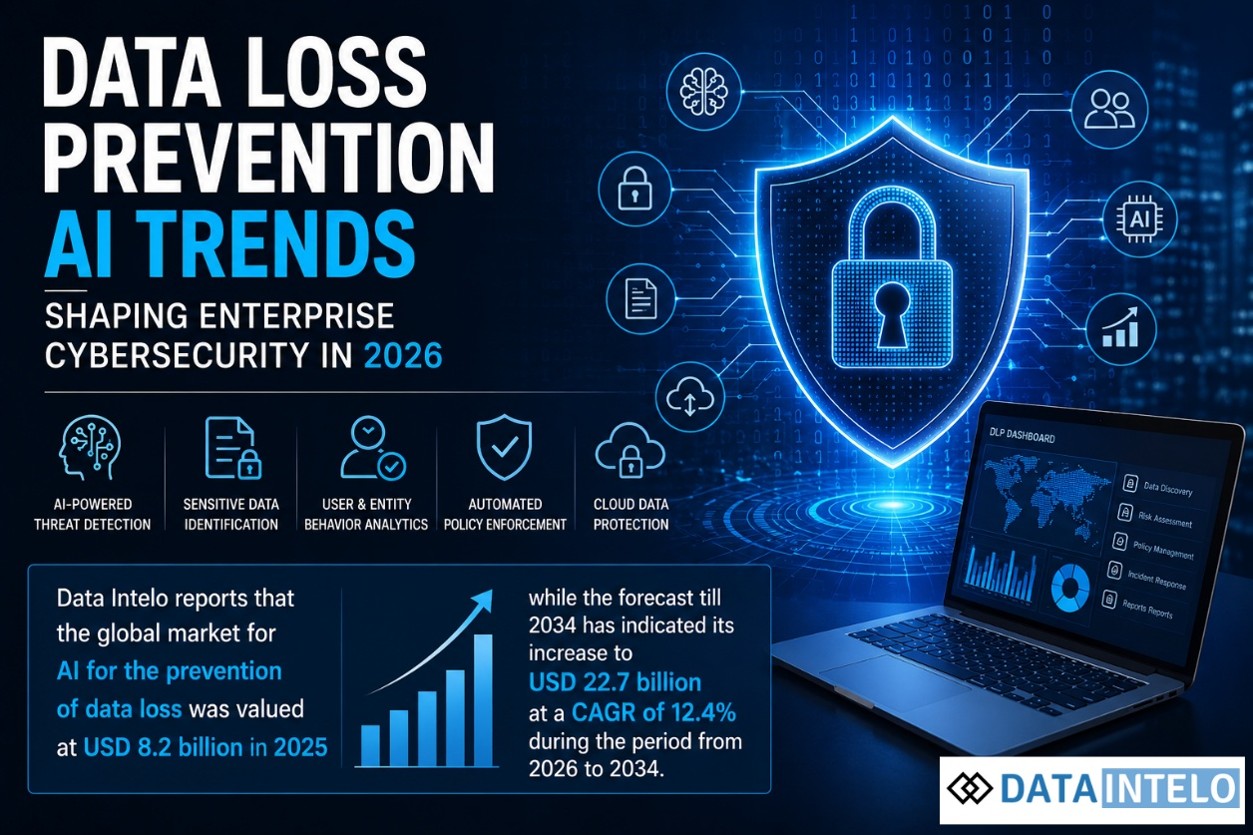
Data loss prevention (DLP) is now pivoting towards a more dynamic phase as organizations face challenges relating to the management of sensitive information at the endpoints, in the applications, on the cloud, and with artificial intelligence
By 2026, artificial intelligence will have emerged as the primary choice for detecting abnormal behavior, categorizing data and determining the seriousness of incidents, as evidenced by the 2025 cost of a data breach report published by IBM whose global average cost of a breach stands at $4.44 million, thus making data protection a priority for companies.
AI-Driven Categorization of Information
The rise of artificial intelligence is now improving the process of classifying information as enterprises deal with a surge in volumes of sensitive data. Data Intelo reports that the global market for AI for the prevention of data loss was valued at USD 8.2 billion in 2025 while the forecast till 2034 has indicated its increase to USD 22.7 billion at a CAGR of 12.4% during the period from 2026 to 2034.
The use of ai-based technologies allows for checking the content of documents, meta data, the activity of users, and the context of any business in order to make an appropriate decision regarding sensitive data.
Unlike the conventional methods of utilizing keywords, AI can differentiate between the different levels of sensitivity of the content within one document. This means that it can help decrease the volume of manual work required for classifying documents and improve the effectiveness of policies in the repositories of enterprises featuring millions of documents.
Behavioral Detection Takes the Place of Static Rules
Traditional data loss prevention rules tend to focus on whether a specific behavior meets a certain set of criteria. With AI infused solutions, another element comes to play: does the user behavior appear to be unusual? In contrast to conventional rules, behavioral analytics can use the reference points formed by thousands of calls.
For instance, a person that usually downloads 20 files daily suddenly makes an operation of transferring 2,000 files to an unknown location produces a significant anomaly. It is much easier for a dynamic model to rank a hundredfold increase than to comply with a static keyword rule. This behavior-based approach is becoming one of the most important aspects of identifying insider threats, hacked accounts, and unintentional leaked information.
Generative A.I. Presents New DLP Challenge
The increased use of generative AI has increased the chances of sensitive information leakage happening through its use. Employees may enter secret text into AI tools, send documents for summarization purposes, or alternatively copy responses into a third-party application. This means that DLP has to enhance its capabilities related to prompt analysis, encoding and generated data analysis.
A research conducted by 2025 has stated that 78% of companies have already used AI in their business processes. The DLP used by companies informed about the implementation of AI can check the content before it is sent and distinguish what content is safe and what contains sensitive data.
Context-Aware Policies Raise Accuracy
The trend of modern Data Loss Prevention (DLP) systems has shifted from simple content matching to context-aware making decisions. With the help of artificial intelligence, various factors such as data classification, user role, device state, destination, time, and user behavior can be combined into a risk score rather than the simple yes/no approach.
| DLP capability | Traditional approach | AI-enhanced approach |
| Classification | Keywords and labels | Content, context, metadata |
| Detection | Fixed rules | Behavioral anomalies |
| Risk assessment | Binary decisions | Dynamic risk scoring |
| AI applications | Limited visibility | Prompt and file inspection |
| Response | Manual review | Automated prioritization |
This is the point that needs to be emphasized in order to solve the problem of the alert fatigue issue with a certain security system which takes into account one million events, of which only 0.1% is worth further investigation. This gives it approximately 1,000 alerts.
The Growing Importance of Artificial Intelligence in Privacy and Security
An artificial intelligence-based data loss prevention system has the problem to strike a balance between monitoring security and ensuring information privacy. More and more organizations are being obliged to find new means to process confidential information without disclosing it. Such means involve masking and tokenization as well as access control methods.
The problem is particularly pressing in environments that are strictly regulated. Organizations such as security teams should outline the conditions under which the models will be used, kept, and examined in practice. Companies are thinking about this in 2026 as they review the question of how AI should work with sensitive data without exposing the necessary information.
The Way Forward: Automation and Human Input
Automation is fast emerging as a key element of data loss prevention. Some artificial intelligence systems are able to either make suggestions or execute actions such as quarantining files, restricting downloads, demanding authentication, or informing security personnel in case of any problematic event. However, complete automation might bring up some issues in case of erroneous interpretation of legitimate actions by models.
To ensure correct prevention of data loss it is very important to balance automation and decision-making of humans. There are actions, which present low risk, and can be automated. At the same time, rare transactions involved highly confidential data require human verification.
Trends to Monitor in 2026
- The reach of Multimodal DLP is now expanding to include other forms of media instead of just text, such as images, PDFs, source code, etc.
- With the introduction of AI in classification, the dependency on manually labored labeling has diminished significantly.
- Thanks to behavioral analytics, it is now much easier to identify abnormal patterns when accessing or transferring information.
- Generative AI governance is leading to the development of policies relating to DLP.
- The amount of automated responses has now significantly increased for simple low-risk cases.
Looking Ahead
The future of DLP in 2026 is dictated more by the “intelligence” aspect of DLP rather than the substitution of current methods. It is quite obvious that with the help of AI, the security forces would be able to analyze numerous events, detect trends, and tell usual activity from dangerous actions. However, the success of this approach still depends largely on the timely information, properly established rules, effective analysis of models, and people monitoring the situation.
In the light of the big amount of intel received and passed by businesses nowadays, DLP is becoming the intelligence-based approach to business processes. It should be noted that the changes in DLP will immediately lead to changes in the way the security forces assess their effectiveness. Nowadays, more attention will be paid to the quality of detection, speed of response, number of false alarms, and regulation of policies in each environment.

