Cyber-Enabled Fraud Emerges as the Most Widespread Global Cyber Threat, New WEF Report Warns

Share
Cyber-enabled fraud has overtaken ransomware to become the most pressing cyber risk facing organizations worldwide. That is one of the central findings of the World Economic Forum Global Cybersecurity Outlook 2026, developed in collaboration with Accenture.
The report paints a clear picture. Artificial intelligence, geopolitical fragmentation, and the rapid scale of cyber-enabled fraud are reshaping the global cyber risk landscape faster than many organizations can adapt. Cybersecurity is no longer just a technical issue. It has become a core business, economic, and national resilience concern.
Why cyber-enabled fraud now tops the risk list
For years, ransomware dominated boardroom conversations. That has changed. CEOs now rank fraud and phishing ahead of ransomware as their top cyber concerns.
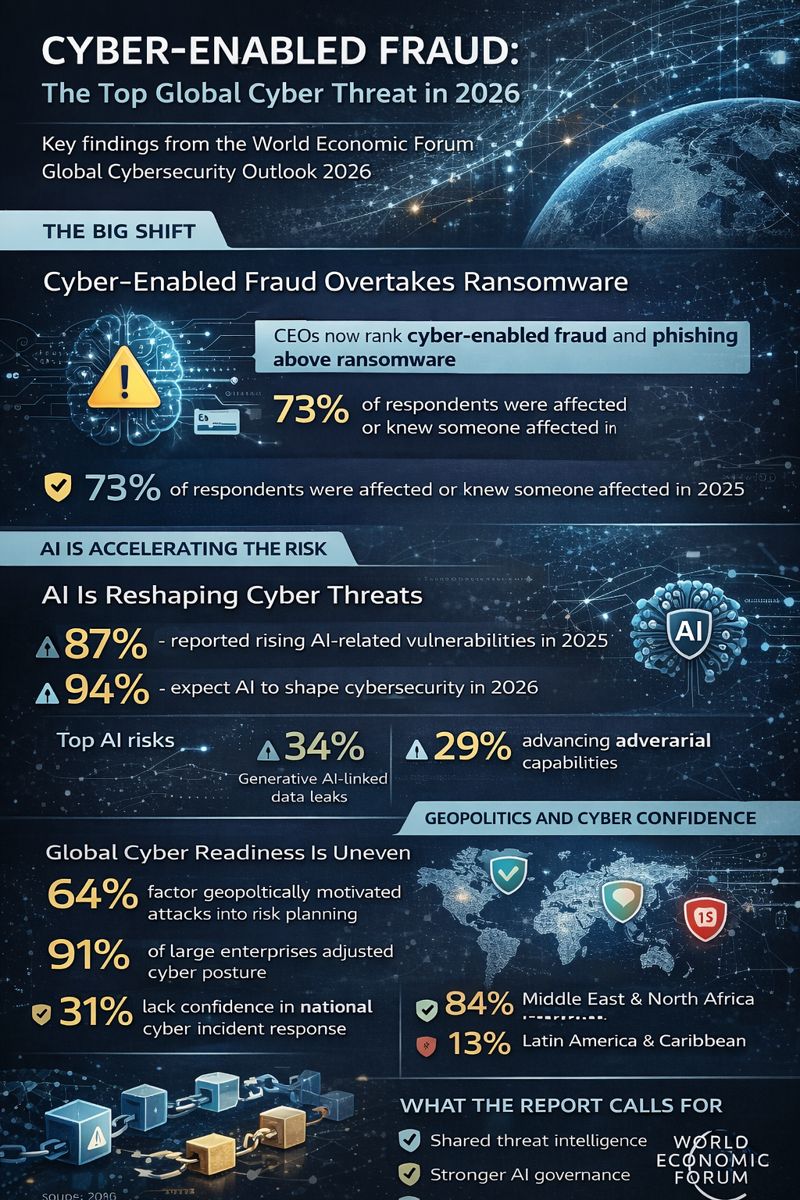
According to the report, 73% of respondents were directly affected by cyber-enabled fraud in 2025 or knew someone who was. This shift highlights how fraud has moved beyond isolated scams into a persistent, everyday threat impacting individuals, businesses, and institutions across sectors.
Cyber-enabled fraud thrives on scale. Digital payments, online identities, deepfakes, and AI-powered social engineering have made fraud easier to launch and harder to detect. The economic and social costs are rising, and trust in digital systems is under strain.
Jeremy Jurgens, Managing Director at the World Economic Forum, summed it up clearly. Cyber-enabled fraud is now one of the most disruptive forces in the digital economy, undermining trust, distorting markets, and affecting people’s lives directly.
AI is reshaping the threat landscape faster than expected
Artificial intelligence sits at the center of the report’s findings. 87% of organizations reported an increase in AI-related vulnerabilities in 2025, making it the fastest-growing risk category.
Looking ahead, 94% of global leaders expect AI to be the most influential force shaping cybersecurity in 2026.
The risks are not abstract. The report highlights specific concerns:
- 34% cite data leaks linked to generative AI
- 29% point to rapidly advancing adversarial capabilities
- AI is being used to automate phishing, impersonation, and fraud at scale
At the same time, organizations are trying to keep pace. The share of companies formally assessing AI security risks nearly doubled, rising from 37% to 64% in one year. Even so, governance gaps and uneven adoption leave many exposed.
This growing reliance on automation is part of a wider shift in how AI is reshaping both cyber offence and defence, which we examine in more detail in our analysis of the impacts of AI on cybersecurity. This was discussed in World Economic Forum 2026.
Geopolitical tensions are weakening cyber confidence
Geopolitics is now inseparable from cybersecurity strategy. 64% of organizations factor geopolitically motivated cyberattacks into their risk planning, and 91% of the largest enterprises have adjusted their cybersecurity posture in response.
Despite this, confidence in national preparedness is declining. 31% of respondents report low confidence in their country’s ability to respond to major cyber incidents affecting critical infrastructure.
The confidence gap is striking across regions:
- 84% confidence in the Middle East and North Africa
- Only 13% confidence in Latin America and the Caribbean
This uneven preparedness increases global risk, especially as cyber threats routinely cross borders and target interconnected systems.
Supply chains remain a major weak point
Digital supply chains are more complex, and opaque than ever. The report finds that 65% of large organizations now see third-party and supply chain risks as their biggest barrier to cyber resilience, up from 54% last year.
Concentration risk is also rising. Disruptions at major cloud providers or internet service providers have shown how a single failure can cascade across entire ecosystems. These incidents are no longer theoretical. They have real-world downstream impacts on operations, services, and public trust.
Cyber inequity is growing, not shrinking
One of the most concerning findings is the widening gap in cyber resilience. Smaller organizations are twice as likely as large firms to report insufficient cybersecurity preparedness.
The talent shortage remains a critical issue:
- 65% of organizations in Latin America and the Caribbean report insufficient cybersecurity skills
- 63% of organizations in sub-Saharan Africa face similar shortages
These gaps leave smaller businesses and emerging economies disproportionately exposed to cyber-enabled fraud and AI-driven attacks.
From protection to resilience
The report marks a shift in how leaders are being urged to think about cybersecurity. Traditional protection-focused models are no longer enough.
Paolo Dal Cin, Global Lead for Accenture Cybersecurity, notes that AI weaponization, geopolitical friction, and systemic supply chain risks are upending conventional defenses. He argues that organizations must move toward cyber defence powered by advanced and agentic AI, tightly integrated with business continuity and trust frameworks.
Cyber resilience, the report stresses, is now a strategic requirement. It underpins economic stability, national security, and public confidence in digital systems.
A call for collective action
The Global Cybersecurity Outlook 2026 makes one message clear. No organization or country can manage these risks alone.
The report calls on leaders to move beyond isolated efforts and focus on raising the collective baseline. That means sharing intelligence, aligning standards, and investing in skills and capabilities so that cyber resilience is not limited to a few well-resourced players.
As AI-driven threats grow and cyber-enabled fraud continues to spread, the cost of inaction will be measured not just in financial losses, but in eroded trust across the digital economy.
About the report
The findings are based on a survey of 804 global business leaders across 92 countries, including:
- 105 CEOs
- 316 Chief Information Security Officers
- 123 other C-suite executives, including CTOs and Chief Risk Officers
The report is released ahead of the World Economic Forum’s 56th Annual Meeting, that is being held between19–23 January 2026 in Davos-Klosters, Switzerland, under the theme A Spirit of Dialogue.
Cyber-enabled fraud may be today’s top concern, but the broader message is forward-looking. Cybersecurity is no longer just about defending systems. It is about protecting trust in an increasingly AI-driven, interconnected world.
FAQs
What is cyber-enabled fraud?
Cyber-enabled fraud is digital fraud carried out using online platforms, AI tools, phishing, and identity manipulation. The World Economic Forum reports that 73% of people were directly affected or knew someone affected in 2025.
Why is cyber-enabled fraud now a bigger concern than ransomware?
CEOs rank cyber-enabled fraud higher because it operates at scale, affects individuals and businesses alike, and causes continuous financial and trust-related damage.
How is AI increasing cyber-enabled fraud risks?
AI automates phishing, impersonation, and fraud campaigns. 87% of organizations saw rising AI-related vulnerabilities, and 34% reported generative AI–linked data leaks.
Why do supply chains amplify cyber-enabled fraud?
Digital supply chains rely on third parties. 65% of large firms cite supply chain risk as their biggest cyber resilience barrier, making fraud harder to contain.
What is the key recommendation from the WEF report?
Move from isolated cybersecurity efforts to collective resilience through shared intelligence, AI governance, and cross-sector collaboration.