
Compensation Fund Email Scam: How I Identified a $10.5 Million Phishing Attempt


Share
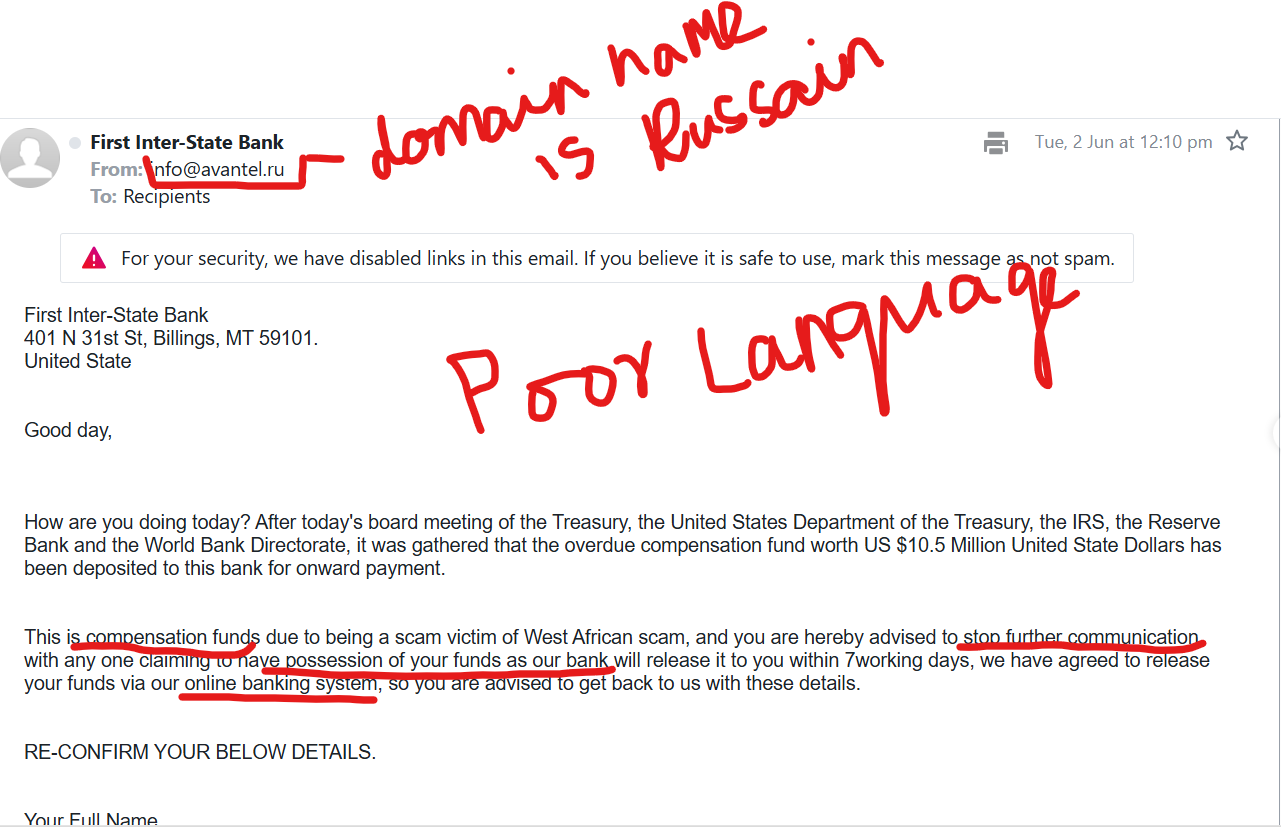


A Compensation Fund Email Scam landed in my inbox recently, and at first glance, it looked similar to many of the financial fraud emails that continue to circulate online. The message claimed that I was entitled to receive $10.5 million in compensation funds and that the payment would be released through a bank within seven working days.
Like many scam emails, it attempted to create trust by mentioning government agencies, financial institutions, and international organizations. It also requested personal information to “process” the payment.
While experienced internet users may recognize these tactics immediately, many people still fall victim to similar scams every year. That is why I decided to analyze this email and explain the warning signs that exposed it as a phishing attempt.
If you ever receive a similar message, understanding these red flags could help you avoid identity theft, financial fraud, and future phishing attacks.
The Email That Raised Immediate Concerns
The email claimed to be from First Inter-State Bank and stated that a compensation fund worth $10.5 million had been approved for release.
According to the message, the funds were connected to victims of a West African scam. It further claimed that the U.S. Treasury, IRS, Reserve Bank, and World Bank Directorate had approved the payment.
The sender requested that I provide the following information:
- Full name
- Residential address
- Age and gender
- Occupation
- Telephone number
- Next of kin details
The message ended with a request for an urgent response so the payment could proceed.
At first glance, some recipients may see the promise of a large financial payout and overlook the warning signs. However, a closer examination revealed several indicators that this was a classic Compensation Fund Email Scam.
| Red Flag | What I Observed in the Email | How I Identified It as a Scam |
| Unrealistic Compensation Claim | The email promised $10.5 million in compensation funds. | Legitimate organizations do not randomly award large sums of money through unsolicited emails. |
| Generic Greeting | The message opened with “Good day” instead of using my name. | Genuine financial communications typically address recipients by their verified name. |
| Authority Impersonation | The email referenced the U.S. Treasury, IRS, Reserve Bank, and World Bank. | Scammers often mention trusted institutions to create credibility and pressure recipients into compliance. |
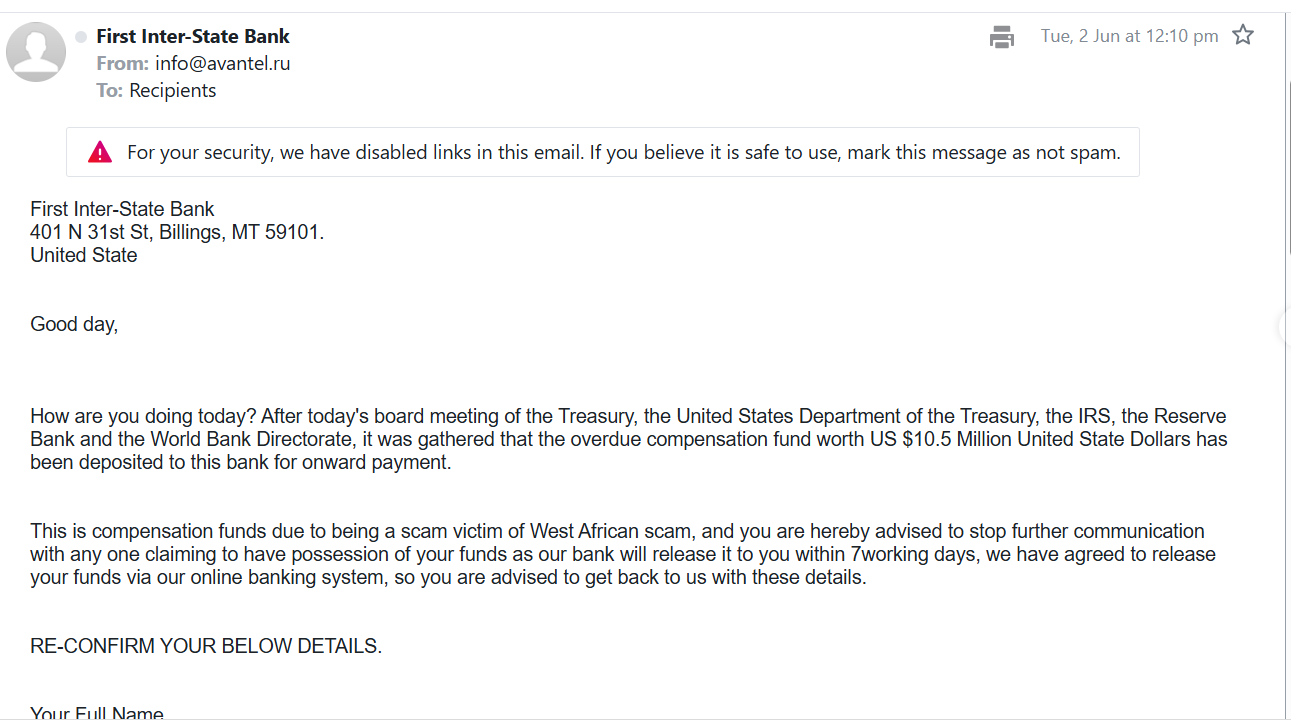
| Suspicious Sender Address | The email originated from info@avantel.ru. | The domain had no connection to the bank it claimed to represent. |
| Different Reply-To Address | The sender asked recipients to respond to mulb@binary.ao. | Legitimate organizations typically use consistent email domains for communication. |
| Request for Personal Information | The email requested my full name, address, age, occupation, phone number, and next of kin details. | This information can be used for identity theft, social engineering, and future phishing attacks. |
| Urgent Call to Action | The message stated that my “utmost response is needed” to proceed with payment. | Creating urgency is a common social engineering tactic designed to prevent victims from verifying claims. |
| Poor Grammar and Wording | Several sentences contained awkward phrasing and grammatical errors. | Professional banks and government agencies usually review customer communications before sending them. |
| Mass Email Indicators | The email was addressed to “Recipients” rather than a specific individual. | This suggests the message was sent to multiple targets as part of a phishing campaign. |
| Lack of Verification Process | The email offered a large payment without any prior claim, application, or legal process. | Legitimate compensation programs follow documented procedures and do not appear unexpectedly in inboxes. |
Red Flag #1: The Promise of Unexpected Money
One of the oldest internet scams involves offering victims money they never expected to receive. Scammers know that financial rewards capture attention quickly. Whether it is a lottery win, inheritance claim, tax refund, or compensation payment, the goal is always the same: encourage the recipient to act before thinking critically. In this case, the email promised $10.5 million without any previous communication, legal process, or compensation claim.
Legitimate financial institutions do not randomly distribute millions of dollars through unsolicited emails. Whenever an email promises a large sum of money that appears too good to be true, it should immediately be treated with suspicion.
Red Flag #2: Misuse of Trusted Organizations
Another tactic used in this Compensation Fund Email Scam was the mention of multiple well-known institutions. The email referenced:
- The United States Department of the Treasury
- The IRS
- The Reserve Bank
- The World Bank
This technique is often called authority impersonation. Scammers understand that people are more likely to trust a message that appears connected to government agencies or financial organizations. By listing several respected institutions together, they attempt to create an illusion of legitimacy. However, legitimate organizations rarely communicate in this manner. They also do not conduct compensation programs through generic unsolicited emails.

Red Flag #3: Suspicious Email Domains
One of the strongest indicators that the email was fraudulent appeared in the sender information. The email claimed to represent a bank but originated from an unrelated domain. The reply address was also different from the sender address. This type of mismatch is common in phishing campaigns.
Before responding to any financial email, always examine:
- The sender’s domain
- The reply-to address
- Any embedded links
If these details do not match the organization being represented, the email should be considered suspicious.
Cybercriminals frequently impersonate banks while using unrelated domains to avoid detection.
Red Flag #4: Requests for Personal Information
The email requested several pieces of personal information before the alleged payment could be processed. This is one of the most important warning signs. Legitimate banks already maintain customer records and do not request extensive personal details through unsolicited email communications. Information such as:
- Full name
- Address
- Phone number
- Occupation
- Family information
can be valuable to cybercriminals.
Even if the information seems harmless on its own, scammers often combine multiple data points to build detailed profiles of potential victims.
These profiles can later be used for identity theft, account recovery attacks, targeted phishing campaigns, and social engineering attempts.
Red Flag #5: Poor Language and Unprofessional Communication
The language used throughout the email contained several grammatical errors and unusual phrases. Examples included awkward wording, inconsistent sentence structure, and terminology that would not typically appear in professional banking communications. Many phishing campaigns originate from criminal groups operating internationally. As a result, the language often contains errors that legitimate organizations would likely catch during review and approval processes.
Grammar mistakes alone do not always prove an email is fraudulent. However, when combined with unrealistic claims, suspicious domains, and requests for personal information, they become another important warning sign.

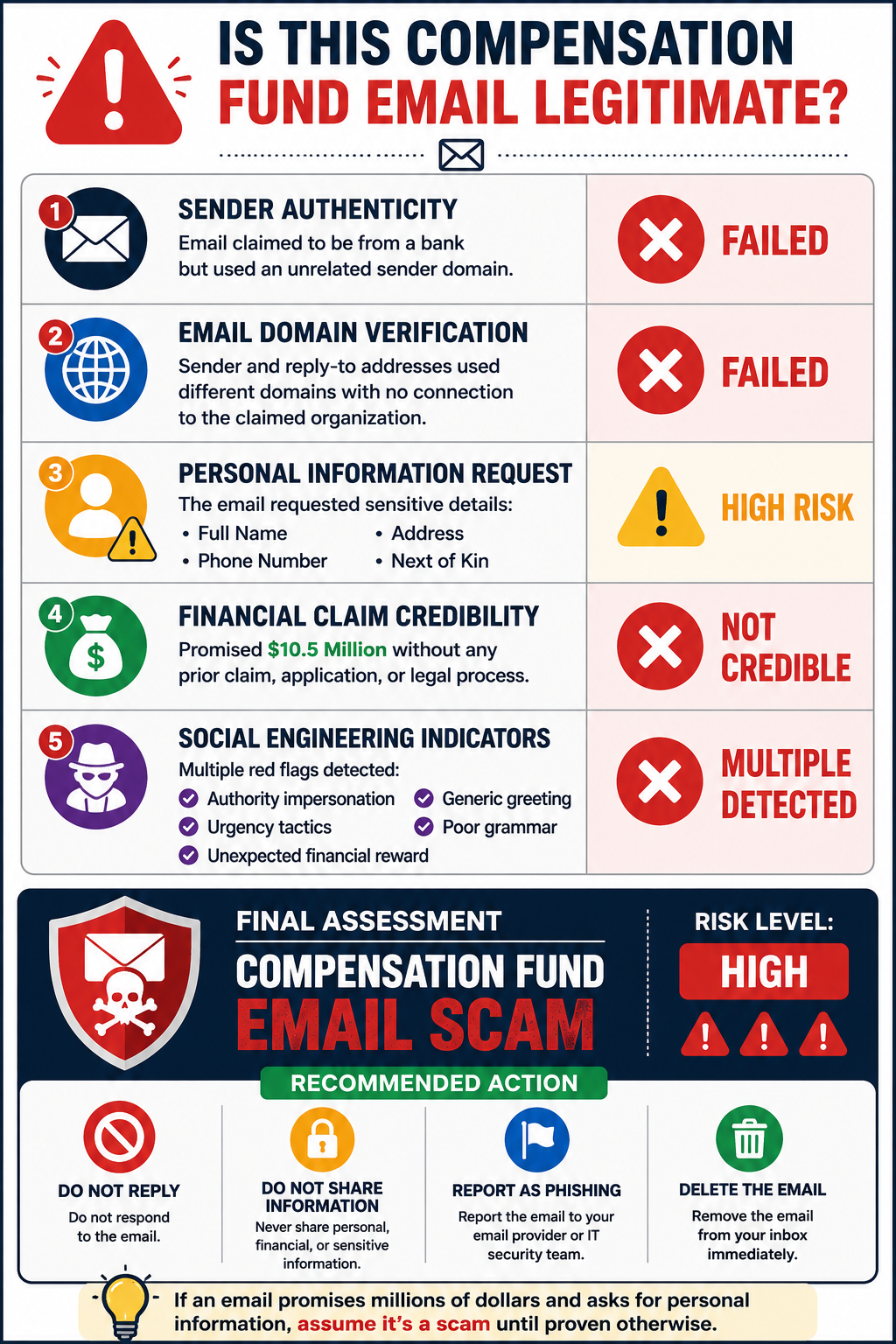
How Compensation Fund Email Scams Typically Work
Most Compensation Fund Email Scam campaigns follow a predictable pattern. The process usually begins with a promise of money. The scammer then requests personal information under the pretense of verifying identity. Once the victim responds, additional requests often follow. These may include:
- Processing fees
- Transfer charges
- Legal costs
- Tax payments
- Verification expenses
The victim is told that these payments are required before the funds can be released. In reality, the promised compensation does not exist. The scammer’s objective is either to collect money directly or gather personal information for future fraud.
While these scams often target individuals, businesses can also become victims. Small businesses frequently receive emails claiming to involve refunds, compensation payments, government grants, or banking updates. An employee who responds to such messages could unknowingly expose:
- Employee information
- Customer records
- Financial details
- Internal business data
For example, a small accounting firm that receives a fake compensation email may disclose information that allows attackers to launch more convincing phishing campaigns later. Similarly, organizations without cybersecurity awareness training may struggle to identify these scams before damage occurs. This is why security awareness education remains important for both individuals and businesses.
What You Should Do If You Receive a Similar Email
If a compensation-related email appears in your inbox, take the following precautions:
- Do Not Reply – Responding confirms that your email address is active.
- Do Not Share Personal Information –Never provide personal, financial, or identity-related information through unsolicited emails.
- Verify Independently –If the email claims to come from a bank or government agency, visit the organization’s official website and contact them directly using verified information.
- Report the Email –Most email providers allow users to report phishing attempts.
- Delete the Message –Once reported, remove the email from your inbox.
Taking these simple steps can significantly reduce your risk of becoming a victim.
To Sum Up
Receiving this Compensation Fund Email Scam served as a useful reminder that cybercriminals continue to rely on surprisingly simple tactics. The email did not contain sophisticated malware or advanced hacking techniques. Instead, it relied on social engineering, false authority, urgency, and the promise of financial reward. The good news is that these scams become much easier to identify once you know what to look for. Unexpected financial offers, requests for personal information, suspicious email domains, and pressure to respond quickly should always raise concerns. Whether you are an individual user or a business owner, taking a few moments to verify an email before responding can prevent significant financial and personal harm. When it comes to compensation fund emails promising millions of dollars, skepticism is often your best defense.
Key Takeaways
- The email promised $10.5 million in compensation funds, a common tactic used in advance-fee and phishing scams.
- The sender and reply-to email addresses were unrelated to the bank being impersonated, making the message highly suspicious.
- The email used trusted organizations such as the U.S. Treasury, IRS, and World Bank to create a false sense of legitimacy.
- Requests for personal information, including address, phone number, and next of kin details, indicated a potential identity theft attempt.
- Poor grammar, generic greetings, and pressure to respond quickly are classic signs of a phishing email.
- If you receive a similar message, do not reply, share personal information, click links, or download attachments. Report it as phishing and delete it.
FAQs
What is a Compensation Fund Email Scam?
A Compensation Fund Email Scam is a phishing or advance-fee fraud scheme in which scammers claim that you are entitled to receive a large compensation payment. The email often references banks, government agencies, or international organizations to appear legitimate. The goal is usually to steal personal information or convince victims to pay fake processing fees.
How can I tell if a compensation email is fake?
Several warning signs can indicate a scam:
- Unexpected offers of large sums of money
- Requests for personal information
- Generic greetings such as “Good Day” or “Dear Customer”
- Poor grammar and awkward wording
- Suspicious sender email addresses
- Pressure to respond quickly
- Claims involving multiple government or financial institutions
If an email contains several of these red flags, it should be treated with caution.
Why do scammers ask for personal information?
Scammers collect personal information to commit identity theft, launch future phishing attacks, or build detailed profiles of potential victims. Information such as your name, address, phone number, occupation, and family details can be used to make future scams appear more convincing.
Is it safe to reply to a compensation fund email?
No. Replying confirms that your email address is active and monitored. This can lead to additional scam attempts and targeted phishing campaigns. It is best to avoid responding altogether.
Can a compensation fund email contain malware?
Yes. While some compensation fund scams focus on collecting personal information, others may include malicious links or attachments designed to install malware, steal passwords, or compromise devices. Avoid clicking links or downloading attachments from suspicious emails.
Why do scammers mention organizations like the IRS, World Bank, or government agencies?
Scammers often impersonate trusted institutions to create credibility. By mentioning well-known organizations, they hope recipients will lower their guard and trust the message without verifying its authenticity.
What should I do if I receive a Compensation Fund Email Scam?
If you receive a suspicious compensation email:
- Do not reply.
- Do not click links or download attachments.
- Do not share personal information.
- Mark the email as spam or phishing.
- Delete the message.
- Verify any claims directly through official websites if needed.
What if I already responded to the email?
If you have already replied, stop all communication immediately. If you shared personal information, monitor your accounts for suspicious activity, change relevant passwords, enable multi-factor authentication (MFA), and consider notifying your bank if financial information was disclosed.
Can businesses be targeted by compensation fund scams?
Yes. Small businesses and organizations frequently receive scam emails disguised as refunds, grants, compensation payments, or banking notices. Employees who respond may expose company information, customer data, or financial records, making cybersecurity awareness training essential.
Are compensation fund payments ever legitimate?
Legitimate compensation payments usually follow a documented process involving verified claims, legal proceedings, insurance settlements, or government programs. They do not arrive unexpectedly through unsolicited emails requesting personal information or upfront payments.