
Vibe Coding and Cybersecurity: What Can Go Wrong When AI Builds the App

Share

Vibe coding means building software by describing it. You write a prompt in plain language, and an AI tool generates the features, the interface, or the whole application, so much of the code is never written by hand.
That speeds things up and lets more people build software. It also opens security holes. An AI-generated app can ship with hidden vulnerabilities, insecure configurations or poorly implemented authentication, and you need to understand these risks before the app goes anywhere near real users.
What is vibe coding, and why is cybersecurity important?
In vibe coding, the user describes what the application should do, and the AI writes the code. Cursor, Replit, and Lovable all work this way. Developers use them. So do people with no technical background, and they can get a working app with very little manual coding.
Productivity goes up. Security doesn’t come with it automatically. A model will happily copy an insecure pattern it has seen many times, skip a security requirement nobody mentioned, or hand you code that works perfectly and leaks sensitive information on the side.
AI code still needs people, for a simple reason: your coding assistant has no idea what your security policy says, how your infrastructure is set up or which compliance rules apply to you. If nobody reviews the code and tests it for security, a vulnerability can sit there quietly until an attacker is the first to notice. An experienced AI assisted development partner can help find those vulnerabilities, review AI-generated code and make sure security and compliance requirements are met.
Cybersecurity risks of vibe coding
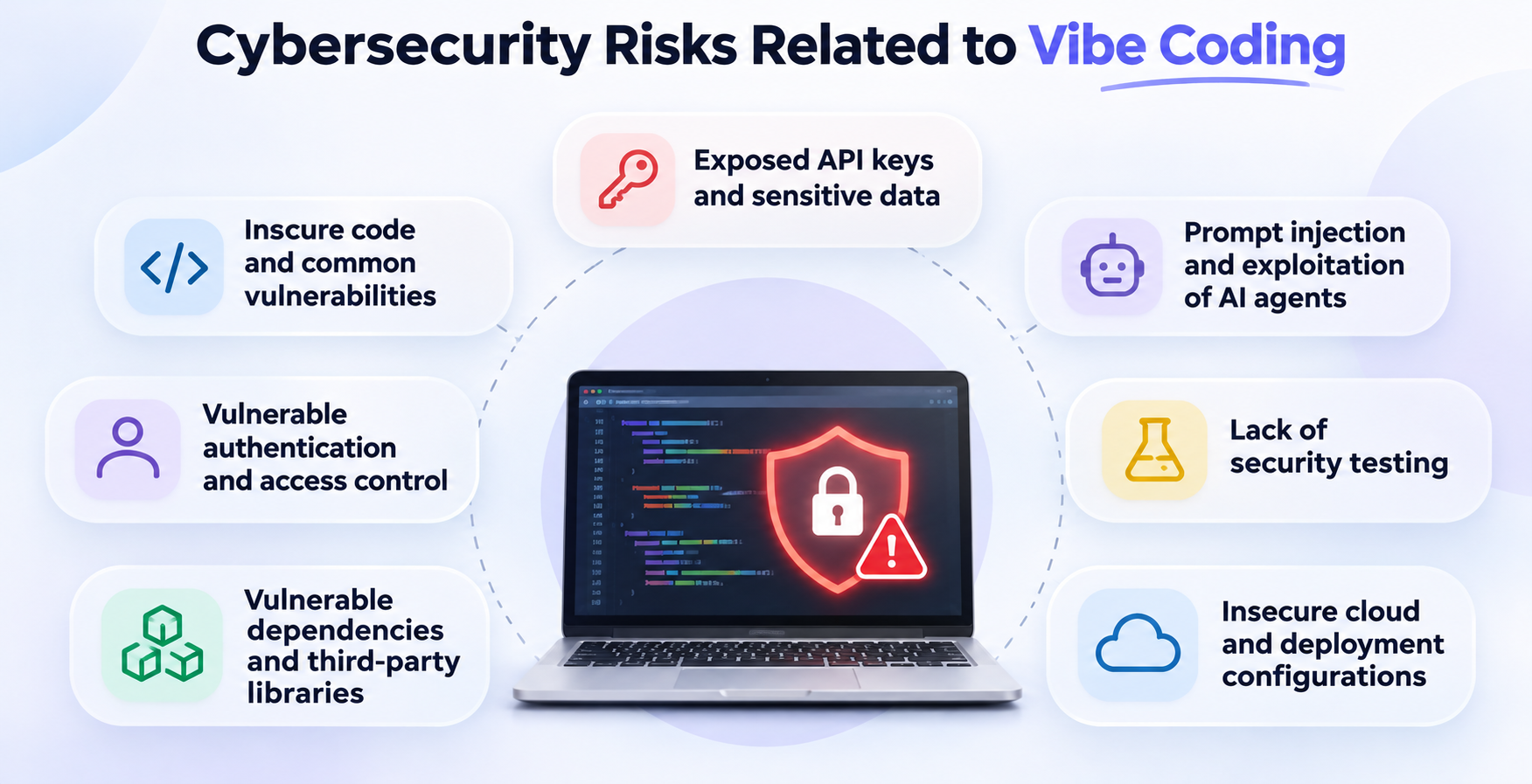

AI-built apps face mostly the same threats as software written the traditional way. The difference is speed. When features ship fast and few people review the code, the exposure grows.
1. Old bugs in new code
SQL injection, cross-site scripting (XSS) and missing input validation didn’t go away when AI started writing code.
Take a database query that drops user input straight into SQL without any safeguard.
That one line is enough for an attacker to change the application’s data, and the results range from unauthorized access and stolen data to an app that simply stops working.
2. Weak authentication and access control
AI tools can produce a login page and a user management system quickly. The security controls behind them may be thin.
Typical gaps are insecure session handling, missing authorization checks, and badly configured authentication tokens.
Together, they can produce an app where a user logs in normally and then sees data that belongs to someone else’s account.
In healthcare, financial services, and enterprise software, that leak is especially dangerous.
3. Exposed API keys and sensitive information
Many AI-assisted projects connect to third-party APIs, databases or cloud services.
Paste a credential into a prompt, or let the AI hardcode it, and it can turn up later in the repository, in frontend files or in logs. Anyone who finds a leaked API key can get into the connected s ervices or run up charges on paid resources. Keep secrets in a secret store or environment variables, and watch what goes into your prompts.
4. Vulnerable dependencies and third-party libraries
Coding assistants often suggest external libraries to save time. Some of those packages may be outdated or vulnerable. Some may not exist at all. Installing a dependency nobody has checked opens the door to supply chain attacks. So confirm each package is the real one, keep dependencies up to date and run an automated vulnerability scanner.
5. Prompt injection and AI agent exploitation
Apps built on a large language model have one more problem. In a prompt injection attack, someone hides malicious instructions in external content that the AI system later reads.
A booby-trapped document, for example, could try to get an AI assistant to reveal sensitive information or take actions it isn’t allowed to take. The risk grows once an AI agent can query databases, run commands or work inside business systems.
So restrict what the agent is allowed to do and check every sensitive action before it runs.
6. Too little security testing
Shipping without thorough testing is one of the biggest risks in vibe coding. An app can pass every demo. It can also hide vulnerabilities its users will never see. If the AI wrote the tests as well, they may miss the same security weaknesses the generated code has.
Security testing should combine automated code analysis and dependency scanning with manual review and, where it makes sense, a penetration test by people whose job is to break the app on purpose.
7. Insecure cloud and deployment settings
AI tools can also help set up cloud infrastructure and deployments. Mistakes there expose sensitive systems.
The common ones are databases anyone on the internet can reach, users with far more permissions than they need, and admin panels without proper protection.
Fairly secure code won’t save an app whose infrastructure settings are wrong.
How to reduce cybersecurity risks in vibe coding
Vibe coding is still worth using. Pair it with established security practices.
Implement secure development practices
Set security requirements before anyone generates code, and have developers review the sensitive parts. Authentication, authorization, payment processing and the handling of personal data need the closest look.
Let tools do the first pass
Security tools in the development pipeline catch a lot of problems early. Static application security testing (SAST), dynamic application security testing (DAST) and dependency scanning pick up common weaknesses before anything is deployed.
Keep people in the loop after launch
Before AI-generated code reaches production, a professional should read it.
After launch, the job isn’t finished: regular security audits, access control reviews, and application monitoring catch the vulnerabilities that new features and updates bring in.
It also helps to give AI agents only the permissions they need and to be careful about what confidential information you share with development tools.
Final thoughts
Vibe coding makes software faster to build and opens development to people who don’t code, but it also creates security problems that businesses can’t ignore. Insecure code, weak authentication, leaked credentials, unchecked dependencies and thin testing can each turn an AI-built app into a liability.
AI can write the app quickly. Making it safe to run still takes careful engineering, with human review, automated security testing, and continuous monitoring around the code.


