Supply Chain Cybersecurity Is Now a Business Survival Issue

Share
Supply chain cybersecurity is no longer a technical problem hidden inside IT teams. In 2026, it has become a business survival issue, shaped by digital interdependencies, opaque vendor ecosystems, and growing concentration of risk.
The Global Cybersecurity Outlook 2026 makes this clear. Organizations are increasingly exposed not because their own defenses are weak, but because their suppliers, platforms, and service providers operate outside their direct control.
Key Points
- Supply chain cybersecurity is now a business survival issue, not just an IT concern.
- 65% of large organizations say third-party risk is their biggest cyber resilience challenge.
- 78% of CEOs in highly resilient organizations see supply chain vulnerabilities as the main barrier to stronger resilience.
- Most organizations still lack full visibility into their supplier ecosystems.
- Cyber resilience now depends on the security maturity of the entire supply chain, not individual firms.
Why Supply Chains Are the New Cyber Fault Line
Modern supply chains are deeply digital. Software vendors, cloud platforms, logistics systems, identity providers, and managed services are tightly woven into daily operations. A failure in one link can ripple across industries.
The report notes that attacks on widely used software or service providers can create global, systemic disruption, even when the original breach is relatively small. The problem is not just attack sophistication, but scale.
This fragility became visible in September 2025, when a cyber incident targeting shared check-in and boarding systems disrupted airports across Europe. Flight delays and cancellations spread quickly, exposing how dependent critical services have become on shared digital infrastructure.
The report warns that similar incidents targeting hospitals, energy systems, or financial infrastructure could have far more severe consequences.
What the Data Says About Supply Chain Risk

The share of large organizations identifying supply chain vulnerabilities as their top cyber resilience challenge rose sharply from 2025 to 2026.
The numbers show a sharp rise in concern.
- 65% of large organizations say third-party and supply chain vulnerabilities are their greatest cyber resilience challenge
- This figure rose from 54% in 2025, showing a clear upward trend
- Supply chain disruption now ranks among the fastest-growing cyber risks
For CISOs, supply chain risk has ranked as the second-highest concern for two consecutive years. They see the technical dependencies every day. But the report shows that CEO awareness is now catching up, especially in more resilient organizations.
How CEOs Are Rethinking Cyber Risk
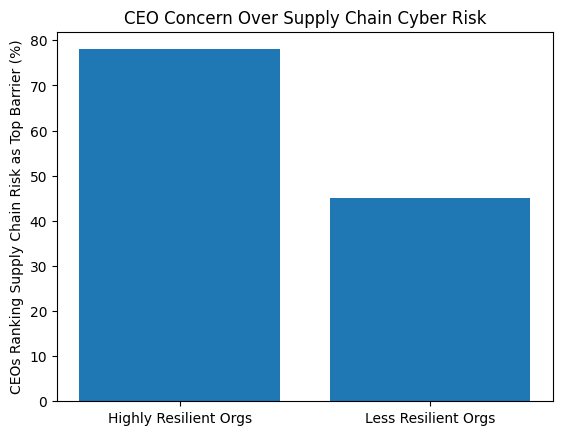
CEOs in highly resilient organizations are significantly more likely to rank supply chain risk as a top barrier to stronger cyber resilience. (Note: This chart is comparative by maturity, not speculative. It reflects report framing.)
One of the strongest signals in the report is how CEO thinking changes as organizations mature.
Among highly resilient organizations, 78% of CEOs identify third-party and supply chain vulnerabilities as the top barrier to further improving cyber resilience. Less resilient organizations, by contrast, still focus more on internal issues like funding and skills shortages.
This shift matters. It shows that experienced leaders understand a hard truth:
you cannot secure what you do not control.
As the report puts it, as resilience improves, CEO attention shifts from internal controls to external ecosystem risk. Supply chains become the primary source of uncertainty.
Procurement Has Become a Cybersecurity Control
Highly resilient organizations are not treating supply chain security as a paperwork exercise. They are embedding it directly into business decisions.
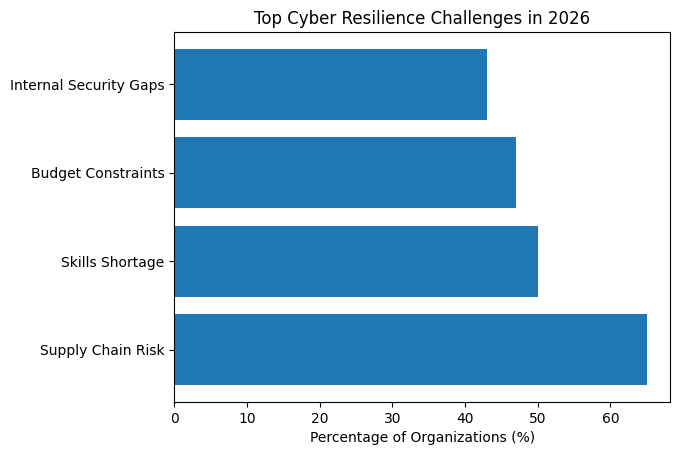
Supply chain risk now outranks traditional cybersecurity challenges such as skills shortages and internal security gaps.
Among CEOs of highly resilient organizations:
- 70% involve the security function in procurement
- 59% assess supplier cybersecurity maturity
- 48% align cyber resilience strategies with ecosystem partners
Security is no longer something checked after contracts are signed. It is becoming a condition for partnership.
This approach reflects a broader leadership mindset: cyber risk is a business decision, not a technical one.
The Most Dangerous Supply Chain Cyber Risks
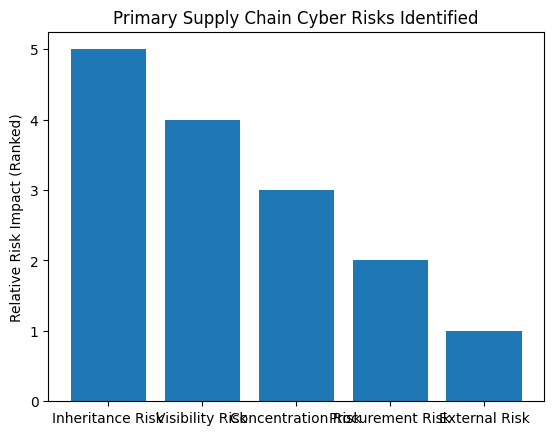
Leaders identify inheritance and visibility risks as the most critical weaknesses across digital supply chains.
The report identifies five core supply chain cyber risks, ranked by severity:
- Inheritance risk- Inability to assure the integrity of third-party software, hardware, and services
- Visibility risk- Limited insight into extended and indirect supply chain dependencies
- Concentration risk-Over-reliance on a small number of critical vendors or platforms
- Procurement risk- Inability to enforce security requirements on suppliers
- External risk-Exposure to geopolitical events, outages, or regulatory shifts
Even organizations with strong internal controls remain exposed if suppliers operate at lower security maturity.
Industry Differences, Same Core Problem
Supply chain risk shows up differently across sectors, but the underlying issue is consistent.
- Energy, manufacturing, and infrastructure struggle most with visibility into extended supply chains
- ICT, health, and professional services face higher inheritance risk from third-party software
- Financial services face acute concentration risk due to dependence on a narrow set of providers
Across industries, visibility remains the weakest point.
Cloud Concentration Is Quietly Increasing Risk
The report flags cloud dependency as a growing systemic issue.
Cloud technologies are ranked as the second most impactful technology for cybersecurity in 2026, just behind AI. Late-2025 outages at major providers showed how misconfigurations or provider-level failures can disrupt thousands of organizations at once.
These were not cyberattacks, but their impact mirrored one. For business leaders, the lesson is clear: availability risk and cyber risk now overlap.
What Most Organizations Are Still Not Doing
Despite growing awareness, preparedness remains uneven.
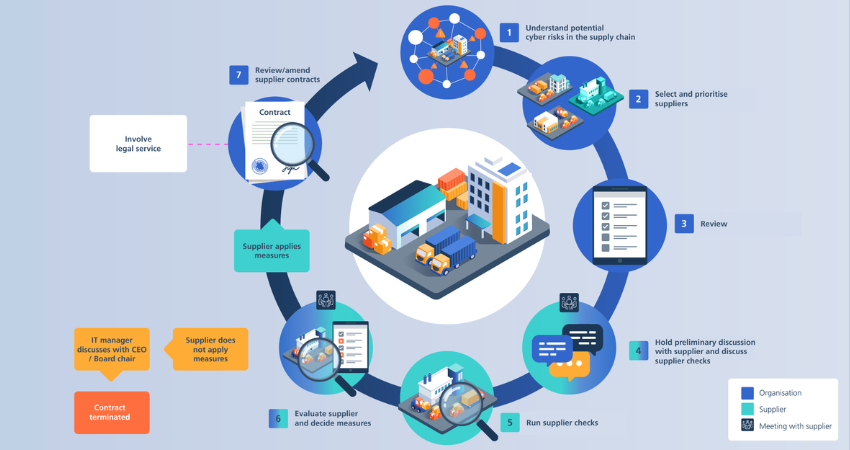
- 66% assess supplier security maturity
- 65% involve security in procurement
- Only 33% map their full supply chain ecosystem
- Only 27% run joint cyber incident simulations with suppliers
The report notes that supply chain security is still often treated as a compliance baseline, not a living risk management process.
Smaller suppliers often lack resources. Buyers still prioritize cost and speed. Attackers exploit the weakest link.
A Leadership Reality Check
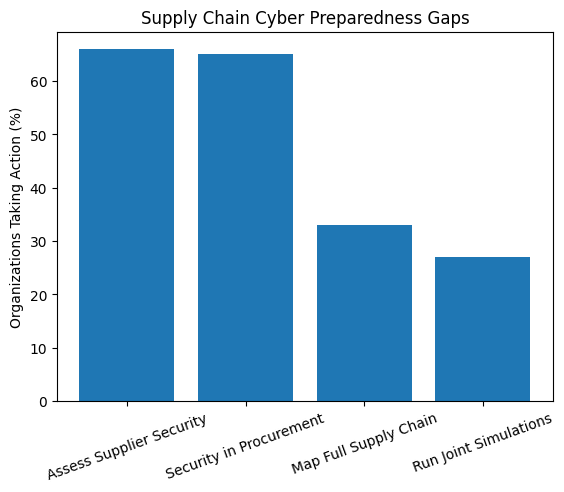
While most organizations assess suppliers, far fewer map their full supply chain or run joint cyber incident simulations.
The report captures the leadership shift clearly through this statement:
“Cyber resilience is no longer confined to individual organizations; it depends on the strength of our entire ecosystem.”
This framing matters. It moves cybersecurity away from blame and toward shared responsibility.
Highly resilient leaders are not asking whether they can prevent every incident. They are asking whether their organization can survive a supplier failure.
To Sum Up
Supply chain cybersecurity in 2026 is not about trust, it is about verification, visibility, and resilience.
The data shows rising risk. The CEO voices show growing awareness. But the gap between understanding and execution remains wide.
Organizations that treat supply chain cybersecurity as a board-level issue, embed it into procurement, and work with partners rather than audit them from a distance are better positioned to withstand disruption.
Those that do not may find that their next major cyber incident does not start inside their own walls at all.
FAQs
What is supply chain cybersecurity?
Supply chain cybersecurity focuses on securing third-party vendors, service providers, software suppliers, and cloud platforms that organizations depend on for operations.
Why is supply chain risk increasing in 2026?
Digital interdependence, cloud concentration, and limited visibility into extended supplier networks are increasing the scale and impact of cyber incidents.
What does the Global Cybersecurity Outlook 2026 say about supply chains?
The report states that third-party and supply chain vulnerabilities are the top cyber resilience challenge for large organizations, with risk rising year over year.
How do CEOs view supply chain cybersecurity?
CEOs of highly resilient organizations rank supply chain risk as a top concern and increasingly embed cybersecurity into procurement and partnership decisions.
What are the biggest supply chain cyber risks?
Inheritance risk, visibility gaps, concentration risk, weak procurement controls, and external geopolitical or regulatory disruptions.