
I Received an Inheritance Scam Email. Here’s How I Exposed It


Share
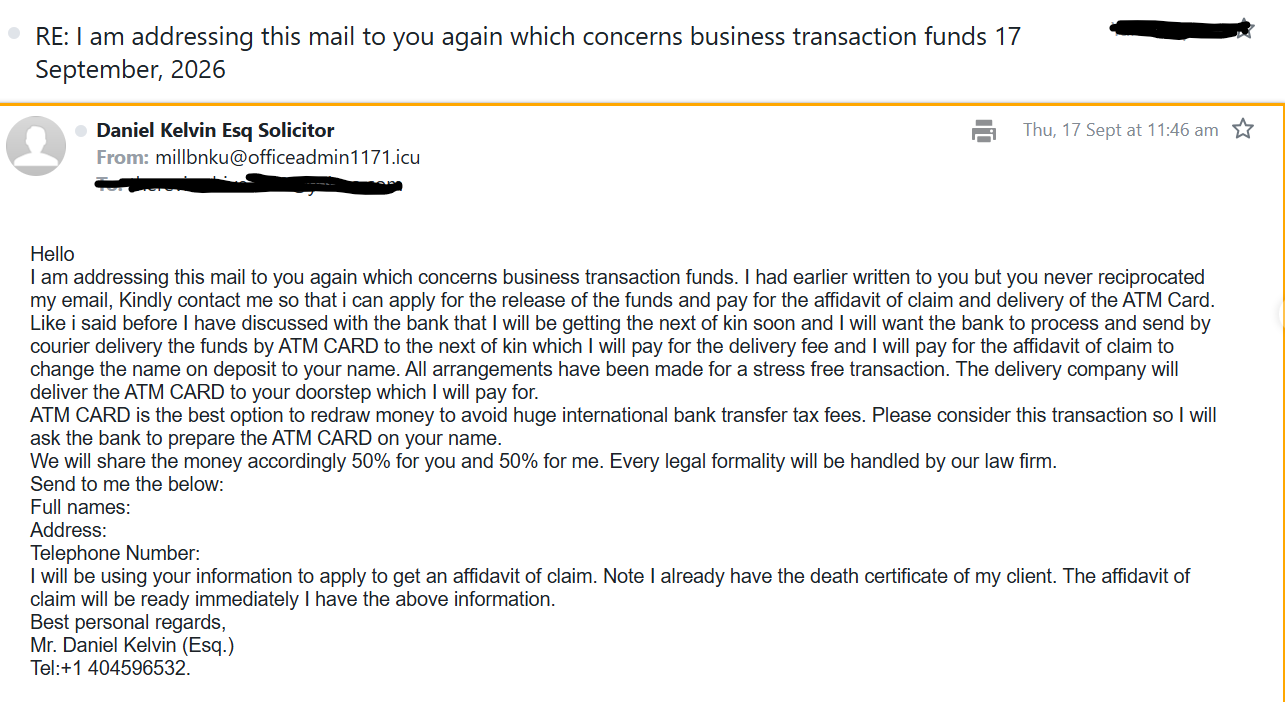


I received an email from someone calling himself “Daniel Kelvin Esq Solicitor.” He claimed to be handling the affairs of a deceased client and said there were business transaction funds waiting to be released. According to the email, I could become the client’s next of kin and receive 50% of the money, while he would take the other 50%.
I had never heard of the sender. I had no connection with his supposed client and had never applied for an inheritance. Yet, he wanted me to provide my full name, address, and telephone number so that he could supposedly prepare an affidavit of claim.
The sender also claimed that the bank would issue an ATM card in my name and have it delivered to my doorstep by courier. He said this would help avoid “huge international bank transfer tax fees.” That was when I decided to look more closely at the email.
Why Was I Supposed to Receive This Money?
The first question I asked myself was simple: Why would a stranger offer me half of a deceased person’s money? The email didn’t provide a convincing answer. There was no explanation of how I was connected to the deceased person or why I was supposedly entitled to the funds.
This is one of the first questions you should ask when you receive an unexpected inheritance email. If you don’t know the deceased person, weren’t named in a will, and have no connection to the estate, there is little reason to believe that a stranger has legitimately chosen you to receive the money.
The promise itself is often the bait. The scammer wants you to focus on how much you could receive rather than asking why you’re being offered the money in the first place.
The Promise of 50% Makes the Offer Tempting
The sender wasn’t asking me to work for the money. He was offering me half of it. That’s what makes this type of scam particularly attractive to someone facing financial difficulties.
An unemployed person who has been searching for work for months may see an unexpected financial offer as a way to cover mounting bills. A young adult trying to become financially independent may see it as an opportunity, while a senior citizen may believe they’ve unexpectedly been named as a beneficiary.
Scammers understand these emotions. They don’t necessarily need their victims to believe every detail of the story. They only need the promise of money to be tempting enough for someone to respond.
I Checked the Email Headers
Instead of replying, I decided to look at the email headers. These are the technical details attached to an email that show information about how the message was sent and the servers involved in delivering it.
The headers showed an originating IP address of 217.60.195.200. They also showed that the sending system identified itself as gmail.com. That doesn’t necessarily mean the message was sent through Google’s Gmail servers, so I looked at the email authentication results for more information.
SPF, DKIM and DMARC Raised More Questions
Yahoo’s authentication results showed an SPF (Sender Policy Framework) softfail, DKIM (DomainKeys Identified Mail) unknown, and DMARC (Domain-based Message Authentication, Reporting, and Conformance) failed. The terms may sound technical, but their results gave me another reason to question the email.
SPF checks whether a particular server is authorized to send email on behalf of a domain. In this case, Yahoo indicated that the sending IP address wasn’t authorized to send mail for Gmail. DKIM provides a digital signature that helps authenticate an email, but Yahoo couldn’t establish a valid DKIM result. DMARC provides another layer of verification, and that check failed as well.
None of these results, taken individually, proves that an email is a scam. But when they appear alongside an implausible inheritance story, a request for personal information, and a mismatch between the sender and Reply-To addresses, they add to the evidence that something isn’t right.
The From Address and Reply-To Address Were Different
There was another detail that caught my attention. The email appeared to come from danielesq971@gmail.com, but the Reply-To address was danielesq@silicons-codex.com.
That means the address displayed as the sender wasn’t the address that would receive my reply. A different Reply-To address isn’t automatically malicious because legitimate organizations sometimes use separate addresses for sending and receiving messages. But in this case, it was another warning sign.
Had I simply clicked Reply, I would have started communicating with the silicons-codex.com address. That’s why checking the Reply-To field can be useful when you’re dealing with an unexpected financial, employment, legal, or investment offer.
What Kind of Scam Was This?
By this point, I was fairly certain that I wasn’t looking at a genuine business proposal or inheritance opportunity. The email had too many warning signs, and the technical information added to my concerns.
This type of fraud is commonly known as an inheritance scam or next-of-kin scam. It also falls under the broader category of advance-fee fraud, where victims are promised a financial benefit but are eventually asked to pay money before they can receive it.
The basic idea behind an inheritance scam is simple. A stranger contacts you and claims that a large amount of money belonging to a deceased person needs to be transferred or released. You may be told that you’re a beneficiary, next of kin, or someone who can help claim the funds. The scammer then gradually introduces requirements that involve your personal information, financial details, or money.
In my case, the sender claimed that an ATM card would be issued in my name and delivered to my doorstep. He also said that an affidavit would be prepared to change the name on the deposit to mine. These claims were presented as routine legal and banking procedures, but there was no legitimate reason for me to be involved in the transaction in the first place.
How the Scam Usually Works
An inheritance scam often begins with an unsolicited email. The sender may introduce themselves as a lawyer, solicitor, banker, government official, or representative of an estate. They may claim that a deceased person left behind a large amount of money and that they need your help to release it.
The first message may not ask you for money. Instead, the scammer may ask for basic personal information and try to establish a relationship. Once you’ve responded, they may provide more details about the supposed inheritance and explain why you need to pay a fee or provide additional documents.
The fee may be described as a legal charge, tax, bank processing fee, affidavit fee, courier charge, or card activation fee. After you pay, another problem may suddenly appear, requiring another payment. The process can continue until the victim realizes that the promised money doesn’t exist.
You May Not Be Asked for Money at First
This is one of the reasons these scams can be difficult to recognize. The first email may not contain an obvious request for money. Instead, the scammer may focus on getting you to respond.
In my case, the sender initially asked for my full name, address, and telephone number. He claimed that he needed this information to prepare an affidavit of claim. It might seem like a harmless request, but providing personal information to an unknown person can open the door to further attempts at fraud.
Once you respond, the scammer knows that your email address is active and that you’re willing to communicate. The next request could involve identification documents, bank information, proof of address, or a payment. That’s why you shouldn’t wait until someone asks for money before deciding whether an email is suspicious.
Why Would a Scammer Want My Personal Information?
Your full name, address, and telephone number may not seem particularly sensitive. Many people share some of this information online. But when you’re dealing with someone you don’t know, you have no idea how the information might be used.
A scammer could use your details to make subsequent communications appear more convincing. They may contact you by phone, email, or messaging apps and refer to information you previously provided. This can create the impression that they have a legitimate file or transaction involving you.
The information could also be combined with other data obtained elsewhere. What begins with your name and phone number could eventually turn into requests for identification documents, banking information, or other personal details. That’s why even seemingly basic information should be treated carefully when the original contact is suspicious.
Don’t Assume a Professional Title Means the Person Is Genuine
The sender called himself “Daniel Kelvin Esq Solicitor.” The title immediately gave the email an appearance of authority. Someone receiving such a message might assume that the sender understands the law and is handling a legitimate estate.
But adding a professional title to an email signature doesn’t establish someone’s identity. Anyone can describe themselves as a solicitor, lawyer, banker, financial adviser, or government representative. The title needs to be independently verified.
If someone claims to represent a law firm or financial institution, look up the organization yourself. Don’t rely on the website, phone number, email address, or other contact details provided in the suspicious message. Use independently obtained information to verify whether the person actually works there and whether the matter they’re describing exists.
The “Stress-Free Transaction” Was Another Warning Sign
The sender told me that “all arrangements have been made for a stress-free transaction.” That wording stood out because legitimate financial and legal transactions usually involve procedures, documentation, verification, and questions.
A stranger promising that everything has already been arranged can make the process sound easier than it really is. The intention may be to discourage you from asking too many questions or checking the details independently.
When you’re dealing with an unexpected financial offer, you shouldn’t be looking for a stress-free transaction. You should be looking for evidence that the transaction is genuine. If someone wants you to act quickly or assures you that everything has already been taken care of, that’s a good reason to slow down and verify the information.
Why the ATM Card Story Doesn’t Add Up
The sender claimed that an ATM card was the best way to receive the money because it would help avoid “huge international bank transfer tax fees.” This explanation was particularly suspicious because an ATM card isn’t a normal substitute for an international bank transfer in an inheritance transaction.
More importantly, there was no reason for a bank to issue me a card connected to someone else’s funds simply because an unknown solicitor requested it. The explanation appeared to make an unusual arrangement sound normal.
This is something to remember when dealing with financial scams. Fraudsters often introduce complicated explanations involving banks, taxes, international transfers, legal documents, and special procedures. The technical language can make the story sound credible, but it doesn’t make the underlying claim legitimate.
Why Scammers Use Legal and Financial Language
The email contained words such as “affidavit,” “next of kin,” “death certificate,” “bank,” and “legal formality.” These terms can make an email appear more official, particularly to someone who isn’t familiar with legal or banking procedures.
But using legitimate terminology doesn’t make a person legitimate. Scammers can research legal and financial terms and include them in their messages to create an appearance of authenticity.
This is why it’s important to look beyond the language used in an email. Ask whether the overall story makes sense. In my case, the terminology couldn’t explain why an unknown solicitor had approached me about a deceased person’s money or why I was supposedly entitled to half of it.
Why the Promise of Easy Money Is So Effective
The offer of 50% of a supposedly large sum of money is the strongest part of the scam. It doesn’t require you to work for the money or invest anything. You’re simply told that you’re entitled to a share.
That’s particularly appealing to people who are under financial pressure. Someone unemployed may see the email as a possible solution to months of financial uncertainty. A young adult may see it as a chance to pay off debts or achieve some financial independence. A senior citizen may believe they’ve unexpectedly been named as a beneficiary.
Scammers understand this. They use the promise of money to encourage people to suspend their normal caution. That’s why an unexpected financial opportunity deserves more scrutiny, not less.
Why You Shouldn’t Rush to Respond
The email made the entire process sound as though it was already in motion. The sender claimed that he had spoken to the bank, that the affidavit could be prepared immediately, and that the ATM card could be sent by courier.
This creates a sense that you only need to provide your details and everything else will happen automatically. But there was no genuine reason for me to rush.
When you’re offered unexpected money, there’s no reason to make an immediate decision. Take time to investigate the person contacting you, the organization they claim to represent, and the transaction itself. If the opportunity is genuine, taking a little time to verify it shouldn’t cause a problem.
Why Unemployed People May Be Vulnerable
Financial pressure can make an unexpected offer particularly tempting. Someone who has been unemployed for months may be dealing with rent, bills, loans, or family responsibilities. An email promising a substantial amount of money can therefore feel like an opportunity worth exploring.
That doesn’t mean unemployed people are gullible. It means scammers understand that financial circumstances can influence how people respond to offers. They know that someone looking for a way out of financial difficulty may be more willing to take a chance.
If you’re unemployed or struggling financially, be especially cautious about unsolicited offers that promise easy money. A stranger offering you a large amount of money without a clear reason should immediately raise questions.
Why Young Adults Should Be Careful
Young adults encounter many different types of online scams, including fake job offers, investment schemes, scholarship scams, online business opportunities, and prize scams. An inheritance scam may look different, but it uses the same basic psychological trick: offering something valuable with little effort required.
The sender may use professional language and a formal title to make the opportunity sound genuine. But a professional-looking email doesn’t make the offer legitimate.
Before responding, ask yourself how the sender found you, why you’ve supposedly been selected, and what connection you have to the person or organization mentioned in the message. If you can’t find a reasonable answer, don’t continue the conversation simply because the offer sounds attractive.
Why Senior Citizens Should Be Careful
Senior citizens can also be targeted by scams that rely on authority and complicated financial or legal language. A scammer may claim to be a solicitor handling an estate or a bank representative trying to release funds.
Terms such as “beneficiary,” “next of kin,” “affidavit,” and “estate” can make the message appear genuine. But these words are easy to use and don’t prove that the sender is who they claim to be.
If you receive an unexpected inheritance or financial offer, don’t be afraid to ask someone you trust for a second opinion. You can also independently contact the organization mentioned in the message. Taking a little time to verify the claim can prevent a much bigger problem later.
What Should You Do If You Receive an Email Like This?
The safest approach is to stop before responding. Don’t provide your full name, address, telephone number, identification documents, banking information, or other sensitive details simply because someone claims to be handling an estate.
Don’t send money to release an inheritance you weren’t expecting. The payment may be described as a tax, legal fee, affidavit charge, courier fee, processing charge, or some other legitimate-sounding expense.
You should also avoid clicking links, opening attachments, or calling phone numbers provided in a suspicious email. If you want to verify the sender, find the organization’s contact details independently and contact them through an official channel.
What If You’ve Already Responded?
If you’ve already replied to a suspicious email, don’t panic. Stop communicating with the sender and don’t provide any additional information.
If you’ve shared your bank details, contact your bank immediately and explain what happened. If you’ve already sent money, contact your bank or payment provider as soon as possible and ask what steps you can take.
If you’ve shared identity documents or other sensitive information, keep an eye out for suspicious activity. Save the original email, the headers, payment records, phone numbers, and any other communications you received. This information may be useful when reporting the incident.
Keep the Original Email
If you receive a suspicious email, don’t delete it immediately if you intend to report it. Keep the original message and, where possible, save the full email headers.
The headers can contain technical information that isn’t visible in the normal email view. In my case, they showed the originating IP address, email authentication results, the From address, and the Reply-To address.
You don’t need to investigate every technical detail yourself. But keeping the original message can help your email provider, bank, cybersecurity professionals, or law enforcement understand what happened.
The Biggest Red Flag Wasn’t in the Email Header
After looking at the headers, it would be easy to focus entirely on SPF, DKIM, DMARC, or the originating IP address. But the biggest warning sign was much simpler: I didn’t know the person who contacted me.
I had no relationship with the deceased client. I hadn’t been named as a beneficiary. I hadn’t asked for the money. Yet someone I had never heard of was offering me half of a supposedly large sum.
The technical information helped reinforce my concerns, but I didn’t need to be a cybersecurity expert to recognize that the story didn’t make sense.
You Don’t Need to Be a Cybersecurity Expert
You don’t need to understand SPF to question why a stranger is offering you an inheritance. You don’t need to understand DKIM to be suspicious when someone asks for personal information, and you don’t need to trace an IP address to realize that an unexpected offer of money deserves careful verification.
Cybersecurity tools can provide useful clues, but common sense is still an important first line of defense. When something doesn’t make sense, stop. Don’t let the promise of money, an urgent request, or a professional-sounding title push you into making a decision before you’ve checked the facts.
The Lesson I Took Away From This Email
This email reminded me that scams don’t always rely on threats or fear. Sometimes, they rely on hope.
The sender didn’t threaten me or tell me that something bad would happen if I didn’t respond. Instead, he offered me money. He presented the offer as a legal and financial transaction and made it sound as though everything had already been arranged.
That’s what makes these scams dangerous. The message is designed to make you think you’ve received an opportunity rather than a warning.
For someone facing unemployment, financial pressure, or an uncertain future, the promise of unexpected money can be difficult to ignore. But that’s exactly when it’s important to slow down and question the offer.