How I Investigated a Suspicious Buyer Inquiry


Share
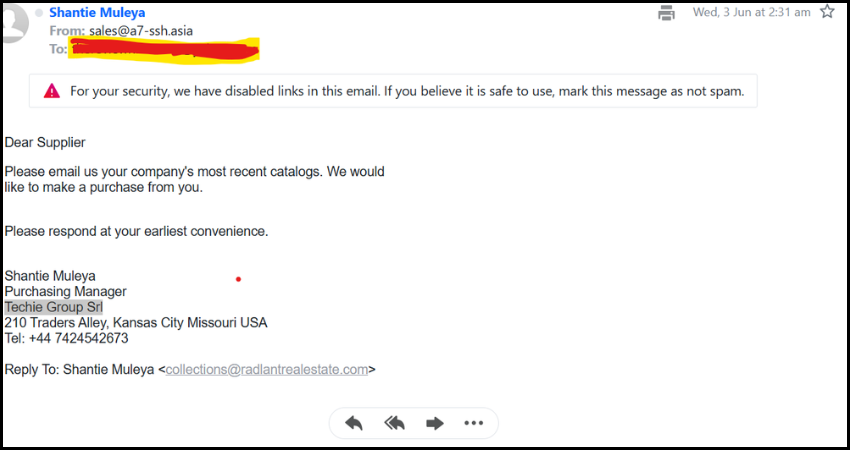


A suspicious buyer inquiry recently landed in my inbox, and at first glance, it looked like a routine business request. The sender claimed to be a purchasing manager representing a company called Techie Group Srl. They asked me to send my company’s latest product catalogs because they were interested in making a purchase.
For many small businesses, this type of message might seem like a potential opportunity. But there was one immediate problem. My website doesn’t sell products. It is a cybersecurity and technology content website. The site publishes news, analysis, and educational content. While I occasionally work with sponsored content and guest posting requests, there are no physical products for sale.
That simple fact prompted me to take a closer look at the email. What followed was a straightforward investigation that uncovered multiple inconsistencies and reinforced an important lesson: every unexpected business inquiry deserves basic verification before you engage.
The Email Raised Questions
The email was short and direct. The sender introduced themselves as “Shantie Muleya,” identified themselves as a purchasing manager, and requested my company’s most recent catalogs. The signature contained:
Company name: Techie Group Srl
Address: 210 Traders Alley, Kansas City, Missouri, USA
Telephone number: +44 7424542673
At first glance, nothing appeared obviously malicious. There were no alarming threats, suspicious attachments, or urgent demands.
However, the request immediately felt out of place. Anyone visiting the website would quickly discover that we do not sell products.
TheReviewHive focuses on cybersecurity, technology, privacy, and scam awareness content. There are no product listings, inventory pages, or catalogs available. That raised an obvious question. Why was someone asking a content website for product catalogs? That was my first red flag.
Why the Inquiry Didn’t Match My Business
One of the easiest ways to assess an email is to ask whether the request makes sense for the recipient. In this case, it didn’t.
Legitimate buyers usually perform at least some research before contacting a company. They often mention specific products, services, or business offerings that interest them.
This inquiry did none of that. The sender didn’t reference my website, any articles, publishing services, guest posting opportunities, or sponsored content options. Instead, they used a generic greeting and requested catalogs without specifying what they wanted to purchase.
This suggested one of two possibilities:
The sender never visited the website.
The same email was being sent to multiple businesses regardless of what they actually do.
Neither explanation inspired confidence.
Examining the Sender’s Details
The email arrived from:
sales@a7-ssh.asia
At first glance, most people probably wouldn’t think much about the sender’s email address. But during any email investigation, the domain deserves attention. The domain is the portion that comes after the “@” symbol.
In this case:
sales = mailbox name

a7-ssh = registered domain

.asia = top-level domain (TLD)
The .asia extension is a legitimate domain used by businesses and organizations operating in the Asia-Pacific region.
Using a .asia domain is not suspicious by itself.
The question I asked was different:
What is the connection between a7-ssh.asia and Techie Group Srl?
Most businesses use email domains that align with their company identity. For example, if a company called Techie Group Srl contacted me, I would expect to see something like:
- sales@techiegroup.com
- purchasing@techiegroup.it
- procurement@techiegroup.com
Instead, the inquiry came from a domain that appeared unrelated to the company listed in the signature.
Another detail caught my attention.
The domain included the term SSH.
In technology circles, SSH commonly stands for Secure Shell, a protocol used by IT professionals to securely access remote systems and servers.
This doesn’t mean the sender was malicious. Domain names can contain almost any words or abbreviations.
However, it added another layer of uncertainty because the domain did not appear connected to the purchasing activity described in the email.
At this stage, I couldn’t establish a clear relationship between the sender’s domain and the company they claimed to represent.
Checking the Email Address
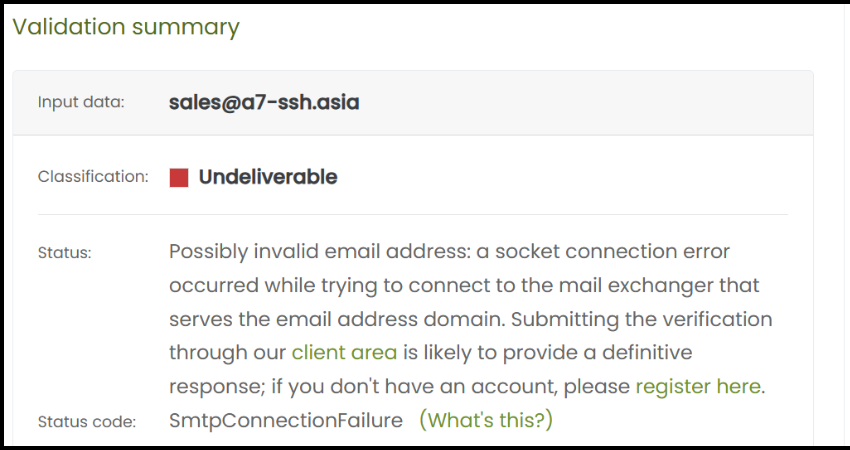
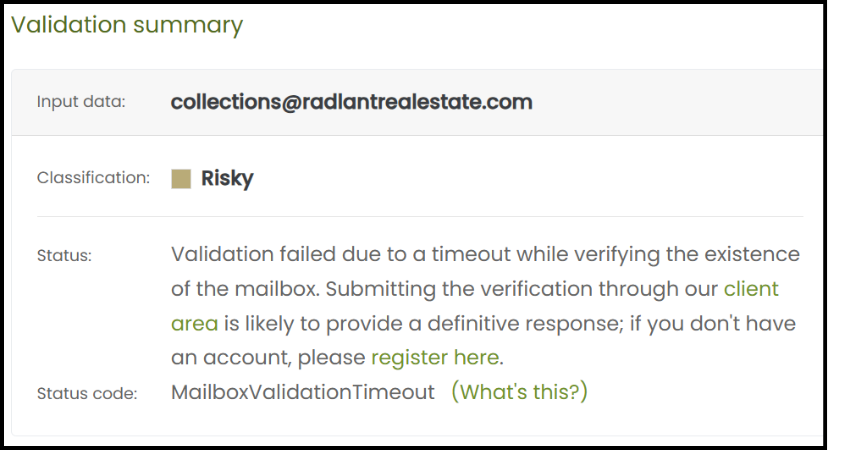
As part of my investigation, I decided to verify the sender’s email address using Verifalia, an email validation service that helps determine whether an email address is technically capable of receiving messages.
The goal was not to prove whether the sender was legitimate. Instead, I wanted to see whether the email address appeared valid from a technical perspective.
The validation summary for both the email addresses is shown below.

The Reply-To Address Raised More Questions
As I examined the email further, another inconsistency emerged. The sender address and reply-to address were different. The email instructed recipients to reply to:
collections@radlantrealestate.com
This immediately raised another question. Why would a purchasing manager representing Techie Group Srl ask suppliers to respond to a real estate domain? Businesses sometimes operate multiple domains. However, those domains are usually connected to the same company.
In this case, I was looking at:
Sender domain: a7-ssh.asia
Reply-to domain: radlantrealestate.com
Company name: Techie Group Srl
None of them appeared connected. The inconsistencies were beginning to accumulate.
Verifying the Claimed Company
My next step was to verify the company itself. Initially, I searched for Techie Group Srl and found very little information.
There was no obvious company website connected to the information provided in the email.
At first, this raised concerns.
However, after further investigation, I eventually found a listing for Techie Group Srl on Europages for UK and Italy, a B2B marketplace that helps businesses connect with suppliers and buyers.
This was an important discovery. It suggested that the company name itself may not have been entirely fabricated. But finding a company listing did not automatically validate the email.
The real question was whether the email I received was genuinely associated with that company.
At this stage, I still couldn’t establish a connection between:
The Europages listing
The sender domain
The reply-to domain
The phone number
The mailing address
This distinction is important. Cybercriminals sometimes impersonate legitimate businesses. Simply finding evidence that a company exists does not prove that a particular email originated from that company.
The Address Could Not Be Verified
The email signature listed the following address:
210 Traders Alley, Kansas City, Missouri, USA
As part of my investigation, I attempted to verify the location.
I searched publicly available records and mapping resources but could not find evidence that this address exists.
This does not automatically mean the address is fake. However, legitimate businesses typically provide addresses that can be independently verified through mapping services, business directories, or public records.
The inability to verify the address added another layer of uncertainty.
The Phone Number Added More Questions
The email also included the following number: +44 7424542673
The +44-country code belongs to the United Kingdom. By itself, this isn’t suspicious.
Many organizations operate internationally and maintain phone numbers in multiple countries.
However, context matters.
The email claimed the company was located in Kansas City, Missouri.
At the same time, the sender used:
A .asia email domain
A reply-to address tied to a real estate domain
A UK phone number
The physical address was located in the United States of America
A company that was difficult to verify independently
Each detail may have an innocent explanation. Together, they created a pattern of inconsistencies. I was unable to find publicly available information linking the phone number to the contact details provided in the email.
Additional Red Flags I Noticed
As I reviewed the message one final time, several other warning signs stood out.
- Generic Greeting
The email began with:
“Dear Supplier”
It didn’t mention admin name, website, or business.
Generic greetings are common in mass email campaigns because they allow the same message to be sent to thousands of recipients.
- No Product Details
The sender claimed they wanted to make a purchase but never specified what they were interested in buying.
Most legitimate buyers provide at least some indication of their requirements.
- No Evidence of Research
Nothing in the email suggested the sender had visited my website or understood what my business actually does.
- Multiple Identity Mismatches
By the end of my investigation, I had identified several separate identities associated with the inquiry:
Techie Group Srl
a7-ssh.asia
radlantrealestate.com
A Kansas City address
A UK phone number
I was unable to verify how these details connected to one another.
Could This Be a Scam?
At this point, many readers may wonder whether this was a scam. The truth is that I cannot say with certainty. I did not engage with the sender and did not receive any follow-up communications. What I can say is that the inquiry displayed several characteristics commonly associated with suspicious business outreach.
Possible explanations include:
Mass spam campaigns

Email validation attempts

Social engineering efforts

Poorly targeted marketing campaigns

Business identity impersonation
Without additional evidence, it would be irresponsible to label the message as a confirmed scam. However, it would be equally unwise to ignore the warning signs.
What Website Owners and Small Businesses Can Learn
This suspicious buyer inquiry reinforced several practical lessons.
- First, always evaluate whether the inquiry matches your business model. If someone asks for products you don’t sell, services you don’t provide, or information that makes little sense in context, take a closer look.
- Second, verify company information independently. Don’t rely solely on email signatures or company names.
- Third, pay attention to domains. The sender domain, reply-to domain, website, and company name should generally align.
- Fourth, investigate inconsistencies.One unusual detail may not mean much. Several inconsistencies appearing together deserve attention.
- Finally, avoid rushing to respond. A few minutes of research can reveal valuable information and help you avoid unnecessary risks.
To Sum Up
This suspicious buyer inquiry began with a simple request for product catalogs. What followed was a series of questions that could not be easily answered. The inquiry didn’t match my business model. The sender domain appeared unrelated to the company name. The reply-to address pointed to a completely different domain. The physical address couldn’t be verified. The phone number raised additional questions. And while I eventually found a Europages listing for Techie Group Srl, I found no evidence connecting the email itself to that listing. Taken together, these findings were enough for me to proceed with caution. Not every unusual email is malicious. But every unexpected business inquiry deserves verification.
Sometimes the most effective cybersecurity habit isn’t advanced threat hunting or malware analysis. It’s simply asking: “Does this make sense?” Before you click reply.
FAQs
What is a suspicious buyer inquiry?
A suspicious buyer inquiry is an unexpected business request that contains unusual or inconsistent details. Common signs include generic messages, unverifiable company information, mismatched email domains, requests that do not align with your business, and contact details that cannot be independently verified.
How can I verify whether a buyer inquiry is legitimate?
Start by researching the company name, website, email domain, physical address, and phone number. Check whether the sender’s email domain matches the company they claim to represent. You should also verify whether the inquiry makes sense for your business and whether the sender references your products or services accurately.
Is a mismatched email domain a red flag?
Not always. Some businesses use multiple domains for different purposes. However, if the sender domain, reply-to address, and company name all point to different organizations, it is worth investigating further before responding.
Why would someone send a buyer inquiry to a business that doesn’t sell products?
There are several possible explanations. The email could be part of a mass spam campaign, an email validation effort, a poorly targeted marketing campaign, or a social engineering attempt. In some cases, the sender may not have researched the business before reaching out.
Can a legitimate company be used in a suspicious email?
Yes. Cybercriminals sometimes impersonate real companies to make emails appear more trustworthy. This is why verifying a company name alone is not enough. You should also verify the sender’s email domain, phone number, website, and other contact details.
What should I do if I receive a suspicious buyer inquiry?
Avoid sharing sensitive information until you verify the sender. Research the company independently, review the email headers, check the sender’s domain, and confirm whether the inquiry matches your business activities. If multiple red flags appear, proceed with caution.
Does a generic greeting indicate a scam?
Not necessarily. However, greetings such as “Dear Supplier” or “Dear Sir/Madam” are commonly used in mass email campaigns because they can be sent to many recipients at once. A legitimate business inquiry is more likely to reference your company name, website, or specific products and services.
Why is verifying a physical address important?
A legitimate business should typically have an address that can be verified through mapping services, business directories, or public records. If an address cannot be verified, it doesn’t automatically prove fraud, but it should prompt additional checks.
What is email validation, and why do scammers use it?
Email validation is a technique used to determine whether an email address is active and monitored. Some spam campaigns send generic messages hoping recipients will reply. Once a response is received, the sender knows the address belongs to a real person and may target it with additional messages.
What are the most common red flags in a suspicious buyer inquiry?
Some of the most common warning signs include:
- Generic greetings
- Requests that don’t match your business
- Unverifiable company information
- Mismatched sender and reply-to domains
- Missing product or service details
- Unverified phone numbers and addresses
- No evidence that the sender researched your business
These indicators do not automatically prove fraud, but they should encourage further verification before you engage with the sender.